Run into a Wall, Crawl Through the Nearest Window

This post originally appeared on Benjamin Roesch’s blog, the almost right words.

Post #17: Crawling Through the Nearest Window

Doing National Novel Writing Month is exhilarating. I think this is mostly because I’ve never written, outside of education, for a capital “D” Deadline and the need to complete X quantity by Y date is a utilitarian sort of enterprise that’s added a different timbre to this writing experience than others whose end point hinges on a self-imposed deadline.

I’ve decided that NANOWRIMO is more about stamina than it is about creativity. Not to shit on creativity. Not at all. But the truth is that the writers who have the best chance of starting and finishing a task like NANOWRIMO are those not necessarily with the keenest imaginations, but with the deepest well of endurance. Those who can follow that sage piece of writing advice that I sometimes think is the only truly useful one: ass in chair.

Writing on a deadline makes you solve problems quickly. My analogy is that when your story runs into a wall, find and crawl through the nearest window. Can’t find a window? Tough. Invent one. I’m writing a sci-fi/horror mash-up because it sounded like a novel (pun so very much intended) change to my usual subject matter (realistic literary fiction) that would breathe enough fresh wind into my sails to make it to the finish line. What I failed to realize is that genre writing is a lot harder than I thought it was.

Of course, all kinds of writing are difficult in their own way, but what I’m talking about is closer to the necessity in genre to respect the beginning-middle-end story structure. I’m not writing a book about an existential crisis that doesn’t need to have an ending to be considered successful. The plot is front and center this time out and the plot needs to, perhaps above all things, make sense to the reader. And not sense as in “real,” but sense as in “consistent” and “logical.” There’s a difference.
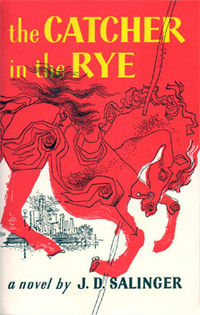
(picture courtesy of Wikipedia)

Consider The Catcher in the Rye. In Salinger’s classic, one need not believe that the things that Holden does are the only things that could have happened. For instance, after Holden’s conversation with the nuns in the diner, we don’t feel the need to make the meet-up logical or the basis to judge what happens next. It may affect the next action, but it doesn’t have to. Nor does the book have to really go anywhere, to end up someplace in order to be a great book, which is, of course, why it doesn’t. For Christ’s Sake, the book’s final image is a kid on a merry go round! In many ways this is exactly what makes a book like Catcher so great and so lasting–it prizes emotion and character above action. And, quite frankly, character is more interesting.

But it all depends on how you look at it. Seen through certain eyes, too large an emphasis on character could be a liability. Most people I know who don’t like Catcher don’t like it because they don’t like Holden, not because “nothing happens.” And if they don’t like it because nothing happens, well, they should probably put down Salinger and read Blue Dot, my NANOWRIMO book. Because, let me tell you, all kinds of things are “happening” in my book.

But, of course, making things happen is its own kind of problem. One problem being that the “happenings” have different rules in a plot driven piece than in a character driven piece. Not dramatically different, but different all the same. In genre, the cause and effect sequence needs to be cleaner, leaner, and ultimately, more satisfying to the reader. After all, that’s what you’re selling them. No one wants to buy tickets to the circus only to find, after the lights have dimmed and the curtains have closed, that they’re actually at an antique show. It’s false
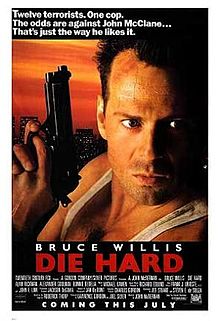
(picture courtesy of Wikipedia)

advertising. In filmic parlance, you might compare the ending of Die Hard to the ending of the last season of The Sopranos. If Die Hard had ended with a long, slow fade out on the bloodied face of John Mclaine before his final show down with Hans and his reunion with his wife, and we were given no closure, no sense that the good guy had prevailed or that the estranged couple had re-united, myself, and a lot of other late 80′s Bruce Willis fans, would have wanted their money back. The Sopranos could get away with such an ambiguous ending because the show was always more about Tony than it was about what Tony was doing. Die Hard is about a guy too, but for that story to make sense to us, that guy needs to always be doing things that lead places.

I guess what I’m saying is that I choose a genre piece for NANOWRIMO because I thought it would liberating, and perhaps easier, to write. But I’m realizing now this was a false assumption. Genre isn’t harder, but it sure as hell isn’t much easier. Which leads back to the earlier point that all kinds of writing are hard.

A problem for me is that I’m not used to writing plots that need to add up so neatly and my characters keep trying to stop my story and let themselves come front and center. Part of me feels like they’re stalling because they don’t know what to do next. I’m on track to finish my book on time, or at least get to 50,000 words on time, but right now the ending keeps getting further away. And the further away it gets, the more I’m getting the feeling that Blue Dot may just be the world’s first alien invasion story that ends with a kid on a merry go round.
NaNoNoNoNoNoMo

This article originally appeared on Harley Jane Kozak’s website.

NaNoNoNoNoNoMo By Harley Jane Kozak

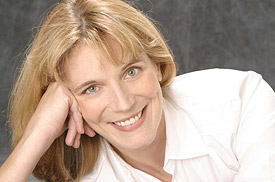
Harley Jane Kozak (photo courtesy of Kozak's website)

This month William—yes, our William, or that William, or that *!@# William, as I now think of him—talked me into NaNoWriMo. It sounds like a new flavor of Haagen-Dasz, doesn’t it? Or an active volcano?
Don’t I wish.
NaNoWriMo is National Novel Writing Month. Where participants—and any idiot can join, William, it’s not like we’re special—vow to write 50,000 words by November 30. Which is about 170 manuscript pages.
“Make no mistake,” the NaNoWriMo website says. “You will be writing a lot of crap.”
I’ve got that part down.
After taking the plunge (why? why?) I was a day late, because William didn’t begin haranguing me until he’d gotten a head start, and also, it took me a day just to read the NaNoWriMo website. My strategy then became to not think FIFTY THOUSAND WORDS. Because I’m no Nora Roberts. Or James Patterson. (Not that James Patterson is James Patterson.) I kept that “You will be writing a lot of crap” motto close to my that “You will be writing a lot of crap” motto close to my heart and eked out 800 words by November 3. 800 different words, I might add, as you’re not supposed to write one word over and over fifty thousand times. But there’s no rule (aside from the rule of good writing) that prevents me from saying something is “very, very” and “really really” whatever it is. I do that very, very often.
Another rule: you must write a novel from scratch. No recycled prose. Some authors cheat, but I was raised by nuns, so I closed the file on my real novel-in-progress, started a new document, named it The Khan Man and just continued with where I’d left off. Chapter One begins mid-sentence and doesn’t even pretend to be a first chapter. William was all excited about me writing a Star Trek novel, but it’s not a Trekkie kind of Khan Man, it’s a Genghis kind of Khan Man, and that’s all I’m saying about that, because I know there are people out there trolling Dumpsters and blogs and even paper shredders for ideas to steal. And if, 18 months hence, the publishing world is overrun with novels featuring 11th century Mongols, I’ll know who to blame, William.
Another NaNoWriMo motto I mutter feverishly is “Fix it in December.” Nancie-the-Gun-Tart has money on me being unable to resist futzing. Sure, I’ve futzed, but my rule of revision is I can’t make it shorter. Still, rewriting is not time-efficient. The Word Count gods demand fresh paragraphs. So I’ve stopped reading what I’ve written. That’s right. I’ve no idea what’s in those 56 pages. And so if I die this month, and someone (William) tries to read my novel, I’ll just . . . die. Thus, I forbid it. If I go, all three computers, plus flash drive, are to be thrown onto the funeral pyre.
So here goes. Current word count:12,203. But it’s not my fault! I’ve been preparing to teach a seminar this weekend in Nebraska, and now my kids only have school half days this week and then NO SCHOOL next week, and Thanksgiving’s at my house and my sister’s wedding’s in Wisconsin, and what demented mind picked November for this?
The only way to pull it off is to throw grocery lists into my novel, along with my Thanksgiving Squash Soufflé Recipe, William’s home phone number, notes to my kids’ teachers, and drafts of the text for my Christmas cards, which need to get to the printer.
Why, just by cutting and pasting this blog into The Khan Man and calling it Chapter Twelve, I’ve bumped my word count up to 12,838.
Next week: I bump off William and steal his novel.

Check out Harley Jane Kozak’s website.

NaNoWriMo: Some helpful hints and tools

This article originally appeared at http://www.tuaw.com/.

NaNoWriMo: Some helpful hints and tools

by Steven Sande

This morning, I noticed a tweet from @rvbelzen that said, “As a NaNoWriMo veteran, do you have any tips for this NaNoWriMo newbie, maybe an article you wrote about it?” Most of the posts that I’ve done about National Novel Writing Month for TUAW have focused on the tools, not on the technique. Based on the tweet, I thought I’d give you some hints from a three-time NaNoWriMo winner (that means you wrote a 50,000-word novel in the month of November) about how to prepare for the writing marathon.

Helpful Hints For Writing Your NaNoWriMo Novel

1) Make sure you have a broad outline of your plot and characters in your mind or on paper. This was the hardest part for me the first two years I did NaNoWriMo, as I had a story in my head but didn’t spend the time to think of characters or how the story was going to evolve. As a result, those first two novels were only about halfway through the total plot line when I got to 50,000 words. What I suggest is sitting down with your favorite writing tool — whether that’s TextEdit, Word, Storyist, Story Mill, Scrivener, or another other writing tool, and just write a quick outline of how the story is going to unfold. Come up with character names and a rough description, locations, etc., and write them down as well.

2) At some point on November 1st, sit down for an uninterrupted spell of writing. In order to write 50,000 words in a month, you’ll need to average 1,667 words a day. I find that setting aside time to write in a place where I’m not going to be interrupted by talk, TV, or tweets is essential. If you’re enthusiastic about your story, that 1,667 words is going to flow out of you, and you’ll find that some days you’re writing 2,500 words. Go for it on those days, because you’ll have other days when you need to take a break. My favorite place to write NaNoWriMo novels? The kitchen table. The chair is uncomfortable, so I need to write quickly so I can get out of it ASAP.

3) It’s all about words, not about tools. I’ve noticed over the last few days that I see more and more tweets about “which tool should I use?” There are debates going on about the merits of Storyist versus Scrivener, or using one of the many minimalist writing tools. Here’s my take on the writing tools: don’t go out of your way to buy a new app that has lots of bells and whistles, because they’ll get in the way of writing your novel. Many of the novel-writing apps have ways to write outlines, build character cards, etc. I found these tools to be so incredibly distracting that I finally just started using minimalist tools. You can easily write a NaNoWriMo novel in Pages or Word — you don’t need an “author’s tool” unless you really think it will help you. My second NaNoWriMo novel was actually written in TextEdit.

4) Have fun writing. If NaNoWriMo turns into a chore, you’re not going to make it. For me, writing fiction ends up being so much different from blogging and writing tech books that it’s an absolute joy. I love thinking up characters, putting them in odd situations, and then trying to get them out of those situations while moving the plot forward. Are they well-written novels? Probably not. But it’s been a blast writing them. To make writing fun, think about something that either excites you or makes you laugh, and then use that as a key launching point for your novel. This year, I’m resurrecting a character from last year. He’s a private detective in the near future (about 10 years from now) who gets involved in some rather bizarre situations like a locked-room murder on a space station and (this year) being injected with nano-particles that cause him to grow.

5) Start fast. Seriously, try to beat your 1,667-word goal every day for the first 10 days. That way, you might be halfway done with the novel by the time November 10th rolls around. What does that mean? You can take a break from writing if you absolutely feel like it, or take more time focusing on a key point of the plot. My wife was a NaNoWriMo winner last year and she totally amazed me by writing almost half of her novel in the first five days of November. I like to start fast and finish at a comfortable pace.

6) Don’t focus on spelling or grammar. Once again, this is all about word count. It doesn’t have to be perfect. You just want to get the story out of your system and onto the screen (or paper, if you so desire). When you’re done at the end of the month, you have a working rough draft that you can then spend time cleaning up. So turn off the spell and grammar check, or ignore the red underlines that mean you misspelled something. Chances are very good that you’re not going to publish your book anyway, so who cares if it is filled with misspellings and lousy sentence structure? As long as you’re happy with it, that’s what counts.

7) Keep your writing to yourself. There’s nothing worse than thinking that you’re doing a bad job when you’re writing. It will absolutely defeat you from getting your novel completed. One of the biggest mistakes you can make during NaNoWriMo is to let somebody else read what you’ve written. Why? Well, everyone’s a critic these days, and the reader will have no hesitation telling you that what you’ve written is horrible or pointing out mistakes. Wait until December 1, 2011, and let them read it then. Don’t even talk about your novel with other folks, unless you’re just telling them how much fun you’re having and how far along you are.

8) Work through writer’s block. Here’s something I had issues with the first year I did NaNoWriMo. I was about one-third of the way through the novel and just lost focus. I had thought a lot about the beginning of the book, but didn’t have a clue where I was going. Preparation (see hint #1) will help this, but realize that you’re going to have days where you just can’t get the brain to wrap around writing! What do I do on these days? Try to write anyway. If I need help, I pick up a favorite good book and read parts of it, carefully noting the way that the writer crafted certain phrases or created a twist that caught my attention. That’s usually enough to motivate me to write more. Also consider taking a walk or doing something to clear your mind. I find that walking is a great way to get my mind to focus on developing plot points or thinking about dialogue.

9) Back up your novel every single day. I’ve been lucky — I’ve never lost any of my writing. But can you imagine how depressing it would be to get two-thirds of the way through your novel and then lose the file? It would be enough to make you never want to write again! I highly recommend doing multiple backups of your novel file every day. My base document is always sitting in a folder on Dropbox, which means that it’s also downloaded to the Dropbox folder on both of my Macs. That’s three copies right there, plus I always have a Time Machine backup going. That’s four. Am I paranoid enough? Probably.

10) Keep your eye on the goal. That’s going to motivate you more than anything. Thinking about getting to that 50,000th word is a daunting thing, but you’ll be surprised just how quickly your words will add up. Take the writing one day at a time, try to stretch your daily total over the required 1,667 words, and you’ll be a winner before the end of the month. I have to admit that there’s no better feeling than wrapping up a NaNoWriMo novel, even when I know that nobody will probably read it. Having done this three times, I’m confident that I can write another novel, and I’m looking forward to that sense of accomplishment at the end of November.

Tools Of The NaNoWriMo Writer

When you’re thinking about which tool to use to write your novel, keep hint #3 in mind — it’s about writing, not about tools. I really do get irritated with the annual debates over which app is better than another, but then again I’m an antisocial curmudgeon. I’ve tried ’em all, but the two apps that I find work the best for me are TextEdit and Microsoft Word. Get a blank piece of digital paper and start writing. I haven’t tried Pages, although I’m sure it would work swimmingly in the “typewriter” Lion full-screen mode. Maybe this year?

Most of the writing tools that people spend their money on before tackling NaNoWriMo fall into two camps — the “Swiss Army Knife” apps that have all the bells and whistles, and the “Minimalist” apps that just give you a blank page and a word count. Here are some examples of both types.

“Swiss Army Knife” Writing Apps

I think I’ve tried each and every one of these apps at one point or another, and even though I’ve used them to start NaNoWriMo novels, I’ve always just transferred my text to another app within a day or two. Your mileage may vary, and you may make use of all of the many features of these apps.

I won’t go into a lot of detail about each of the apps; the developers have info for you and in many cases will let you download a trial copy:

Scrivener (US$44.49)

Storyist ($59.99 for Mac, $9.99 for iPad)

StoryMill ($49.95)

Manuscript ($39.99)

Ulysses ($19.99)

CopyWrite ($24.99)

DEVONThink ($49.99): Actually more of an outlining tool, but can be used for writing.

OmniOutliner ($39.99): Once again, an outlining tool that is perfect for writing. Also available on iPad for $19.99.

Minimalist Writing Apps

WriteRoom ($24.99): available for both Mac and iOS ($4.99)

Ommwriter Däna ($4.99): available for both Mac and iPad at the same low price!

Byword ($9.99)

Clean Writer ($0.99): available for Mac and iPad

Writer ($2.99)

Grandview ($4.99)

iAWriter ($9.99): also available for iPad ($0.99)

I’m sure there are a lot more tools available, but I’ll leave this as an exercise for TUAW readers to go out and do some research. If you find any, please let us know in the comments. Also, if you’re a NaNoWriMo winner and have some additional hints and tips, be sure to write a comment.

By the way, in case you’re wondering how long this post is, it’s 1827 words. That’s more than a person needs to write every day to be a NaNoWriMo winner. YOU CAN DO IT!