Author Talks about the Writing Craft

Stacey Longo’s account of speaking to a high school class about writing.

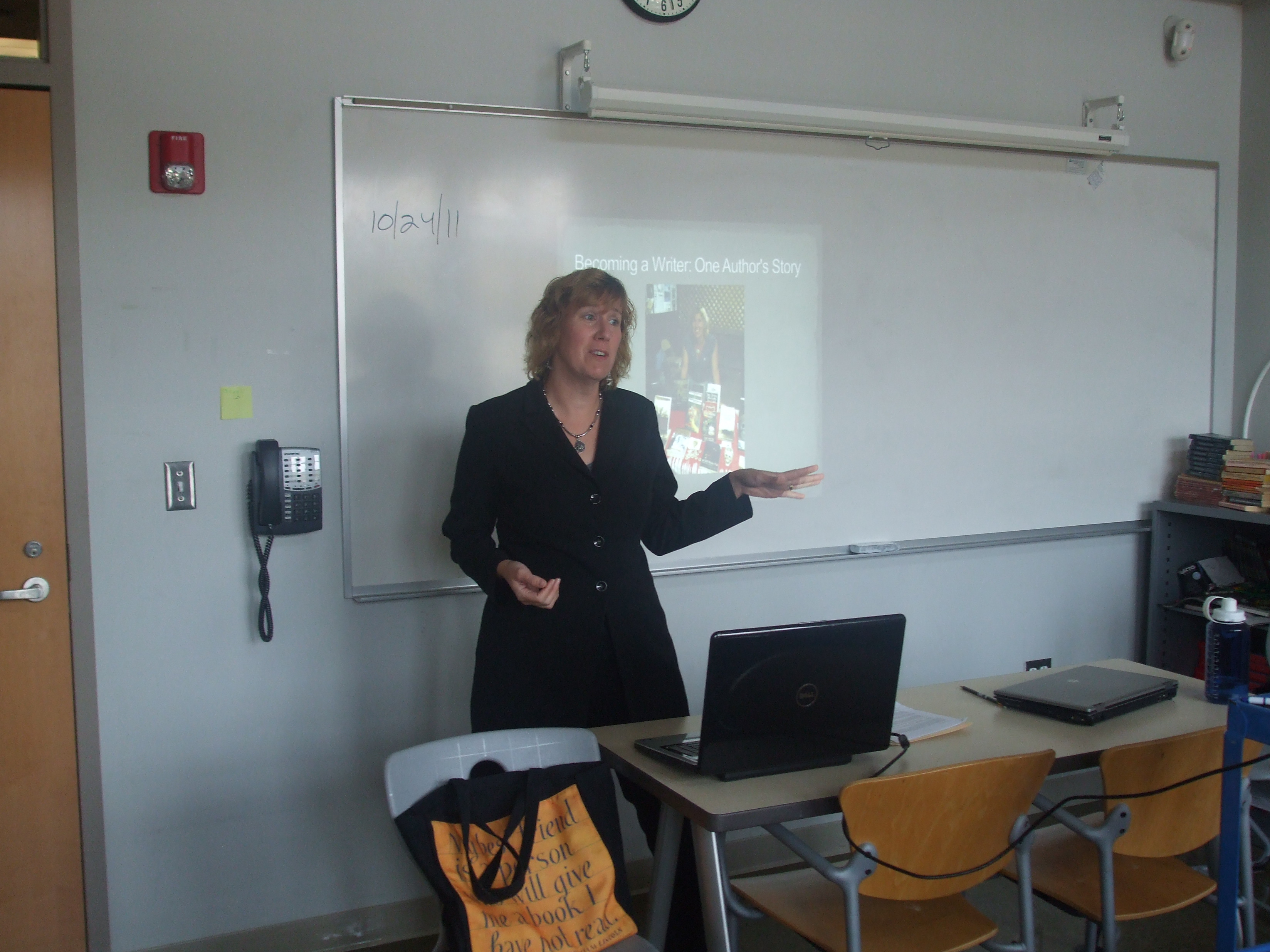
Stacey Longo talking about writing to a class of students (photo courtesy of Kim Kane)

On October 24th, I had the opportunity to speak at the ACT Arts Magnet High School in Willimantic, CT. The topic was Writing as a Craft and an Industry. I opened with a little background about my own writing career and my roots as a humor columnist. After listing my credentials, I explained how hearing Shroud publisher Tim Deal present at a Poe Celebration two years ago inspired me to jump from humor to horror. I also admitted that while I sell short stories about zombies, decapitations, and carnivorous beach dunes, my blog focuses on the humor to be found in every day life, from the perils that come with trying to raise two cats to the agony of eliminating the fish smell in the house two days after you’ve cooked cod for dinner.

My advice to these kids was simple:

1. Write all the time, about anything that strikes your fancy.
2. Read more than you write.
3. Read On Writing by Stephen King.
4. Know your market and what’s selling.
5. Read submission guidelines and follow them.
6. Keep your day job to support your writing habit.
7. Never, ever mistake the Twilight series for quality writing.

We held a short Q&A session in which the students had several questions, such as “Have you really met Nathan Schoonover?” and “Where does Nathan Schoonover live?” followed by the more serious question, “How serious is Nathan Schoonover’s relationship with his significant other?” I had foolishly forgotten how popular this paranormal investigator is with the teenage female demographic before
including him in my ‘Look at all the Cool People You Will Meet’ portion of my PowerPoint.

I left the kids with a short story I’d written about them and a stress ball with my website (www.staceylongo.com). And at the very end of class, one shy girl named Sam asked me if she could send me a short story she’d written about a lonely disemboweled zombie for feedback.

It makes me proud to see the youth of America so inspired!

Tips for Selling Your Work: For Traditional and Self Published Authors (Or Those Who Are Thinking about It)

The article “Tips for Selling your Work: For Traditional and Self-Published Authors (Or Those Who Are Thinking about It) by Phil Sexton originally appeared on Writer’s Digest’s website (http://www.writersdigest.com/editor-blogs/there-are-no-rules/tips-for-selling-your-work-for-traditional-and-self-published-authors-or-those-who-are-thinking-about-it)

Whether you’ve been published traditionally or are self published, your success as an author can only be measured by a few different things:

* Quality of the work
* Personal satisfaction
* Positive response from readers
* Copies sold
* Revenue generated

Now those last two elements might seem crass for those of us whose aspirations are more literary than monetary. But it’s the hard truth that impressive sales enable you to get more projects published, live more comfortably, and build a bigger readership.

To that end, we’re going to start posting occasional marketing tips from Rob Eager, author of the upcoming Sell Your Book Like Wildfire, and a freelance marketing specialist who has worked with numerous publishers and bestselling authors to help promote their books.

This week’s tip:
SEO is an abbreviation for a term used by website programmers and hosting companies that stands for “Search Engine Optimization.” This concept refers to employing various methods to make your website appear on the first page of displayed answers when someone conducts an Internet search on Google, Bing, Yahoo, etc. There are both paid and free techniques that can be used to help the search engines find you and rank you higher than other sites. The problem is that there are all manner of technology sharks who will lure you into paying extra money to use their SEO “secrets.”

These techniques usually focus on trying to drive random people to your site when they conduct an Internet search. But, that’s not your goal as an author. Instead, you want to be the primary option when someone searches on your specific book topic or expertise. The good news is that you can enhance your search engine results for free through properly choosing your website metatags, keywords, blog posts, and providing lots of online articles on your subject. Tell your webmaster to make sure that your site contains keywords that focus on your name, book titles, and article titles.

As an author, you want targeted, repeat traffic to visit your website – not random, disinterested traffic. You’re trying to build a community, not a flea market of casual observers. So, don’t let people up-sell you on paid SEO services. Most of those tactics are a waste of money. You will grow legitimate website traffic as you build your reader community and strengthen word-of-mouth among your fans.
—Rob Eager

If you’re interested in self publishing, be sure to check out the official Writer’s Digest self publishing imprint, Abbott Press. We provide self publishing services, as well as education, information and a collaborative environment for creating your book. To learn more, simply click here. We’d be happy to discuss the options available to you.

Best
Phil

A Writer’s Life, “I’ve Never Heard of You”

This article, “A Writer’s Life, ‘I’ve Never Heard of You,'” by James Jackson is from http://www.huffingtonpost.co.uk/james-jackson/a-writers-life_b_979923.html.

Some fourteen years ago now, the fellow had marched across a crowded airport departure hall in order to deliver his crushing verdict. He entered the bookstore in which I was signing copies of my first thriller, picked up and briefly studied the paperback and slowly put it down, looked me in the eye and told me straight. Absolutely no doubt about it, he had definitely not heard of me. I smiled and replied: ‘That’s because I don’t write children’s fiction’. Security was called.

Such are the trials and encounters involved in writing for a living. Some never get used to it. One friend of mine – a hugely successful bestselling author – confided to me she feels genuine pain whenever she is gratuitously criticised. The revelation amazed me, for affirmation surely came in the millions of her books purchased and read avidly by her fans throughout the world. But no, the occasional brickbat still hurt.

She should count herself lucky. Another friend – an actress – stepped from the stage-door after a feted West End performance and found two American tourists waiting for her in the rain. Her face lit up. ‘Did you enjoy the play?’, she enquired. ‘No, we really did not’, bluntly came the reply. Well, she did ask and one cannot win them all. Maybe those in the creative world should grow a thicker skin and accept that criticism and subjectivity are part of the deal. Frankly, m’dear I have never really given a damn.

Indeed, I have always worked on the basis that reviews – like media interviews – reflect more on the individual penning the plaudits or poison than on anything one has produced oneself. One Amazon review – read to me down the phone with great relish by my brother – spoke of how ‘It must be Jackson’s friends and family who give him such good write-ups… he will be needing them’. I suspect that particular contributor is a frustrated and unpublished novelist, for they are ever the most spiteful.

On a bathroom wall I still have framed the first rejection letter that I ever received from an editor. Rather naively, and without the advice of an agent, I had punted a manuscript in her direction. A terrible mistake. She wrote back: ‘The characterisation is thin, the dialogue unconvincing, and the violence gratuitous’. Ah well, that has never been known to stop a book deal. Within three weeks I had found myself an agent and shortly thereafter secured a pretty significant publishing advance (my agent bought herself a new pair of boots to celebrate). It was the very same book that provoked the airport bookshop incident. Beginner’s luck, I suppose.

Few things prepare one for a career as an author. I kicked against it for years, resenting the isolation and even finding myself smoking cigarettes with tree surgeons working nearby (I am a non-smoker). Only now do I fully embrace this life of gainful unemployment, the freedom to lunch, the advantage of not trudging to work through the sleet and snow and darkness.

Complete the book, push it out, get on with the next. That is how it goes. After almost two years since the start-point, the title hits the stands and promotion begins. So too does the wait to gauge it is heading into The Sunday Times top-ten bestseller list. A friend once rang to say she had seen my books piled high in a famed London store and had spread them around to create an impression of high demand. That afternoon a second friend rang to inform me he had noticed my books spread about in the same bookshop and had piled them up to ensure a stronger visual presence. Avoid help from those you know.

A new book now begins its gestation and another historical thriller is due to appear in January 2012. So the cycle continues, a challenge, a total immersion, a privilege. Whilst giving a talk in Cambridge, I was once asked if there was any genre of writing I would not attempt. An easy question. It would have to be sci-fi: things are strange enough with a fan base that occasionally dresses as Templar knights. Readers garbed in bacofoil spacesuits would probably drive me over the edge. Yet the life of a writer would be impoverished without the truly committed.

As for the editor who so cruelly dismissed my first manuscript all those years ago – I gather she now works in the soft furnishings business.

How to Meaningfully Grow Traffic to Your Site/Blog

How to Meaningfully Grow Traffic to Your Site/Blog by Jane Friedman (an article from http://www.writersdigest.com/editor-blogs/there-are-no-rules/digitization-new-technology/how-to-meaningfully-grow-traffic-to-your-siteblog)

It’s a problem that every new blog or website faces in its early days—or every day (!): How to get readers (also called traffic).

There are a few well-worn pieces of advice in this area, such as:

  1. Comment on other people’s blogs. Virtually all comment systems ask you to leave your name and site URL. If you leave valuable comments, people may visit your site.
  2. Link to other people’s blogs frequently and meaningfully. If you link to someone, and you send them
    significant traffic, they’re going to notice! They might link to you
    one day, or pay attention to your work if you’re within the same community.
  3. Add your URL to your e-mail signature, business card, book, etc.
  4. Offer guest posts on sites/blogs with more traffic than your own.
  5. Be active on relevant community sites, which can interest people in what you’re doing, which can lead to visits to your site/blog.
  6. Ask for a link trade, where others agree to permanently link to your site/blog in their blogroll, and you return the favor on your own site. (This is by far a less popular method nowadays; it’s pushy and can damage credibility if you don’t believe in the links you’re sharing. Better for this to happen naturally, over time.)
  7. Be active across social media and alert people when you have a new post. (And/or make sure your URL is clearly listed on every social media profile.)

Your mileage will vary on No. 7 depending on your social media presence, how savvy you are, and if you’re reaching out in the right areas.

But I’m a strong believer in the breadcrumb method, where you have accounts on multiple community sites. That’s because you never know how people might find you, and the more doorways you have leading to your site, the more traffic you will get over time.

Even if you’re not active or devoted to a particular community site or social media channel, you can still appear to be active if you adjust the settings in your favor.

To help explain, let me show you where my site or blog traffic comes from, then explain how that traffic happens.

Here are 5 key, continuing sources of traffic for this blog (No Rules) in the past year—aside from search engines and direct traffic.

1. TWITTER

Both Writer’s Digest and I have active presences on Twitter (130K and 50K followers, respectively). When a link is broadcast that a new post is up, it reaches thousands of people initially, and then thousands more through retweets and mentions.

2. FACEBOOK

New blog posts are automatically fed onto my Facebook personal page, as well as the Writer’s Digest fan page (without any help from me, because it works through NetworkedBlogs). Other people also commonly post links to my blog content on their own Facebook walls.

3. WRITERSDIGEST.COM
There’s a permanent link to all Writer’s Digest blogs on the homepage, and it’s a consistent driver of traffic to No Rules.

4. BLOGGER MENTIONS (and permanent bloggers’ links)
When taken individually, one person’s blog or site may send just a handful of visits per day or week. But when you multiply that effect by dozens or hundreds of bloggers, that’s a huge impact. But you only get to enjoy this dynamic if you’re blogging for the long haul. It rarely happens overnight.

5. STUMBLEUPON
To tell the truth, this is one site where I am not active, and only recently did I even start an account. But over time, this site has started sending MORE traffic my way as my most popular posts are tagged and catalogued. (Right now, this controversial post that’s tagged is sending me a few dozen visits a day from StumbleUpon.)

Some other important sources of traffic this past year have been Writer Unboxed (where I offer guest posts) and Alltop, where this blog is catalogued as part of the writing and publishing pages.

Here are the top 5 sources of traffic for my personal site (JaneFriedman.com) in the past month. They constitute about 80% of my traffic.

1. THERE ARE NO RULES (this blog)
This make sense since NO RULES is where I focus most of my time and energy in producing new content. I rarely link to my personal site in my posts. Instead, it’s a static link on the lefthand sidebar if people want to know more about me.

2. GOOGLE (organic search)

The No. 1 search term that brings people to my site is “Jane Friedman.” I am probably attracting a considerable number of visits from people looking for The Other Jane Friedman.

3. TWITTER
Traffic from Twittercomes from 3 areas:

  • from the static URL on my Twitter profile (see above)
  • from the tweets I send with links
  • from the retweets and mentions from my followers

4. DIRECT VISITS
These visits are from people who have bookmarked my page, click on direct links from e-mail notifications, or otherwise type in “JaneFriedman.com.”

5. FACEBOOK
Traffic from Facebookcomes from 3 areas:

  • from the static URL on my profile page
  • from the links I post to my site
  • from the links other people post to my site

Some of my biggest traffic bumps happen when a major Facebook group posts a link to my series, When Mom Was My Age—which shows you the value of consistent series or features on your site/blog.

If you look at the long tail of my site traffic—on this blog as well as my personal site—I’m getting a significant number of visitors, over a year’s span, from:

Does it take me any effort to get this traffic?

No. I simply make sure that I use all settings and opportunities for auto-updating, when applicable.

Take my LinkedIn profile as an example. I don’t spend time on this site. But I’m “active.” See below; the top red arrow points to my Twitter updates, which are automatically fed into my profile and provide constantly refreshed information about what I’m doing. I don’t lift a finger.

The bottom arrow points to a mash-up of things I’ve told LinkedIn to report, based on my other activity online.

On LinkedIn, I also feed in my blogs, which appear under my profile summary.

This keeps me active on the site without requiring my time. Look for these types of feeds and settings on every site you use!

This is why I give the appearance of being everywhere at once, while really just focusing my energy on a few things: my professional blog, Twitter, Facebook.

Why those 3?

Because those places give me the most return on my investment of time and energy. Everyone’s results will be different, though, which is why you absolutely must find out where your site traffic comes from. (Use Google Analytics to get started.)

People will find you in a hundred different ways, and it’s more important than ever to have your own site—so you can direct people to your “home,” where readers and community influencers have an opportunity to find out where you’re most active, and choose their preferred means of staying updated.

I can guarantee that after this post, I’ll have a lot of people joining me on Facebook or LinkedIn because they didn’t realize I was there!

And that’s a good thing.

The 4 Pet Peeves of Freelancers (and How to Tackle Them)

The 4 Pet Peeves of Freelancers (and How to Tackle Them) by Brian A. Klems (via www.writersdigest.com)

We freelance writers tend to think of editors as the ones having all the pet peeves, but we also have plenty of things that drive us crazy. We’ve all dealt with editors who neglect to respond to pitches, sources who don’t show for scheduled interviews, markets that take forever to pay—or all of the above, and then some.

Every business, including writing, has its challenges. But these challenges needn’t hurt your productivity or income—if you know how to handle them. Here’s how to beat four of the most common pitfalls of the freelance life.

PET PEEVE NO. 1: THE AWOL EDITOR
You researched the market, came up with a timely, compelling idea and sent a stellar query. Now weeks have passed and you still haven’t heard from the editor. What do you do next—you know, besides check your e-mail every five minutes?

Follow up. If you hear nothing after a reasonable time (say, four to eight weeks), send a brief e-mail that includes your original pitch, and ask if the editor is interested in the idea. Let her know (politely) that if you don’t hear from her in, say, two weeks, you may market the idea elsewhere. That often triggers a response, and shows you’re serious about your business. But if you don’t hear anything, do cut bait and pitch the
idea elsewhere.

PET PEEVE NO. 2: WRITING IN THE DARK
Sometimes an editor will provide you with a detailed assignment. But what happens when you’re not given much direction at all for your story?

“I’m not interested in hearing, ‘Just start researching and writing and I’ll let you know if you’re on track when I see it,’ ” says freelance writer Kathy Sena, who has written for USA Today, Newsweek and Woman’s Day. “Like every writer, I love a concise, clear assignment letter that spells out exactly what is to be covered, the approximate number and type of sources, word count, etc. If an editor doesn’t provide that, it makes me wonder if he really knows what he wants.”

Her solution to a vague assignment? “If we’ve just talked on the phone or had a brief e-mail or two, and there doesn’t seem to be a detailed assignment letter forthcoming, I’ll write a draft assignment letter myself.” Sena then asks the editor to confirm the details so she can get to work. While expediting the process, this also helps avoid another pet peeve—multiple revision requests—by clarifying the editor’s needs ahead of time.

PET PEEVE NO. 3: THE AWOL SOURCE
You found the perfect source for your piece and arranged a telephone interview a few days before your deadline. But when you called at the scheduled time, the source wasn’t there! Several voice mails and
e-mails later, you still haven’t been able to connect. Now what?

The key is to identify multiple source options from the outset, says freelancer Polly Campbell, a blogger for Psychology Today and ImperfectSpirituality.com. “In most cases, during the preliminary research I come up with two or three sources that could be ideal for the piece, and I always contact at least two,” Campbell says. “Then, if one doesn’t work out, you just keep going down your list.”

Another way to keep this problem from putting dents in your deadline is to pursue interviews as soon as you can (and avoid relying on a single method of contact—always obtain or request both an e-mail address and a phone number). In other words, never wait until right before the piece is due. That will give you some breathing room if something takes longer than expected or falls through.

PET PEEVE NO. 4: CLIENTS THAT PAY LATE
You wrote the story and turned it in on time. You answered a few follow-up questions from your editor and submitted backup material for fact checking. Your work is done—so where’s your check? Not getting paid on time (or at all!) ranks high on the freelance pet-peeve list.

“It’s hard enough to manage a variety of publication styles, editorial personalities, invoice requirements and multiple deadlines, but when you have to put on the account collections hat, things really get difficult,” says freelancer Sharon Miller Cindrich, author of A Smart Girl’s Guide to the Internet and other books.

To stay on top of accounts receivable, Cindrich recommends providing every client with a detailed invoice that includes the pay rate, publication date (if known), due date, projected payment due and contact information. Then follow up as often as necessary.

“If I don’t get paid, I send e-mail reminders with the attached invoice to help the publication’s staff save the time of looking for old e-mails or piles of paperwork for the original,” she says. “I might also pop a hard copy in the mail—sometimes it is easier to drive your point home when someone … has it in their hand.”

Sure, you’ll always face some obstacles as a freelancer. But in many cases, planning ahead and following up (whether on a query or invoice) will help you overcome them, meet your deadlines, and, of course, collect your checks.

Steve Jobs and re-imagining obituaries

This article, “Steve Jobs and re-imagining obituaries,” by Michelle V. Rafter appeared on her blog, Word Count: Freelancing in the Digital Age (http://michellerafter.com/)

20111008-040819.jpg

To do great writing, read great writing. Here’s the great writing I’ve been reading this week.

If you’re like me, over the past few days you’ve probably spent some time – or a lot of time – reading about Steve Jobs. The Apple Computer founder and ex-CEO died of pancreatic cancer this week at 56. He’d retired in August after having been on a leave of absence since early this year from the company he and a friend started in his parents’ garage in 1976.

It’s been a time for reflecting on the mark that Jobs left, not just on the technology industry, but on how people communicate and connect, and where he stands in the pantheon of American inventors and innovators.

For writers, it’s also been an opportunity to study a basic but often bungled story type: the obituary.

Studying the Obituary

Obituaries are a journalism staple. Open to the back of any local newspaper and you’ll see them. These days, most of what you see are paid obituaries that families write themselves and buy by the column inch, since financially-challenged newspapers don’t have as much space to devote to them as they used to. What you see is usually terribly written.

During the semester I taught an intro to news writing class in a graduate journalism program, students were required to write an obit as part of the general curriculum. It was one of the harder exercises of the semester. Why? Writing a good obituary is more difficult than it looks. Most students structured their stories chronologically, starting with when the person was born, and moving through where they went to school and worked, who they married, when they died – just like those paid obits in the back pages of the paper.

But when someone dies, readers don’t want a laundry list of facts and dates. They want the most important stuff and they want it right away: who the person was, why what they did mattered and how they made a mark on their community or the world.

The Modern Obit

Today, obituaries can cover the basis but take many different forms, which is apparent if you look at what’s been written about Jobs. Besides the classic, straight narrative, obits or tributes can be a personal remembrance, photo montage, video, slideshow or compilation of quotes from the famous or not-so-famous. One company, Mint Digital, disassembled a MacBook Pro and using the parts to create a Steve Jobs portrait – that’s it at the top of this post.

Here are a handful of Jobs obituaries and other tributes that stuck with me for their context, emotion or originality:

Traditional Obituary – Straight forward obituaries from the New York Times and Washington Post, attempt to put the man behind the Mac, iPod and iPhone in perspective, as a 21st century entrepreneur, tech visionary and marketer with a prickly, secretive side that made him a difficult subject to interview or photograph.

Personal Remembrance – Long-time Wall Street Journal tech columnist and All Things D cofounder Walter Mossberg shared stories about a side of Jobs most people, including reporters, never saw. After returning to Apple in 1997, Jobs called Mossberg Sunday evenings for some off-the-record shop talk. Later when he was sick, Jobs invited Mossberg to visit him at home and the two went for a walk:

He explained that he walked each day, and that each day he set a farther goal for himself, and that, today, the neighborhood park was his goal. As we were walking and talking, he suddenly stopped, not looking well. I begged him to return to the house, noting that I didn’t know CPR and could visualize the headline: “Helpless reporter lets Steve Jobs die on the sidewalk.”

But he laughed, and refused, and, after a pause, kept heading for the park. We sat on a bench there, talking about life, our families, and our respective illnesses. (I had had a heart attack some years earlier.) He lectured me about staying healthy. And then we walked back.

Apology – Brian Lam used Jobs’ passing to write a long apologia and explain what happened while he was editor at Gizmodo during the infamous iPhone 4 leak in 2010. After an Apple employee lost a phototype of the phone and it ended up in the hands of a Gizmodo reporter who wrote about it, Lam exchanged numerous telephone calls with an increasingly more frustrated Jobs, who wanted the device back but didn’t want to publicly confirm what it was. Lam held out and got confirmation in writing, but later regretted it. “I thought about the dilemma every day for about a year and half,” he writes in The Atlantic. “It caused me a lot of grief, and I stopped writing almost entirely. It made my spirit weak. Three weeks ago, I felt like I had had enough. I wrote my apology letter to Steve.”

Website – For a day after Jobs died, tech site BoingBoing temporarily rebooted its design to mimick the then-revolutionary (and still very black and white) graphical user interface of the original 1984 Macintosh computer.

Slideshow – As part of its coverage of Jobs’ passing, the New York Times asked readers to send in thoughts and photos, which the paper assembled into a “Reader Memories” slideshow. One family of a grandmother in Chile who recently died of cancer sent in a picture of her in bed with a MacBook Pro on her lap making a last video-phone call to a granddaughter in Belgium.

Video – For its homage, social media new site Mashable compiled a video of Jobs’ 10 most “magical” moments, including introducing the first Macintosh and launching the iPod, iPhone and iPad. In place of the photographs of Bob Dylan, Pablo Picasso, Maria Calas and other square pegs originally featured in the classic “Think Different” commercial Gizmodo’s Jesus Diaz substituted photos and videos of Jobs during his various stints at Apple, granting him star status through association.

Cartoon – Hugh McLeod, the Gaping Void cartoonist, used the copy from the same ”Think Different” commercial as the basis for a text-only cartoon that he posted on his website and offered free to anyone who wanted to download it (I ran it here yesterday).
How Location Writing Worked for One Author

Location, Location, Location!
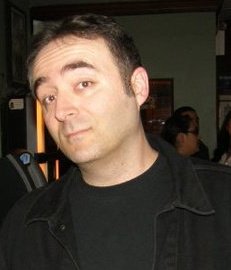
By Nick Cato

Although I would later read about it in several books on writing, I discovered “location writing” on my own due to several circumstances at the time.

And the time was 1998.

After years of dabbling with short stories, I had finally plotted my first novel. I banged out the first few chapters in front of my computer, and while I still had the drive to finish the book, something wasn’t right. At first I thought maybe this wasn’t meant to be a novel. Maybe another fifteen chapters and I could shop this thing as a novella. No—that wasn’t it. Then finally, after wasting too much time snacking and staring out the window in contemplation, it simply “hit” me.

I needed to go somewhere to write this thing.

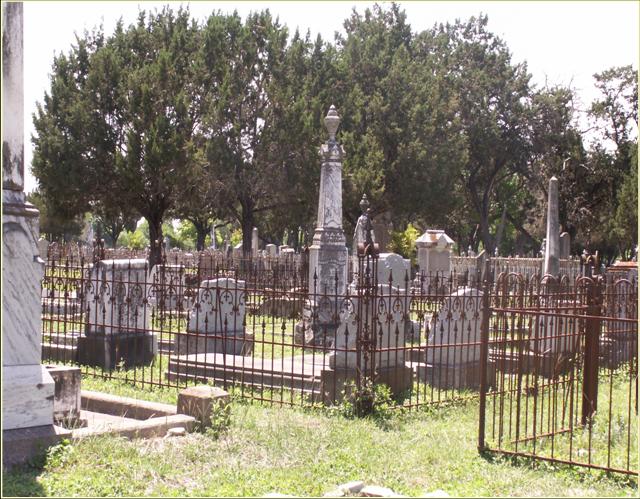
Of course, considering this was a zombie novel, the first place I went was a local cemetery. I had a day off from work so I parked on one of the narrow dirt roads between the tombstones with a mead notebook and Papermate pen. I took in my surroundings (and hoped the maintenance staff wouldn’t bother me) and spent the next six hours writing until my hand told me it was time to rest. Then I grabbed a burger and went back for another hour to re-read everything I had written and made some minor changes.

I managed to get close to eight thousand words done that day, and became a bit too giddy, thinking I had discovered the secret to getting work done. On my next visit to the cemetery a week later, I had spent almost as much time as before, only at the end of the day I had written maybe four thousand words; a good output, but not what I had hoped for.

Not discouraged, I decided to write my next section at the area where my next scene was to take place. So I made sure I had a full bottle of Poland Springs and I pulled into an isolated parking spot at my local shopping mall. And wouldn’t you know it? The words flew out of me like I was on fire. Nine thousand words, much of which I kept in the final draft.

During the writing of my novel, I wrote at about a dozen locations, each one giving me a different feel and a new inspiration. Within eight months I had an eighty-four thousand word novel in my hands, and to this day I continue to write on location as often as possible.
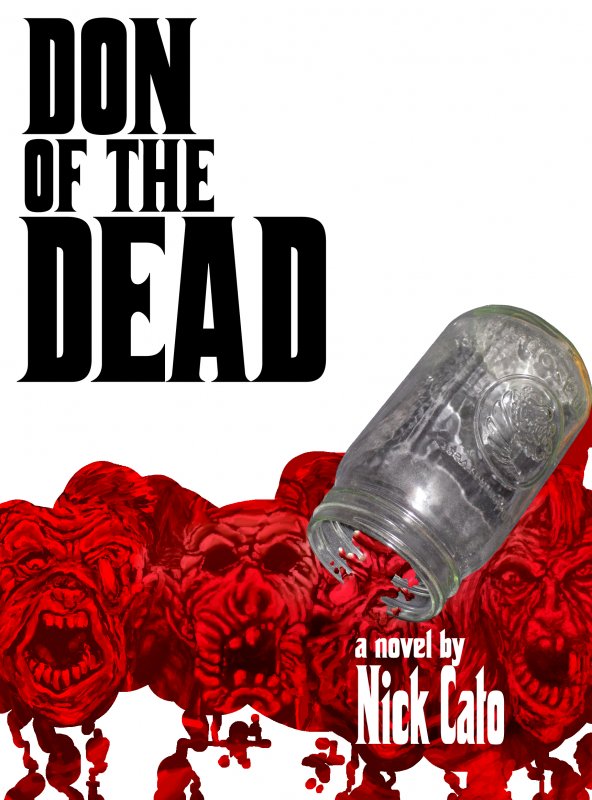
While I wouldn’t sell this novel until 2008 (and after close-to twenty thousand words were chopped off of it), location writing has helped me to complete two other novels and over fifty short stories and two novellas, not to mention countless non-fiction pieces.

Location writing also helped me to develop my first-draft system: to this day I still write 85% of my first drafts the old fashioned way (with pen and paper), my second draft coming into play as I transfer the handwriting to computer. While weather and time off from the day job often dictate the amount of location writing one can do, I’ve found it to be a priceless tool in the war to get words out.

If possible, give the Location Writing Method a shot. Find a location similar to the one you’re currently writing about. Don’t worry what others may think as they see you sitting there, jotting or typing away on the laptop; the busier you get the more the world around you fades out. But don’t let it fade out until you’ve FULLY taken in your new writing surroundings. Take your time looking at every nook and cranny, keep the windows open (if you’re in a car as I often am) and make notes of the smells and sounds. Make notes of as many details as you can. There have been times I’ve filled up both sides of a sheet of paper with minor things I eventually added to the background in certain scenes.

If this works for you—and you fail to reproduce the same amount and/or quality of writing upon your second visit to the same place—simply change locations. Or, with your notes handy, try finishing your current section at home while the memories of a particular location are still fresh in mind.

And let me know if it works for you!

A Writing Advice Article from Stepcase Lifehack

An article from Stepcase Lifehack (http://www.lifehack.org/.

11 Books to Inspire, Encourage, and Cleanup Your Writing by Chris Smith

I’d like to call myself a writer. But I have found that it is hard to do. Mostly because of fear of the craft and how I sometimes don’t think that I can “stack up” to other, better writers.

What I have found is that my notion of me being terrible at writing isn’t anything unique. Not in the slightest. The best writers in the world all struggle with this notion on a daily basis. It’s hard for me to believe that writers like Steven King and Natalie Goldberg don’t believe that they are awesome at writing all the time, but it’s true.

So, instead of being hard on myself I decided to read what other writers had to say as well as learn some writing technique in the process. Below are 11 books that can help you inspire, encourage and clean up your writing.

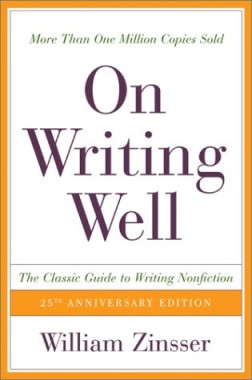
On Writing Well

This book is a classic and one of the first that I read when I got into writing. Zinsser writes in a very approachable style and reminds you that writing isn’t always fun; that it is a real job and that you have to write through blood, sweat, procrastination, and tears to be considered a writer.

He is the one that helped me understand that writing less is more.

On Writing

It would be hard to not include a book about writing from one of the best selling authors of all time; Stephen King. This book dives into King as a person and also provides the reader with how he stays motivated and how he goes about the writing process. There is some excellent stuff in this book and definitely worth reading a few times to glean.

Anyone that listens to Metallica while writing horror and mystery is my kind of human.

Writing Down the Bones

Ah, what can I say about Natalie Goldberg? That she is one of the greatest writing enthusiasts and teachers I have come across.

In Writing Down the Bones, Goldberg reminds us that we can’t beat ourselves up as writers and no matter what we will. She shows us how to get out of our “monkey mind” and how to write without the inner critic stopping your from putting down your ideas.

If you are a writer or even know a writer, Writing Down the Bones can “inspire” you and move you to keep your ideas and pen moving.

The Artist’s Way

Several months ago I heard about the idea of writing 750 words a day to get out of myself and to keep the flame of writing alive. It helps you by making a guarantee with yourself; no matter what, no matter how tired or apathetic I am, I will write 750 words a day.

That idea came from the Artist’s Way by Julia Cameron. Cameron suggests writing “Morning Pages” every day. The idea is to write 3 pages of long hand writing and no matter what don’t stop while you are writing. It is supposed to liven the writer in you as well as work through some cruft so you can be more creative.

And it works.

Bird by Bird

Bird by Bird is a book by the infamous Anne Lamot. I have yet to read it but from the endless awesome reviews at Amazon, it seems to be a truly great book about writing.

Lamott is known for speaking her mind and isn’t afraid to tell you the truth about writing. She has written around a dozen books

The Courage to Write

The Courage to Write is what it says; a short book to help writers not be afraid of the keyboard or pen and help to get them writing more. Raplh Keyes is a well known writing teacher and in this book tries to help us get over the fear of putting pen to paper (or fingers to keyboards).

Keyes writes about the reasons why we become fearful of writing and it’s no surprise that the fear is something in ourselves rather than something external.

The Pocket Muse and The Pocket Muse 2
This is a fun book and isn’t truly a writing technique book like most of the others. What the Pocket Muse is intended to do is give writers a spark to write and be creative. There are many sayings and prompts throughout the book with different types of visuals to get a writer’s mind going.

It’s a nice little book to have by your side, especially if you want to find something for a little boost to get started writing.

The Daily Writer

The Daily Writer is another book that isn’t completely about writing technique. What the Daily Writer provides is 366 prompts and writing exercises that you can use everyday. Every good writer that I have encountered over the years has kept a journal or has written every single day without fail. So, something like the daily writer coupled with the above mentioned Morning Pages can kickstart your writing habit and your creative process.

I’ve used the Daily Writer for almost 7 months now and it is definitely worth the time and money to check out.

Immediate Fiction

I tend to not write fiction but have been thinking about trying some more and more. Especially when a friend recommended “Immediate Fiction” to me. Once again, I don’t have first hand knowledge of this book, but according to my friend and reviewers on Amazon, this is one of the best books for help with writing fiction.

The Elements of Style (4th Edition)

Ah, the classic. I remember sitting in my first semester of college writing with this weirdly colored and amazingly short book as our text. I in no way recognized the importance of Mr. Strunk’s book then. It took several years and a revisit to college to understand its impact on my writing.

The 11 rules of Usage and Composition are extremely valuable and something that every potential writer should take note of.

The Essential Don Murray: Lessons from America’s Greatest Writing Teacher

Don Murray is sort of the “black horse of writing”. Not too many people outside of the field know about him as he doesn’t have the grand allure of authors like Steven King. But Don Murray may have been one of the best writers and writing coaches in the West.

The Essential Don Murray is a collection of all of Murray’s scattered works and provides the reader with many strategies and tips for writing. But, what this book truly shows us is how much Murray loved writing and tries to help the reader love it too.

Chris is a developer, writer, tech enthusiast, and husband. He holds a degree in MIS and CMPSC from Penn State Behrend. Chris is also interested in personal productivity and creativity and how to utilize technology to get more things done. Check out his tech writing at androinica.com where he writes about Android.

By dudley228 Posted in Advice

Author Kristi Petersen Schoonover’s Write-up and Pictures from the Hebron Harvest Fair

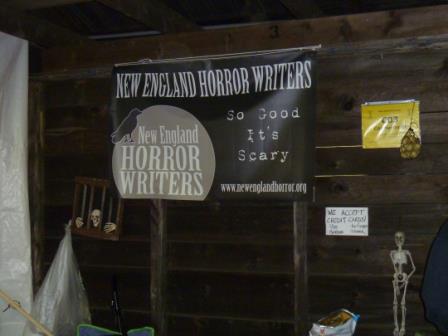
The NEHW banner on the back wall of the booth at the Hebron Harvest Fair

Hot Times at the Hebron Harvest Fair: The Thrill of Discovery by Kristi Petersen Schoonover

As a writer who gets herself “out there” a lot, I’m asked all the time by other writers: why? Why should I spend the money? Why should I go to an event? If I don’t sell any books, I won’t have made back my investment.

This is how I always answer: I enjoy investing in my writing career, and most of that money goes to publicity — which often includes attending events, like being part of the New England Horror Writers booth at the Hebron Harvest Fair this past weekend. Do I expect to make a huge number of sales? Not really. I do it to get my name out there and to meet people directly — something that pays off in the long run in more ways than just monetary. I spent five years writing for a public relations firm, so I know a little bit about the value of second endorsement — that’s why social media has exploded the way it has. People are much more likely to buy something if their friends tell them to than if they see it in an ad.

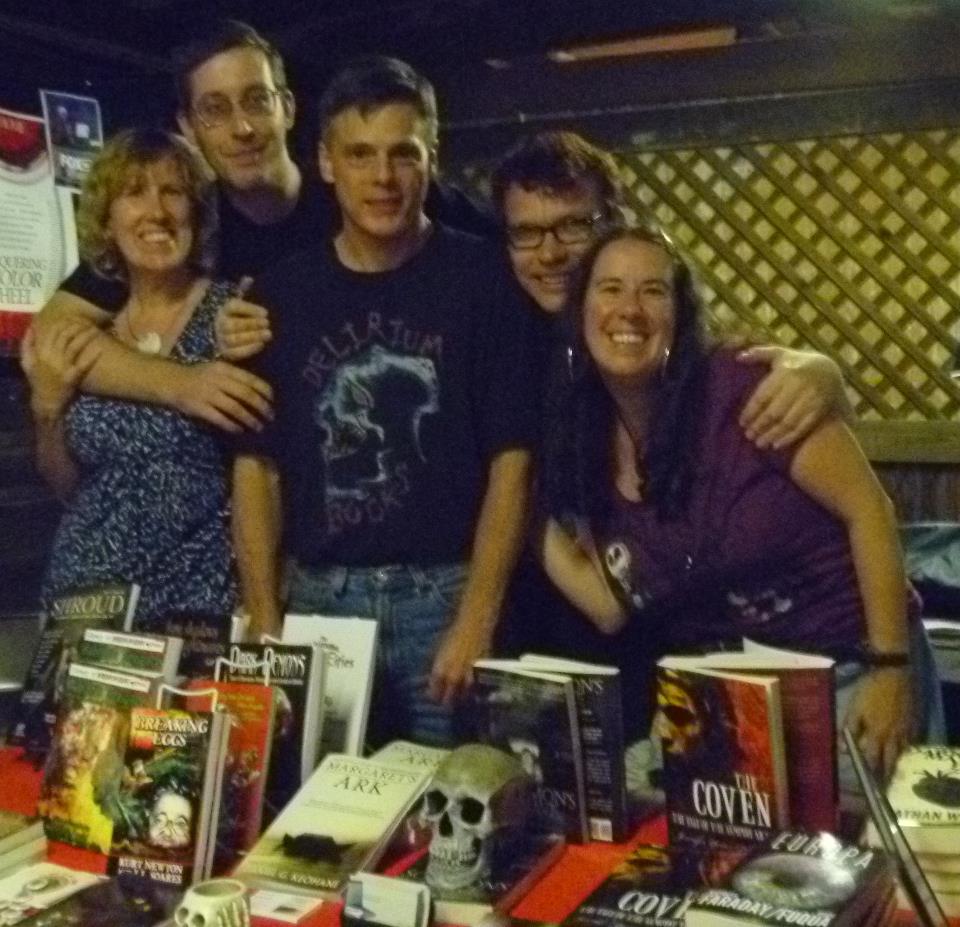
From left to right: Stacey Longo, Jason Harris, Kurt Newton, Danny Evarts, and Kristi Petersen Schoonover

Likewise, people are much more likely to purchase one of your books if they’ve met you and talked to you. Maybe not that minute, maybe not that night or the next day, but at one point, they will. I have an Amazon Wish List a mile long, mostly loaded with titles of books by writers I know or met at an event. And believe me, I will purchase those books when I’ve got some cash and the time to read them. Even if it’s a year from now.

But there’s another reason to attend these events, another reason that I’d actually forgotten about until this weekend: thrill.

That thrill of a reader discovering a new book he would like to read, of meeting the writer behind that book he was holding in their hands, of having that book signed and personalized — of just talking to writers about reading and writing.

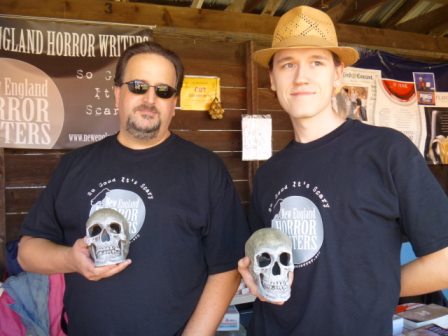
Authors Scott Goudsward and Greg X. Graves practicing their Hamlet

I had put together a bunch of ghost stories, folded them in half, and inserted our NEHW flyer inside. I’d approach people and ask, “Would you like a ghost story for Halloween?” I expected most people to either say “no” or just unenthusiastically take it. But I got tons of surprises! A blonde in pink shorts smiled, opened the story right away, started reading, and crashed into someone. A woman in a brown sweatshirt went on and on about how much she loved ghost stories. One man in a DUCK, NORTH CAROLINA sweatshirt was so excited he offered to pay me for it. Two teenaged girls came back later and were begging me for more. For an hour on Saturday, the crowds had thinned and not many booths were busy, so I visited the vendors, figuring they could read for a few minutes while nothing was going on. The guys at one booth (I won’t say, because I don’t want to get them in trouble if their bosses end up reading this) were more than enthusiastic. “Oh, yeah!” the guy said. “I totally love scary stuff!”

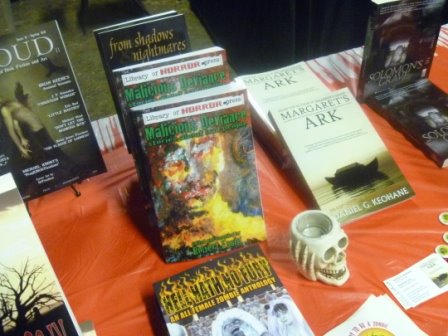
Shroud magazine and a few books on a table at the NEHW booth

One woman came into the booth, all smiles, after I had handed her one of the ghost stories. She made a beeline for the table. “Oh my God! Is this the Disney book? [referring to Skeletons in the Swimmin’ Hole]. I saw this in the paper and I can’t believe I found it!” She just grinned and grinned (and I have to admit I had never seen anyone react that way to my book, so I felt a little strange) and when Ken teased her about “Hey, great, now she isn’t going to get one of mine,” she said, “You write, too?” (She was referring to Shock Totem). “Well,” Ken said, “I’m the editor.” She wasn’t fazed. “I’ll get one, which issue do you think I would like?” (I can’t remember if she wanted him to sign it or not, but I seem to recall she did. Ken can correct me). When I went to go get a cup of coffee, I passed one man sitting on a rock, reading. He had a copy of Kurt Newton’s Life Amongthe Dream Merchants and Other Phantasies. I had seen him at the booth with the book in his hands, and then when he realized Kurt was actually standing there, it was like he had won the lottery. Similar scenes played out with nearly all the writers who were there with their work.

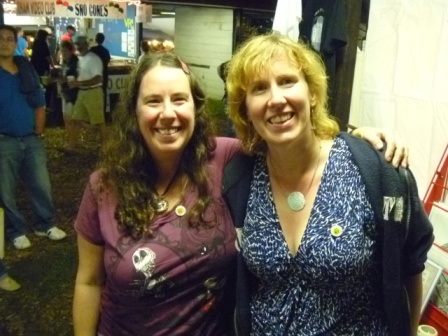
Authors Schoonover and Longo

Kids were thrilled to talk about It’s Okay to Be a Zombie with Danny Evarts. Others were excited to talk with writers about other books. Countless discussions were going all weekend on everything from Stephen King to what new books are coming out to how to break into the business. And most people who purchased hung around for awhile to talk. It was a pretty lively booth most of the time.

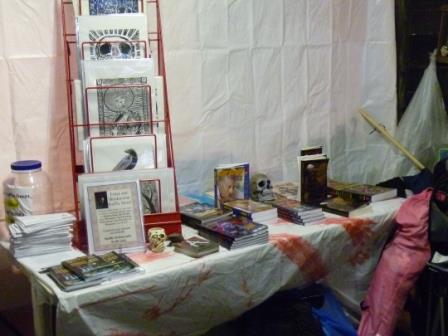
A table in the NEHW booth at the Hebron Harvest Fair

No one can put a price tag on these experiences. I’m pretty sure I still get that thrilled look on my face when I buy a book I simply can’t wait to read (um, in fact I did it there when I found out there was a Lizzie Borden story in an issue of Shroud, so of course I bought it). I still get that thrilled look on my face when I meet an author of books I love (you should have seen me meet Peter Benchley. I think I just had my mouth open the whole time). I am always excited by the settings. And the readers at our booth, they got excited too. As I stood there, I was excited for them.

So if you’re on the fence about going to an event and you can at all afford it (we all have to eat, too), stop thinking about it in terms of the investment/profit ratio. Start thinking about it in terms of the second endorsement, the magical memory and the reader’s thrill of a new discovery and meeting the writer whose book he’s got in his hands. The readers we were, and probably still are.

I know that’s how I was inspired to become a writer in the first place.

Here is a link to more photos taken by Schoonover, www.facebook.com/#!/media/set/?set=a.2147791928413.118778.1054758035