Thoughts on Revising Versus Redrafting

This entry originally appeared on NEHW member Craig D.B. Patton’s blog.

On Starting Again

by Craig D.B. Patton

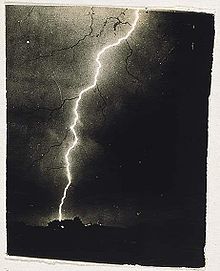
Revising vs. redrafting. Tinkering with what you wrote the first time vs. tossing all of it in the (virtual) bin because you realize you just plain whiffed on the first attempt. I think I’ve had a habit of resisting the latter. It’s harder, emotionally, for me to accept the fact that I invested time and energy and didn’t actually create something worth keeping. I like it much better when the lightning bolt flies straight and true and fries something with a really solid BOOM!

(picture courtesy of Wikipedia)

But it doesn’t always. And I’ve missed enough times now to be better at recognizing and accepting it. It’s also become one of the times when I remember what bands go through in the studio. I’ve never been in a band, but I’ve read enough articles and books to have a sense of how some of them work and how bumpy and long and curving the road to creating some of my favorite music was. Take after take after take. Experiment after experiment that seems great conceptually and then just lies there on the floor when tried. Songs that have no chorus. Choruses that have no verses. Bits of instrumentation that don’t work until combined, which happens sometimes by design and sometimes accidentally. Hours and hours of horrible music before the good stuff arrives, if it does at all.

But the seed idea, if it’s good enough, survives through all that.

Which is the same with stories. A good idea is a good idea. The problems come when trying to tell the story. And sometimes it takes a while.

I have a song/story like that now. The first take/draft was fun while I was doing it. There are some good images and moments, particularly in the second half of it. But it wound up…meh. And meh doesn’t get fixed by cutting a few paragraphs and rewriting a few more. So I’ve marched back into the studio. Changed a few effects pedals. Reworked some instrumentation. The red light is on.

Time for another take.

What To Do After Writing Your First Novel

What To Do After Writing Your First Novel

by David Price

This is all new to me. I finished writing my first novel just five months ago. It’s been a long time coming. There’s been so much to do since I finished the first draft, more than I ever imagined. I knew I’d have to edit it, but I never guessed how much work that would be, because I’d only written short stories before. I found out I needed to have a website, start a blog, as well as get active on facebook and twitter. Last and not least, I needed to network. As far as networking goes, the best thing I have done to date was join the New England Horror Writers.

The NEHW seemed like a good, solid group, right away. I immediately got involved in the facebook discussions and tried to help by contributing to the website. I had a chance to meet some of the members at Rock and Shock, and then about a month later at Anthocon. Those two events were great places to start and meet a few people, but the best chance to really get to know some people was going to be the Christmas party at John McIlveen’s.

Driving there was a bit of an adventure for me. I had trouble following the mapquest directions, and found myself wishing I had taken the GPS from my wife’s car. Overall, Haverhill is not that far from my home city of Peabody (pronounced Peebuddy, Jason), but once I got past Georgetown, I was in unfamiliar territory. It probably took me about a half hour longer to get there than it should have, because I turned around and backtracked so many times. In the end, I made it though.

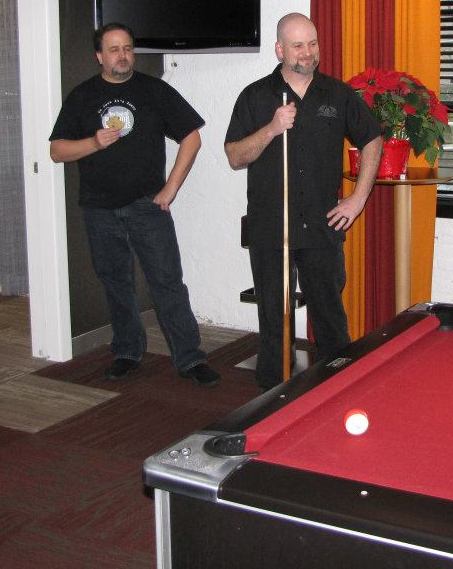
From left to right: Scott Goudsward and David Price playing pool (picture courtesy of John M. McIlveen)

Now, I’ve been an introvert all my life, so meeting new people isn’t really my specialty. I’m sure a lot of you other writer types out there can relate to this. I walked into the conference room where the party was being held and all those old anxieties came to the surface. All the seats at the table were taken, which didn’t make it any easier to blend in. Luckily, Dan Keohane got up from the food table and asked in anyone wanted to play pool. A few of us teamed up and we played some pool. This gave me a chance to mingle with just a couple people to start and break the ice. As an added bonus, our host John McIlveen brought down enough alcohol to supply a frat party. I’ve been in enough social situations to know the lubricating powers of alcohol, so I grabbed a beer and tried to relax.

People came and went, but I had the chance to talk to Paul McMahon, Scott Goudsward, John McIlveen and Tracy Carbone during the day. Eventually, Stacy Longo and Jason Harris showed up, the two people who I’ve had the most contact up until now. I’m not so good at mingling that I had the chance to meet everybody, but hopefully I’ll get there eventually. I’m learning more all the time. Everybody had their own experiences and their own advice to share. The NEHW is a very friendly, supportive community, and I’m glad I can be a part of it. As day turned to night, the partygoers dwindled to a level I was more naturally comfortable with.

At eight o’clock, those of us who had stuck it out that long, gathered around the television so we could check out Tracy Carbone’s appearance on Animal Planet. This was the best time for me. We all got a kick out of Tracy’s appearance on some show that had to do with exotic pets. It lightened the mood up for a fun conversation. At that point, Scott Woolridge and Gardner Goldsmith were telling stories about convention experiences, other writers they have met, and the British sci-fi comedy, Red Dwarf, a show I had never seen before. Gardner really had some great stories to share about Red Dwarf and what the show meant to him. Gardner and a friend of his even flew over to England one year, just to watch the show on tv.

As Gardner was telling us this story, he described his big, burly friend who went with him. He looked around the room, reached over and tapped me on the shoulder, “Kind of like this guy,” he said. I have to chuckle about this. I have been part of a few different social circles over my life, such as hockey players, construction workers, Boy Scout fathers and now writers. Everything being relative, I seem to be some sort of hybrid. When I am around the athletes and construction workers, I am generally one of the smaller guys, but when I hang out with Boy Scout dads and other writers, it goes the other way.

Anyway, it was a fun day filled with interesting people. I’ve never completely fit in with the athletes and construction workers. Nothing against them, mind you, I’ve been part of that crowd for over twenty-five years. Still, it’s nice to finally find a group of people who can sit around all day talking about H. P. Lovecraft, Star Wars, the next Stephen King mini-series and the zombie apocalypse. I hope I get the chance to get to know more of this group over the coming year. Maybe by the 2012 Christmas party I’ll even know the names of the others that I didn’t get a chance to meet. I guess I’ll wrap this up now. I think I’ll watch one more episode of Red Dwarf on Netflix before bed.

Editor’s Note: Along with being a NEHW member, David Price is part of the NEHW Publicity Committee.

The Mirroring of Life and Fiction

This entry originally appeared on NEHW member Inanna Arthen’s blog.

Hey, how did that fiction get in my real life?

by Inanna Arthen

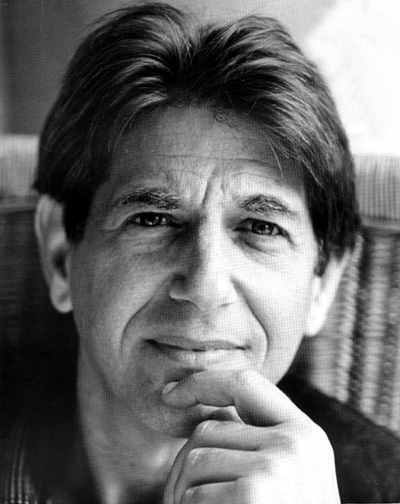
Peter Coyote (picture courtesy of texasgoldmovie.com)

There has always been a consistent pattern in my life whereby my fiction and my actual experiences echo and mirror each other in the weirdest ways.The first time I encountered actor Peter Coyote was in Steven Spielberg’s E.T., in which he played the mysterious scientist tracking the little alien. I’d never heard of Mr. Coyote before. But I confess: it was a case of crush at first sight. I’m not prone to fannish excesses–I won’t even collect autographs–so I didn’t look up Mr. Coyote’s biography or read gossip magazines or anything like that. Probably almost any other fan of his knew a lot more about his background than I did. But I loved him in E.T.,and I watched for him in other things. Many years ago, I went to a Red Cross blood drive to donate blood. I can no longer pinpoint exactly when this was, except that I’m fairly sure it was between 1982 and 1989, and I think the blood drive was in Acton, Massachusetts, where I lived in the 80s. It wouldn’t have been far from there, anyway. I had taken some film magazines with me to read – Premiere, I think. This was during my efforts to break into film acting locally. I even read Variety.After I finished with the donation and was resting, the way the Red Cross always makes you do so you won’t just jump up, barf and pass out, I was reading the magazines, and one of the blood drive volunteers came by see how I was doing. I said I was doing great, and then she picked up one of the magazines and said, “Oh, could I just look at these?” I said of course, and as she flipped through them she said, “I have a brother who’s an actor, and I always like to see if they say anything about him.”“Oh, really?” I said, pricking up my ears for a possible industry contact. “What’s his name?”

“Peter Coyote.”

I didn’t respond very politely, because to me, this was like saying she was related to Justin Bieber. It’s amazing that I didn’t jump up and pass out. “Oh, you can’t be, you’re making that up!” I said, or something like it. (In my defense, I was running a pint low at that moment.)

She looked a bit offended and said, “No, I’m not, why would I make that up? Most people have never heard of him.”

“Of course I’ve heard of him! He was in E.T.! He’s a doll!” (I’m sure they took a bit more than a pint, actually.)

She seemed rather pleased at that, so I hope I redeemed myself. “He is a doll,” she said, laughing.

That was the gist of our discussion – she had other donors to see to – and I didn’t even think to ask her own name, or look at her badge if she was wearing one. (I think it just said, “Volunteer” or whatever the term is they use.) I always wondered if she was really on the level. Why would a movie actor’s sister be volunteering at a blood drive in Acton, Massachusetts, fer gosh sakes?

But then, why wouldn’t she be? Actors come from all over the place. I lived in Acton and I was trying to be one.

But now it’s the 2010s and I’m trying to be a novelist. My third book, All the Shadows of the Rainbow, is set during the 1960s, plus a few years on either side. I lived through the 1960s, but just as I did with the 1950s and The Longer the Fall, I’ve been doing what I call “total immersion research.” I’m reading as much contemporary material as I can find, and watching raw film footage from that era, and generally working to enfold myself in the zeitgeist of the times, so I can, not just write it, but live it from the inside out.

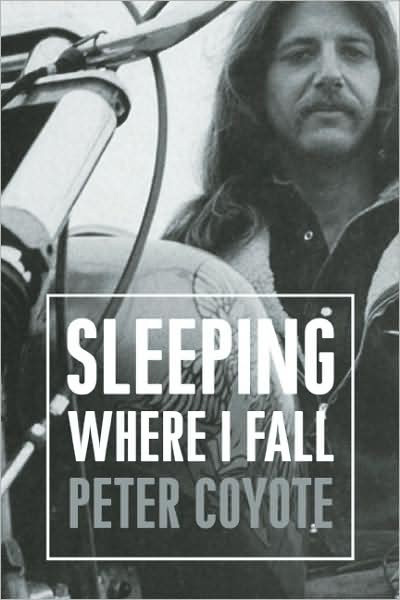
(courtesy of Peter Coyote's website)

By complete happenstance, I discovered that Peter Coyote had been deeply involved in the 1960s counterculture –he was a member of the Diggers and the Free Family, lived on several communes, worked with the San Francisco Mime Troupe, and was at the center of a lot of things that happened in those years. He’s written a memoir about it all, called Sleeping Where I Fall. I learned about it from a random reference on the Red Room website, which I rarely visit, but I just happened to click over there on the day when this book was mentioned. I instantly located a copy. I’ve been reading it for the past week or so.

I’ve been enthralled with the book, because I hadn’t known any of this about Peter Coyote’s personal history. It helps explain why, the instant I saw him onscreen, I just felt this “click.” I’ve been relating strongly to so much that he says in his book. I knew I liked him as an actor, but I never realized that he was what I think of as, “one of us.” He does have a younger sister, although he doesn’t give any clues as to her life or whereabouts. Sleeping Where I Fall was published in 1998, and I’d love to hear what Mr. Coyote thinks about the social and political developments of the last 13 years. I’d guess we share similar views.

Sleeping Where I Fall is going to be one of the most helpful resource books I read, and I’ve got a stack of them. But I’d be enjoying it even if I wasn’t writing All the Shadows of the Rainbow. To add yet more synchronicity to the mix, I found a documentary called Commune by running keyword searches on Blockbuster. When it arrived, it turned out to be about Black Bear Ranch, one of the Free Family communes that Peter Coyote lived with, and Mr. Coyote appears in the film.

It’s just strange how themes and people can weave in and out of our lives in violation of all probability or logic. Over and over again, I’ve been downright spooked by the way things that I’m writing tie into my real life in completely unexpected and inexplicable ways. It’s part of the reason that I’m one of those writers who feel that their fictional universes and characters have wills of their own. I don’t calculate and control the stories I tell, or the people who inhabit them. My characters tell me what’s going to happen and I simply record it … and sometimes, I feel like I’m living it with them. Every once in a while, I feel like I’m living out my fiction in the (so-called) real world.

You might think I’d be more nervous about blowing things up in my novels, in that case! But what good is art if it doesn’t shake you up sometimes?

Run into a Wall, Crawl Through the Nearest Window

This post originally appeared on Benjamin Roesch’s blog, the almost right words.

Post #17: Crawling Through the Nearest Window

Doing National Novel Writing Month is exhilarating. I think this is mostly because I’ve never written, outside of education, for a capital “D” Deadline and the need to complete X quantity by Y date is a utilitarian sort of enterprise that’s added a different timbre to this writing experience than others whose end point hinges on a self-imposed deadline.

I’ve decided that NANOWRIMO is more about stamina than it is about creativity. Not to shit on creativity. Not at all. But the truth is that the writers who have the best chance of starting and finishing a task like NANOWRIMO are those not necessarily with the keenest imaginations, but with the deepest well of endurance. Those who can follow that sage piece of writing advice that I sometimes think is the only truly useful one: ass in chair.

Writing on a deadline makes you solve problems quickly. My analogy is that when your story runs into a wall, find and crawl through the nearest window. Can’t find a window? Tough. Invent one. I’m writing a sci-fi/horror mash-up because it sounded like a novel (pun so very much intended) change to my usual subject matter (realistic literary fiction) that would breathe enough fresh wind into my sails to make it to the finish line. What I failed to realize is that genre writing is a lot harder than I thought it was.

Of course, all kinds of writing are difficult in their own way, but what I’m talking about is closer to the necessity in genre to respect the beginning-middle-end story structure. I’m not writing a book about an existential crisis that doesn’t need to have an ending to be considered successful. The plot is front and center this time out and the plot needs to, perhaps above all things, make sense to the reader. And not sense as in “real,” but sense as in “consistent” and “logical.” There’s a difference.

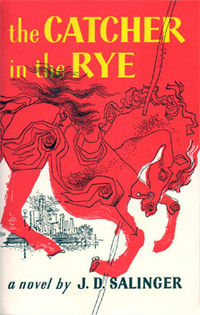
(picture courtesy of Wikipedia)

Consider The Catcher in the Rye. In Salinger’s classic, one need not believe that the things that Holden does are the only things that could have happened. For instance, after Holden’s conversation with the nuns in the diner, we don’t feel the need to make the meet-up logical or the basis to judge what happens next. It may affect the next action, but it doesn’t have to. Nor does the book have to really go anywhere, to end up someplace in order to be a great book, which is, of course, why it doesn’t. For Christ’s Sake, the book’s final image is a kid on a merry go round! In many ways this is exactly what makes a book like Catcher so great and so lasting–it prizes emotion and character above action. And, quite frankly, character is more interesting.

But it all depends on how you look at it. Seen through certain eyes, too large an emphasis on character could be a liability. Most people I know who don’t like Catcher don’t like it because they don’t like Holden, not because “nothing happens.” And if they don’t like it because nothing happens, well, they should probably put down Salinger and read Blue Dot, my NANOWRIMO book. Because, let me tell you, all kinds of things are “happening” in my book.

But, of course, making things happen is its own kind of problem. One problem being that the “happenings” have different rules in a plot driven piece than in a character driven piece. Not dramatically different, but different all the same. In genre, the cause and effect sequence needs to be cleaner, leaner, and ultimately, more satisfying to the reader. After all, that’s what you’re selling them. No one wants to buy tickets to the circus only to find, after the lights have dimmed and the curtains have closed, that they’re actually at an antique show. It’s false

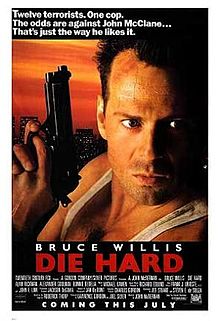
(picture courtesy of Wikipedia)

advertising. In filmic parlance, you might compare the ending of Die Hard to the ending of the last season of The Sopranos. If Die Hard had ended with a long, slow fade out on the bloodied face of John Mclaine before his final show down with Hans and his reunion with his wife, and we were given no closure, no sense that the good guy had prevailed or that the estranged couple had re-united, myself, and a lot of other late 80′s Bruce Willis fans, would have wanted their money back. The Sopranos could get away with such an ambiguous ending because the show was always more about Tony than it was about what Tony was doing. Die Hard is about a guy too, but for that story to make sense to us, that guy needs to always be doing things that lead places.

I guess what I’m saying is that I choose a genre piece for NANOWRIMO because I thought it would liberating, and perhaps easier, to write. But I’m realizing now this was a false assumption. Genre isn’t harder, but it sure as hell isn’t much easier. Which leads back to the earlier point that all kinds of writing are hard.

A problem for me is that I’m not used to writing plots that need to add up so neatly and my characters keep trying to stop my story and let themselves come front and center. Part of me feels like they’re stalling because they don’t know what to do next. I’m on track to finish my book on time, or at least get to 50,000 words on time, but right now the ending keeps getting further away. And the further away it gets, the more I’m getting the feeling that Blue Dot may just be the world’s first alien invasion story that ends with a kid on a merry go round.

12 Holiday Gifts That Writers Will Actually Use

This article originally appeared on the website, The Millions.

12 Holiday Gifts That Writers Will Actually Use

by Hannah Gersen

coverIn “Aren’t You Dead Yet?”, one of the stories in Elissa Schappell’s new collection, Blueprints for Building Better Girls, the narrator, an aspiring writer, receives a black, leather-bound journal as a gift from her best friend. Although she loves the look of the journal, she never writes in it. When her friend discovers this, he’s angry, and even accuses her of slacking off:

I tried to explain that I hadn’t written in it because I loved it so much and I didn’t want to ruin it. The pages were so nice, and sewn in, you couldn’t just rip them out. Whatever stupid thing I wrote down would be in there permanently.

This passage reminded me of the many beautiful blank journals I’ve received over the years, journals I’ve never used. Whenever I fill up one of my trusty spiral notebooks, I go through the stack and tell myself I’m finally going to start using them. But then I think of sullying those pristine, unlined pages with my half-formed thoughts, and I feel as guilty as the narrator in Schappell’s story.

Unfortunately, the same guilt intrudes on many of the other lovely writerly gifts I’ve received. At the risk of sounding ungrateful, I confess that I have a lot of nice pens I never use, because I’m afraid of chewing on them; a lot of classic novels I haven’t read because I feel guilty about not having read them; and a lot of inspirational writer’s guides I never read, because what if I’m not inspired?

None of these gifts are offensive, and no one will begrudge you for giving them. But they are boilerplate gifts. Writers get blank journals for the same reasons that teachers get mugs, assistants get flowers, and grandmothers get tea. If you want to give the writer in your life something he or she will truly adore, here are twelve ideas:

1.  A Cheesy New Bestseller

covercoverOne of the best presents I ever got was The Nanny Diaries. I really wanted it, but there were over 300 people on the library’s waiting list (I live in New York), and I wasn’t going to shell out $25 for something I was unlikely to read twice. The funny thing is, I never told my roommate that I wanted to read The Nanny Diaries. She just guessed that I had a secret craving for it. Of course, it can be as hard to gauge your friend’s taste in pop culture as it in high culture, but it’s better to guess wrong in the pop culture arena, because your friend is more likely to exchange it for something she likes better. Whereas, if you give her Gravity’s Rainbow, she’ll keep it for years out of obligation.

2.  Good lipstick

Writers are often broke. If they have $30 to spare, they are going to spend it on dinner, booze, or new books. Not lipstick. But writers are pale from spending so much time inside and could use some color. Make-up can be a tricky gift because it suggests that you think your friend’s face could use improvement. That’s why it’s important to go to a department store make-up counter and buy something frivolous and indulgent, like a single tube of red lipstick or some face powder or blush in a nice-looking case.

3.  Foreign language learning software

Most writers wish they knew more languages. It can also be relaxing to be rendered inarticulate in a new language, in that it offers a real break from personal expression, nuance, and irony. At the same time, learning a new language sharpens your native tongue, and expands your vocabulary. It’s sort of like cross training. Although language classes with live instructors are generally more effective than computer programs, I prefer software because it allows me to take the class on my own time and at my own pace.

4.  A Bathrobe

John Cheever famously donned a suit every morning in order to write. But as Ann Beattie recently revealed, and as a generation of bloggers already knows, most writers wear awful clothing while they are working. Help your writer friend out by giving her a beautiful robe to cover up her bizarre ensembles. Even if she already has one, she probably hasn’t washed it in a long time, and could use another.

5.  A Manicure

I bite my nails, especially when I’m writing. I’ve noticed that a lot of other writers have suspiciously short nails, too. Manicures help. Also, manicures get writers out of the house—and off the internet.

6.  “Freedom”, the internet-blocking software

Freedom” is a computer program that blocks the internet on your computer for up to eight hours. I don’t understand why it’s effective, since it’s relatively easy to circumvent, but as soon as I turn it on, I stay off the internet for hours at a time. (There is also a program called “Anti-social”, which only blocks the social parts of the internet, like Facebook and Twitter.)

7.  Booze, coffee, and other stimulants

Find out what your friend likes to drink and buy a really nice version of that thing. Wine can be tricky, but we are living in an age of over-educated clerks, so don’t be afraid to ask for help. If your friend is a coffee or tea drinker, find out how he brews it and buy him really good beans or tealeaves. Even better, find out what cafe he frequents and see if they sell gift certificates.

8.  Yoga Classes

Yoga does wonders for anxiety, depression, and aching backs, three common writerly afflictions. Most yoga classes also incorporate some kind of meditation practice, which is also very helpful.

9.  A pet

In a recent Atlantic blog post containing advice from world’s most prolific writers, a character from one of Muriel Spark’s novels is quoted, describing why cats are good for writers: “If you want to concentrate deeply on some problem, and especially some piece of writing or paper-work, you should acquire a cat… The effect of a cat on your concentration is remarkable, very mysterious.” Another prolific writer, Jennifer Weiner, recommends dogs on her website, where she’s posted a list of tips for aspiring writers. Dogs, she explains, foster discipline, because they must be walked several times a day. Furthermore, Weiner notes, walking is as beneficial for the writer as it is for the dog: “While you’re walking, you’re thinking about plot, or characters, or that tricky bit of dialogue that’s had you stumped for days.”

Obviously, a pet should not be given casually, or even as a surprise, but it’s worth considering, especially if you hear of an already-trained dog or cat that needs a new home.

10.  Freezable homemade foods: casseroles, soups, breads, and baked goods.

This is a potentially Mom-ish gift, but if your friend is on deadline, a new parent, or just far from home during the holidays, a home-cooked meal could be a lovely gesture. I emphasize freezable because it should be something that you make at home and leave with your friend to eat later. If you can’t cook, buy a pie.

11.  A hand-written letter

I know how corny this sounds, but many writers, especially fiction writers, still get a fair amount of rejection notes via the U.S. mail. You can easily make your friend’s day by sending an old-fashioned, chatty letter or even just a holiday card.

12.  The Gift, by Lewis Hyde

cover The Gift examines the role of artists in market economies, taking the lives of two major American poets as case studies. It’s the perfect antidote to all the earnest, helpful guides that aim to teach writers how to be more publishable, saleable, and disciplined. Where most writing guides make writers feel they could succeed if only they were more productive and efficient, The Gift argues that productivity and efficiency are market-based terms that have little meaning in gift economies, which is where many creative writers exchange and share their work. Another way of putting it is to say that The Gift makes feel writers feel less crazy.
The Pen Is Mightier Than The Phone: A Case For Writing Things Out

This article originally appeared on the Fast Company website.

The Pen Is Mightier Than The Phone: A Case For Writing Things Out

by Kevin Purdy

Writing things down, with your actual hands, is just plain better at getting you to remember and execute good ideas. Here’s why.

There’s all kinds of advice across the web about when to use which app for each small thing that needs doing. But the advocates for using paper to complete certain tasks are not so loud (you can’t hear them typing, among other things). Yet a Forrester Research survey of business professionals found that 87 percent of them supplement gadgets with paper productivity, and 47 percent thought their personal and company efficiency would improve with better note-taking. The survey might have been biased, since it was sponsored by the makers of the Livescribe smart pen, but you can’t help but think it touches on a need to refamiliarize ourselves with ink and thinly sliced wood pulp.Paper, but more specifically handwriting, will likely always be with us, and that’s a good thing. It’s a smoother path from your brain to the printed word, it saves you from task-switching overload, and it possibly makes the best to-do list.So here’s a chance for advocates of the handwritten way to make their best pitch for the best uses of dead trees.

Lightning-Strike Ideas

Carrying a notebook with you at all times is cheap and easy. You can catch those startlingly crisp ideas about a project that pop up in the auto shop waiting room, the airport, a bookstore, or wherever. Marina Martin, business efficiency consultant and self-described “quintessential Type-A Personality,” says that even the most fluid, thoughtful electronics introduce too much friction into the process of thinking, writing down, then thinking further out.

“We’re more likely to find an electronic device, open our favorite word processor, and fiddle with a margin and font size before committing a single word to the page,” Martin wrote in an email. “Automatic spellcheck and word correction can slow the process further and cause you to lose your train of thought.”

By committing your thought to paper, you’re also doing more to lock it into place. Virginia Berninger, professor of educational psychology at the University of Washington, has the brain scans to prove it. Berninger told the Wall Street Journal in Oct. 2010 that as your hand executes each stroke of each letter, it activates a much larger portion of the brain’s thinking, language, and “working memory” regions than typing, which whisks your attention along at a more letters-and-words pace.

A 2008 study, also cited in the Journal, asked adults distinguish between characters in another language and their trick mirror images. Those who had a chance to write out the original characters with pen and paper had “stronger and longer-lasting recognition” of the proper orientation than those who found the character on a keyboard.

Better To-Do Lists

The role of paper is “changing from information recording and archiving, to a more temporary role of containing transient information,” says Jenny Englert, senior cognitive engineer at Xerox, in summarizing some of the research her firm is doing on the future of work and work practice ethnography. In other words, paper still makes for a great to-do list (which, as you’ve just learned, is easier to remember).

A paper to-do list is easier to edit wherever you are, and can contain sketches and special characters without requiring you to learn new software or keyboard tricks. Paper also “provides a visual cue that persists spatially (it doesn’t disappear behind a computer screen),” Englert writes, and can be left right where you need to be reminded of it.

Martin notes, too, that it’s harder, psychologically and physically, to let an item grow stale on a to-do list, especially if you’re getting other items done around it.

“When it comes time to rewrite a messy or mostly done list, merely facing the idea of writing out the same task for the fifth time can be enough motivation for me to do it right then, so it never has to be written down again,” she says.

Jobs and Events That Seem Overwhelming

Dr. Sian Beilock’s book Choke: What the Secrets of the Brain Reveal About Getting it Right When You Have To, explores the many, many ways that the most talented people can set themselves up for huge failures at crucial moments. One thing that reliably helped very smart students with major test anxiety was writing about their anxieties to “off-load” them. And that was very specifically noted as “writing.” In general, ask a whole bunch of geeks where they write down their thoughts and feelings, and you might be surprised at how many choose pen and paper.

As another Fast Company blogger pointed out, critics and researchers see paper as a medium that allows for deeper thought and focus. By its nature, it’s a single page that you pick up and give a key position to, and you can see exactly how much you have done with it. On another level, paper lacks hyperlinks, search boxes, and notifications, the kinds of context switches author Nicholas Carr believes have rewired and distracted our brains.

Of course, there are lots of ways to digitize your paper thoughts once you’ve nailed them down, if you’d like–Livescribe, Evernote, and tools like the ScanSnap among them. Handwriting and paper’s biggest selling points may be that you don’t have to “switch” or “transition” anything at all. They’re always there, and will be for a long time.

The Girl With The Dragon Tattoo to be Released Early on December 20

“THE GIRL WITH THE DRAGON TATTOO” TO BE RELEASED DECEMBER 20 AT 7 P.M. NATIONWIDE

CULVER CITY, Calif., December 13, 2011 – Moviegoers will get a jump on one of the most highly-anticipated films of the season as The Girl with the Dragon Tattoo opens one day early beginning on December 20 at 7 p.m. nationwide, it was announced today by Jeff Blake, chairman, Worldwide Marketing and Distribution for Sony Pictures.
Commenting on the announcement, Blake said, “This is one of the busiest times of the year for moviegoing and we can’t wait to share this outstanding thriller with audiences all over the world. We feel that by opening for night-time shows on December 20th, fans of the book will be given the perfect opportunity to get a jump start on the release of an exceptional film.” In The Girl with the Dragon Tattoo, Academy Award®-nominated director David Fincher (The Social Network) uncoils the world of Stieg Larsson’s global blockbuster thriller on the screen. Within the story’s labyrinth lie murder, corruption, family secrets and the inner demons of the two unexpected partners chasing the truth of a 40-year-old mystery. Mikael Blomkvist (Daniel Craig) is a financial reporter determined to restore his honor after being convicted of libel. Engaged by one of Sweden’s wealthiest industrialists, Henrik Vanger (Academy Award® nominee Christopher Plummer), to get to the bottom of the long-ago disappearance of his beloved niece, Harriet – murdered, Vanger believes, by a member of his large family – the journalist heads to a remote island on the frozen Swedish coast, unaware of what awaits him. At the same time, Lisbeth Salander (Rooney Mara), an unusual but ingenious investigator with Milton Security, is hired to do a background check on Blomkvist, a job that ultimately leads to her joining Mikael in his investigation of who killed Harriet Vanger. Though Lisbeth shields herself from a world that has repeatedly betrayed her, her hacking skills and single-minded focus become invaluable. While Mikael goes face-to-face with the tight-lipped Vangers, Lisbeth plies the wired shadows. They begin to trace a chain of homicides from the past into the present, forging a fragile strand of trust even as they are pulled into the most savage currents of modern crime. The screenplay is by Steven Zaillian, based on the book by Stieg Larsson originally published by Norstedts. The producers are Scott Rudin, Ole Søndberg, Søren Stærmose, and Ceán Chaffin. The film is presented by Columbia Pictures and Metro-Goldwyn-Mayer Pictures. About Sony Pictures Entertainment Sony Pictures Entertainment (SPE) is a subsidiary of Sony Corporation of America, a subsidiary of Tokyo-based Sony Corporation. SPE’s global operations encompass motion picture production, acquisition and distribution; television production, acquisition and distribution; home entertainment acquisition and distribution; worldwide television networks; digital content creation and distribution; operation of studio facilities; development of new entertainment products, services and technologies; and distribution of entertainment in more than 142 countries. Sony Pictures Entertainment can be found on the World Wide Web at http://www.sonypictures.com.

Dane Cook Talks about His New Movie and His Inspirations

by Jason Harris

photo courtesy of Roadside Attractions

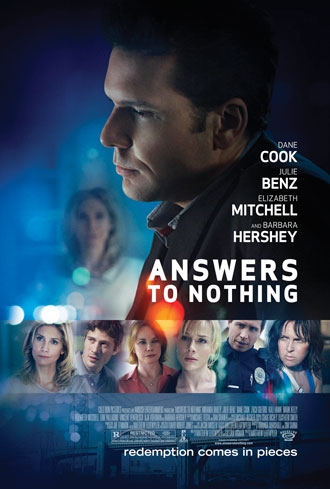
Actor and Comedian Dane Cook wanted to “share emotion and pain” he has experienced in his life in his new film, Answers to Nothing, which opened in theaters along with being available on video on demand this past Friday.

“With my comedy, I want to share my joy and positive experiences,” Cook said. “The main point of comedy though is people coming to laugh and enjoy themselves. What attracted me to this film is that I could relate to personal experiences in a different way. I can empathize with certain aspects of my character’s life.”

According to press materials, the film is “set against the backdrop of a missing girl case, lost souls throughout Los Angeles search for meaning and redemption and affect each other in ways they don’t always see. Ryan (Cook) and Kate (Elizabeth Mitchell) are in a strained marriage. They are trying to have a baby, but instead of bringing them closer together the difficulties are tearing them apart. Two strangers, sharing a home, they each lead private lives unbeknownst to each other. Ryan, grew up listening to the impossible romantic story of his grandparents’ courtship, but isn’t even sure he believes in love. He hates his mother for believing that his father is coming back, even though he left her 10 years ago, and he hates himself for following in his father’s steps of infidelity.”

Cook believes his character is “distancing himself from people and his emotions” even as his character is a confident therapist. He does believe his character is a “complex individual, but it is behavior we all do.”

“We show up every day to work and put on our game face, but people don’t know personal life circumstances,” Cook said.

As he filmed this movie, Cook didn’t want to let his fans down.

Being able to view his personal experiences in a different way attracted him to Answers to Nothing, Cook said. The film allowed him to tackle different philosophies, he said.

“You get to play pretend, but also share important moments in your own life.”

Actors are not always connected to their characters, Cook said.

“I understand some of the behaviors in feeling detached,” Cook said. “I lost both of my parents to cancer and when you experience something like that, you really hold onto those moments and hope you can grow from them … ”

The film, Mr. Brooks, led Cook to receive his role in his new film and his career grew from that, he said. Answers to Nothing director Matthew Leutwyler saw him in the film.

Cook made an audition tape for Mr. Brooks and received a call from Kevin Costner, who directed the film. Cook was told by Costner that was what they were looking for, he said.

There are people in Hollywood that Cook would love to work with.

Cook would love to work with Woody Allen, Jason Reitman, and Diablo Cody.

“I have met with Jason a few times and would love to play in his world,” Cook said.

He has met with Steven Spielberg, which he considers “one of the most poignant moments of his career.” Spielberg gave him some words of wisdom which has guided him in his life.

“I auditioned for [Spielberg] and got incredible feedback,” Cook said. “He is a big inspiration.”

He grew up loving comedic actors especially Gene Wilder.

“I really have a great respect for comedians that take on challenging roles, like Whoopi Goldberg in The Color Purple, Jim Carrey in Eternal Sunshine of the Spotless Mind, and Robin Williams in Good Will Hunting,” Cook said. “I know the pain that many comics have living within us. I love to see the way they can reach comedic audiences and then also [reach] those dramatic audiences and make them cry their eyes out.”

He thinks it’s great when a comedic performer can make people laugh and cry. He thinks “it’s magic” when that happens.

“I’d love to be able to do some of what I did in Answers to Nothing and some of what I did in My Best Friend’s Girl and create a character rich in all things good and bad that exist in us.”

Cook said if the role doesn’t come about, he may write it.

Cook has two independent films coming out next year that he hopes audiences will find. He is also working on a comedy for NBC for the 2012 television season. They are Detention and Guns, Girls, and Gambling. Detention is “a mash-up genre movie — it’s a horror, coming of age film” and Guns, Girls and Gambling stars Gary Oldman as an Elvis impersonator.

“I really look forward to people seeing that one,” Cook said about Guns, Girls and Gambling. It’s sort of a heist action film.”

Support versus Tolerance

This blog entry was found on author Alex Laybourne’s website by Publicity Committee member, Stacey Longo.

As writers, we seek the approval of others for what we do. We may say that we write for fun, or because we love it, and that is all true. A writer writes because they have to, but we publish because we want to share our work, and in doing so we hope for good great reviews and the respect of our peers.

If you talk to any successful person, they will invariably say that they have a wonderful family who supported them the entire way. Just watch any Oscar speech and you will see what I mean. This is also true, and say what you like about successful businessmen or actors. I cannot see another profession that takes quite the toll on friends and family as that of a writer.

We live in worlds inside our head, worlds that not even our nearest and dearest – unless they happen to be writers themselves – could ever understand. We are moody and brooding when writing because we want to write more or need to work out a particular kink in the mechanics or arc of the story, or we are grumpy and moody because we are not writing at that moment in time. We write down and take a sometimes perverse interest in the crazy things that happen around us because it could be a good story idea at some point down the line. Yet our loved ones stick by us. They support us every step of the way.

I have a friend who is really into these self-help books… or as I like to call them – common freaking sense. However, one point that comes across again and again is to surround yourself with people who love and support you. It is supposedly some big secret to success (sorry the RANT will stop and I’ll get back on topic now).

What got me thinking was, how can you tell the difference between support and tolerance. Those loved ones that smile and nod their heads when you talk about your writing or sit there plotting, writing and editing. Yet on the inside, just below the surface they are thinking… “You fool. Oh well, at least it keeps them quiet. Stops them from causing trouble”

Can you still count that as support? Are they a positive influence in your life? They support your writing, but when it comes to promotions, and you want to invest some money or a chunk of time during the day to promoting, they put their foot down and refuse. Where does that leave you?

I am lucky enough to have the important people in my life supporting me, but there are a few that I know merely tolerate my dalliances with the written word, and view my attempts to carve a name for myself as nothing more than folly. They are waiting for me to grow up, to start pushing myself hard in other avenues… whatever they may be… please, send all answers to me on a postcard, because I draw a blank here.

This post is dedicated to these people. The silent partners who suffer us writers and support our every step, without ever truly understand what it is we do, and why. It is also a swipe at those who merely tolerate our actions. You all know who you are, and fellow writers, you probably know who they are too. You may not understand why we do it, and you don’t have to. You should support us unconditionally. We are not asking you to do it for us, nor are we demanding you buy 500 copies of our book to make us feel good and give us a rankings boost. We are merely asking that you believe in us. Smile and nod when we talk about our work, even if it is just like the approach taken by John Wemmick with the Aged P in Great Expectations. We are the ones putting ourselves out there, you have absolutely nothing to lose.