NEHW Writing Workshop

NEHW WRITING WORKSHOP:

WORCESTER, MA— NEHW is hosting a writing workshop at Annie’s Book Stop on 65 James Street in Worcester, MA on Saturday, Feb. 4 from 10 a.m. until 5 p.m. The class is geared towards beginning to intermediate writers interested in bettering their writing and editing abilities while exploring all the “what now?” possibilities for publishing.

The class will be taught in three parts: writing, editing, and publishing; offer a bagged lunch; and include a professional critique of up to 2000 words of registered attendees’ manuscripts.

Attendees will learn under three professional members of the New England Horror Writers: Kristi Petersen Schoonover, T.J. May, and Trisha J. Wooldridge.

Schoonover is a three-time Norman Mailer Writers Colony Winter Resident; her short fiction has appeared in Carpe Articulum, The Adirondack Review, Barbaric Yawp, New Witch Magazine, Toasted Cheese, and others. Her most recent work, Skeletons in the Swimmin’ Hole, is a collection of ghost stories set in Disney Parks.

May is a writer of dark fiction, daylighting as a behavior therapist to children with autism. He is a regular contributor to Shroud Magazine, co-founder of SUMM Publications, an active member of the HWA and Co-Director of Events for the New England Horror Writers.

Wooldridge is the President of Broad Universe, an international non-profit dedicated to celebrating and promoting women who write speculative fiction. She’s contributed to several anthologies, including the EPIC-award-winning Bad-Ass Faeries series, is an associate editor for Spencer Hill Press, and freelance writes and edits for magazines, independent authors, and academic websites.

As this is the first workshop offered at the 65 James Street Annie’s, there is a special price of $30 for the course, or $25 for members of New England Horror Writers, Worcester Writers Collaborative, or Worcester college students. Attendees will need to pre-register either at Annie’s and will have to turn in their manuscript for critique no later than January 27. Seating is limited to 21 attendees. Walk-ins, if there is space, must pay full price and will not have a reserved bag lunch nor will they get the professional critique—but they are eligible for class critique.

For more information, contact Annie’s Book Stop via www.anniesbookstopworcester.com or email anniesbookstopworcester@gmail.com. The phone number for the store is 508-796-5613. Space is firmly capped, so register now!

For more information about the event and all media, contact: Trisha Wooldridge, trish@anovelfriend.com,774-239-3655.

Author Talks ‘Suicide’ with the NEHW

Interview with Author J.P. Freeman

by Doug Rinaldi

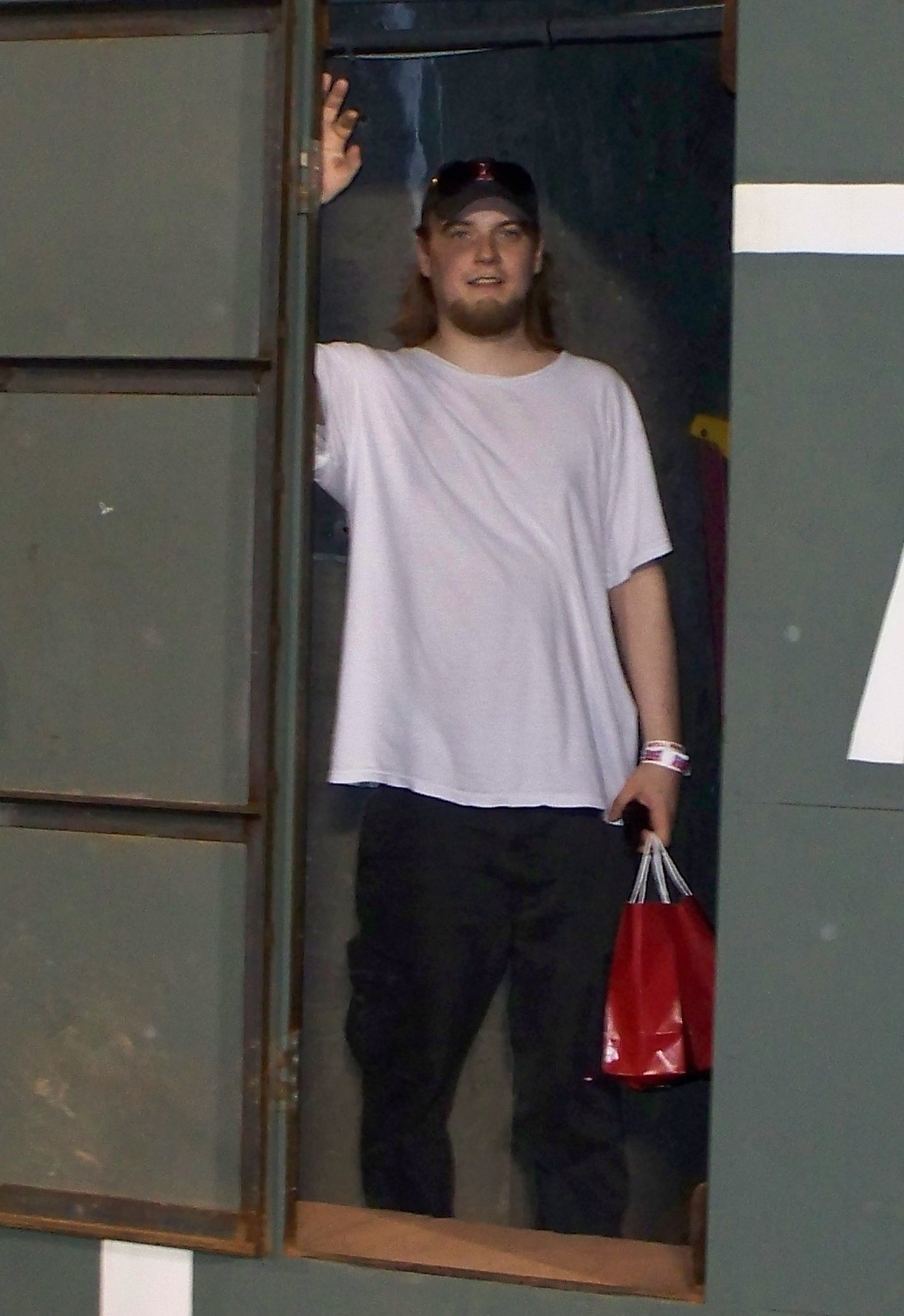
J.P. Freeman (photo courtesy of Freeman)

Q:  First off, please introduce yourself and tell us a little about who this J.P. Freeman guy is, where he’s been, and what he’s done.

A: Well, first off let me say I really appreciate this opportunity to say hello to the New England Horror Writers. I’ve never been too good at these types of things but I’ll give it my best shot. A little bit about me … I was born in Maine and I have lived here my whole life. I have always been interested in arts and entertainment. In high school I started to play around with music, joining multiple underground heavy metal bands. I continued down that path for a few years after high school until, I finally realized that it wasn’t something I wanted to do, or could do for that matter, for the rest of my life. I also knew that a regular nine to five [job] wouldn’t work for me. I needed a way to express my creative side. There were too many ideas locked in my head looking for a way to escape. So I picked up a pen and started to let them out. At that point I started to look into horror anthologies, hoping to get a few of my shorts published. I managed to get a few of them published, one of them being Suicide Man, which ended up being the seed that Things Better Left Unsaid sprouted from.

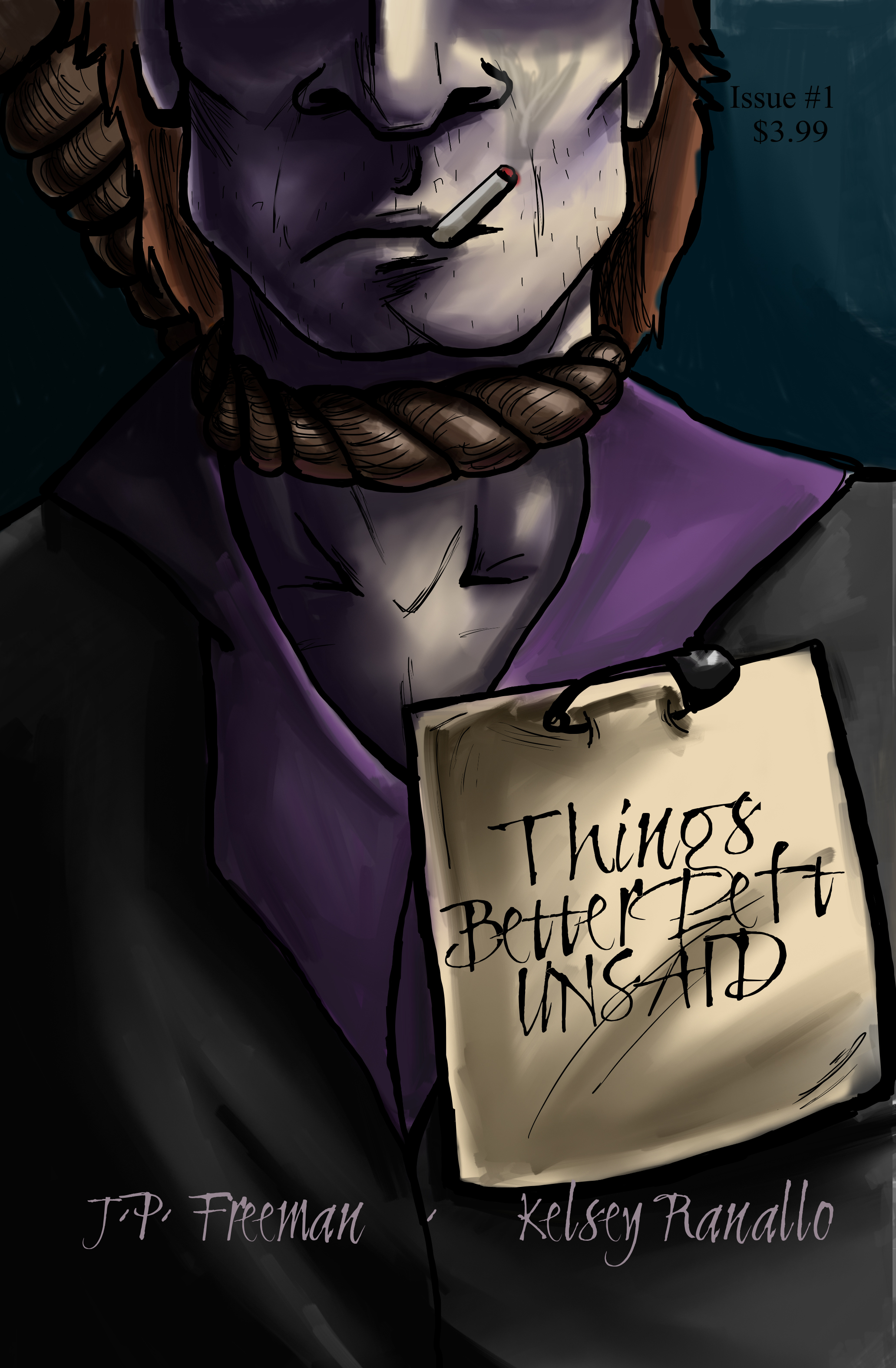
Things Better Left Unsaid cover (photo courtesy of J.P. Freeman)

Q:  What is the story and concept behind “Things Better Left Unsaid”?  Why the name change from Suicide Man to Things Better Left Unsaid?

A: Things Better Left Unsaid is the story of a man named, Dale Hicks. Dale is a man at the end of his rope. With nothing left to live for, he decides to end his miserable life. Only, things don’t go exactly as planned for Dale. He wakes finding himself in a strange place surrounded by strange people. Unable to find a way out Dale hits rock bottom. Just when things seem like they couldn’t get any worse, a chance encounter with a little girl turns Dale’s existence upside down.

Suicide Man is the name of the short story in which Things Better Left Unsaid is based, but the two stories are very different. I think when you pick up the first issue and see the first page you will see why Suicide Man was an easy first choice. In the end I just thought the comic should have a name of its own so I went with Things Better Left Unsaid.

Q:  Most obvious question, why did you choose the comic book medium for this tale?  Did Things Better Left Unsaid exist in any other more traditional formats prior to this decision?

A:  As I mentioned earlier, this was originally a short story I did called Suicide Man. I set out working on a collection of short stories and Suicide Man was the first or second story that I came up with. As I tried to move forward I kept thinking about how I could link these new stories to Suicide Man, or how I could have used these new ideas to make that story even stronger. So my collection of random short stories started to become a book of stories about the same group of characters and they all tied in at the end. There was just something about these people that kept calling to me to tell their tale. It started to seem like Dale didn’t want to die after all, like maybe he had a bigger purpose.  To me it seemed like a television show on paper more than a collection of short stories. Then I thought “man, this would be cool as a comic book.” I didn’t really think a comic book would be possible because I can’t draw all that well. So I put out an ad to see if I could find anyone that would be interested in illustrating for me. I got over a hundred applicants! I was pretty amazed by the response. I sat and looked through all the drawings people sent in and narrowed it down to a handful. After that I contacted the few that I was interested in working with and Kelsey Ranallo stood out among the applicants and I quickly signed her on as the artist for the comics.

Q:  Tell us a little something about the artist you have turning Things Better Left Unsaid into a work of visual art.

A: Her name is Kelsey Ranallo. She’s the best. I came into this project not knowing and proper terminology or specifications, nothing. She had to take the time to explain things as we went along (which I’m sure wasn’t fun for her) and keep me from losing my mind in the process. She had me script out my story into comic book pages and panels and describe in detail my character concepts. The next thing I knew the people in my head were coming to life on paper! That has been the coolest part for me, actually seeing my characters in action.

Q:  How many issues are you aiming for with this story?  What are the plans for it once it reaches its conclusion?

A: There are going to be 8 issues. Once they are all finished the series will be released as one graphic novel.

Q:  What’s the release schedule look like for this series?  What are your plans for getting your story out to the masses?  Any publishers or comic book imprints looking to scoop this up?

A: As of right now it looks to be quarterly. I hope to get them out faster but for right now that is the plan. The first issue will be out January 13th. Each issue will be twelve pages and the graphic novel will be 96 pages when completed. I plan to self release the comics via www.comixpress.com and I will be offering signed copies on my website at www.jpfreemanpresents.com. I am also looking into making it available in digital format but that will be down the road a little bit. So far I haven’t submitted it to any publishers, but if you know of anyone interested send them my way!

Q:  What’s next for J.P. Freeman?  Tell us about your plans after Things Better Left Unsaid?  If it’s successful, do you see yourself sticking with this medium or going back to a more traditional form of storytelling?

A: There are a few things in the works for me. I plan to continue writing short stories and to put out a collection of them in the near future. I would also love to sit down and write my first novel this year. If Things Better Left Unsaid catches on I would definitely like to continue writing comic books as well (as long as people want to read them). I am really enjoying working on a project with a continuing story arc.

Q:  Any advice for aspiring writers who want to challenge themselves and the status quo of genre fiction writing?

A: Even though it feels like everything has been done before, it’s important to come up with something original. Make sure to put your own little twist on anything you try to create. Don’t follow the rules of writing. Make your own rules and push the envelope. Be sure to write everything down. All your ideas, as small as they may seem at the time, may come in handy in the future. A lot of Things Better Left Unsaid came from bits and pieces of multiple stories and ideas fused together. Don’t ever completely scrap anything. That idea that seems terrible today might not seem so bad after all in the future. I can’t count the times I woke up in the night with a bit of a story stuck in my head. I sleep with a notebook next to me so I can jot down any ideas that come to me in slumber land. Also don’t show anyone what you’re working on until it’s finished. If you let someone close to you read a work in progress they may steer you in a direction you didn’t intend to go. Don’t let others corrupt your baby.

Q:  Anything else you want to tell us?  Advice?  Comments?  Shameless plugs?  Go for it!

A: I just hope everyone stops by and says hello on one of my sites or pages. I would really appreciate it if people would like my author page on Facebook, www.facebook.com/jpfreemanpresents and stop by my website at www.jpfreemanpresents.com. There will be links there for Things Better Left Unsaid as well as my other available projects. I enjoy interacting with other writers and fans so don’t be shy.

                                                                     ~

Doug Rinaldi is a member of the NEHW and a part of the publicity committee.

Jeers of a Clown: Exploring the Balancing Act of Black Humor Writing

This entry originally appeared on Adrienne Jones’s website.

Jeers of a Clown: Exploring the Balancing Act of Black Humor Writing

By Adrienne Jones

Back in college, a bunch of us got called into the dorm lounge one day to receive some bad news—one of our dorm mates had attempted suicide. He was fine, they were able to save him, but he wouldn’t be coming back to school. A terrible thing, of course. We all sat mournful and appropriately shocked at the news. Then my buddy Al asked the dorm director how this kid had…you know, done it. Turns out he’d taken an overdose of Sudafed.

I went into one of those inappropriate snicker fits, the kind that happen in church or in a meeting with your boss, where laughter is the worst option. I was weakened by it, sliding off the chair, unable to stop while the others stared on in horror, like I was a monster. Come ON! The guy tried to dry his sinuses to death.

Since I started publishing fiction, my brand of humor as been repeatedly called “dark” or “black,” which recently led to pondering the source. Does a dark sense of humor come from the viewpoint of an author, or does the world regularly present us with these scenarios that only a certain personality type recognizes as humorous? Is it the same thing? And where do we draw the line between dark humor and a simple lack of taste?

The late Roald Dahl considered this endlessly, as evidenced in this quote: “If a bucket of paint falls on a man’s head, that’s funny. If the bucket fractures his skull at the same time and kills him, that’s not funny, it’s tragic. And yet if a man falls into a sausage machine and is sold in the shop at so much a pound, that’s funny. It’s also tragic. So why is it funny? I don’t know, but what I do know is that somewhere within this very difficult area lies the secret of all black comedy.”

I think most will agree that Roald Dahl found that balance in his own work. I wonder if his was based purely on speculations, or if he too felt plagued with darkly humorous scenarios thrust before him in daily life. This reminds me of another incident that happened while I was skiing with a group of friends at Killington Mountain. We spotted a man with no arms, expertly swishing down a mogul field, and thought, “Wow. That is incredible.” There was nothing funny about it. We certainly weren’t juvenile and callous enough to laugh at a no-armed skier. We looked on in awe and admiration of his courage.

Yet two hours later we spotted the same man in the ski lodge, casually watching the television as he had lunch with a companion. My friend nudged me and signaled to the TV screen, on which played out the Black Knight scene from Monty Python and The Holy Grail. The knight continued to fight King Arthur even as both his arms had been hacked off by Arthur’s sword, jumping and kicking as fake blood gushed dramatically from his stumps. Dear God, I thought, why are you doing this to me? I mean, what are the odds of watching a no-armed man watching a comedy scene about a no-armed man? I don’t want to laugh at the no-armed skier! The universe is NOT playing fair.

There is a certain safety in laughing at such things in the realm of entertainment, and it would stand to reason that suspension of disbelief or the fiction buffer is the key. But there are just as many staunch haters of Monty Python’s brand of humor as there are fans. I’ve seen people come to blows over this topic. Which brings back the theory that dark humor is about viewpoint, in observer and creator alike.

Since I can’t dig up Roald Dahl and ask him, I participated in a discussion with some living writers of black humor about their life view and how it affects their writing. Author Aurelio O’Brien used to make his living on the big budget animated kiddie films, but crossed over to the dark side with his first novel Eve, a blackly humorous tale of genetic tampering gone awry in a dystopian future.

“For me, so much of life is observably funny and this automatically feeds my writing. When I was creating my all organic, genetically designed future, things like McDonald’s characters directly inspired me to go further than I might otherwise think to go…The little giggling McNuggets are really chunks of dead fowl flesh with cute little smiles carved into them. I find these kinds of things to be so twisted and humorous and odd. Most people don’t think about these characters beyond their surface appeal. So, when people tell me my Lick-n-Span© is gross, I think, is it really any grosser than having a hacked-up chicken giggle at you?”

I agree with O’Brien on this, most consumer icons are creepy. Like the Tidy Bowl man and Mr. Clean. Why is it always a little fantasy man helping the lonely housewife with her daily chores? Strange men coming up out of the floor and the toilet? And why does the housewife always keep them a secret from her husband? Notice the way Mr. Clean winks at her when hubby walks in? And what’s the actual purpose of that little hand guy from Hamburger Helper? What’s he really helping her with?

Speaking of sex and animation, most people know Gary K. Wolf as the creator of Disney’s Roger Rabbit, but he’s also a novelist, and one of the masters of dark humor. For Wolf, the humor definitely comes from a unique way of seeing the world, and is more second nature than calculated creativity.

“There’s something unfathomable about humor writers that compels them to look at a situation or a character, twist it, turn it, squeeze it, squash it until it’s a round peg that fits into a square hole and looks funny doing it,” says Wolf. “Good stand-up comedians have the same ability, taking everyday situations and making them funny. They do it verbally. Most of the humorous writers I know, me included, aren’t very funny in conversation. In fact, I’m so boring I could suck the laughs out of a hyena convention. However, give us a blank page and a pen, and we’ll have you in stitches. I’ve been applauded by editors, critics, and readers for the humor in my work. All well and good except they were talking about what I consider to be my serious work. What I’m saying is that there’s something perverse about the way I look at reality or, in the case of science fiction, unreality I see a situation, I make it funny. Can’t help it. Don’t do it intentionally. That’s just the way I write.”

Gary makes a good point here about stand-up comedians, which prompted me to speak with one of my favorite and darkest comedians, winner of the 2009 Boston Comedy Festival, Dave McDonough. Dave, who’s confessed to needing roughly 70 jokes written for a half-hour set, has a “serial killer on Valium” kind of delivery, and pushes the envelope with some wince-worthy jokes, but he’s booked solid most weeks, so the man has found his groove, and his audience.

“There is a balancing act but you can’t make everyone happy,” says McDonough. “I cross the line sometimes but that’s half the fun. I don’t have any material I draw the line at except Muslim jokes, because I need my head. I tell a Jesus Christ/abortion joke and a male-inmate rape joke that often get applause breaks, so there’s a way to make the darkest of topics palatable to the public. I’m nowhere near as dark or as crazy as the freak I play onstage, I’m really a positive, introverted person by nature who happens to believe that the world is coming to an end.”

So writers and entertainers alike seem to reiterate my previous theory, that black humor is a personality trait, an inherent point of view within the creative mind before the material ever reaches the page, or the stage. But in the spirit of point/counterpoint, I figured there had to be a dark humor writer who didn’t necessarily see the real world through gore-colored, Groucho Marx glasses. Someone calculating, a mere craftsman, crazy on the page but with a solid, normal worldview—author Jeff Strand.

If you’ve read Strand’s popular, horror/humor brand of fiction, you’re now scratching your head and saying, “Did she just call Jeff Strand normal?” Especially after reading excerpts like this one from his book Disposal, which shows off his talent for making gore and violence a casual affair.
“We’ll finish slicing up my husband’s body, then we’ll get rid of the chunks, then we’ll take a long shower, and then we’ll get some sleep–and no, you can’t spend the night–and then I’ll pay you.”

The reason I thought I’d get calculated normalcy from Jeff Strand obviously didn’t come from the content of his fiction. But having had many writing-craft related discussions with Strand, I always end up shaking my head at the logic he applies to the structure of writing, putting himself completely outside the whacky content in order to plot his scenes with almost mathematical precision. He’s like the Professor on Gilligan’s Island, fixing the radio while everyone else is running around throwing coconut cream pies.

But I was wrong. While Strand recognizes more conventional logic about the crux of black humor, in the end he too opts for the warped theory.
“We’re living in dark times, and one theory is that because it’s difficult to cope with or even comprehend some of the horrors around us, we use them for comedic effect to help us better deal with them,” says Strand. “Which is a good theory. But at the same time, I think most of us are just sickos. The college student who creates an elaborate online animation of The Puppy Blender isn’t doing it as a defense mechanism. We’re all warped!”

Though like Roald Dahl, Jeff finds himself balancing that delicate line between humor and bad taste. “If I can come up with a genuinely funny angle that’s more than just ‘Oooh! Look how tasteless I can be!’ then my only off-limits material would be specific real-life people suffering tragedies. Cancer itself is acceptable. A real-life person dying of cancer is not. I wouldn’t necessarily feel the need to make something funnier just because of the uncomfortable subject matter—it would just have to be handled in a way that justified the material.”

And so ends the cage match, the popular vote going to the theory that black-humor writers have an inherently twisted perspective, a real-life view of the world that powers the motor for creating the dark funnies. Limitations are applied when putting pen to page, balancing the scales of humor and darkness to make the mix palatable for human consumption. If the mix is just right, the audience will laugh. Or at least some of them. Because as all humor is in the eye of the beholder, it’s inevitable that part of the population will always stare slack-jawed, horrified as you giggle maniacally at the boy who tried to dry his sinuses to death.
The Pros of Publishing Short Stories on Amazon

This entry originally appeared on NEHW member Mark Edward Hall’s website.

The Pros of Publishing Short Stories on Amazon

by Mark Edward Hall

I get asked a lot, mostly by newbies, how I can make money by publishing .99 cent Ebooks on Amazon. First, my .99 cent books are all short stories. I make .35 on a short story that would otherwise be lost in my computer forever. I have twelve of my shorts out there now with more to come and it actually amounts to a tidy bit of extra income each quarter. Most all of my shorts have been previously published, so anything I make on them now is a bonus and welcome extra income. By the way, I also publish these same stories on Smashwords and Barnes & Noble.

All my novel-length works are 2.99 or above. On Amazon you receive 70% of anything priced above 2.99. On a 2.99 Ebook I receive 2.05. Not too bad when you consider that the stuff I have with a publisher (three books to be exact) only nets me 17.5% of list. The publisher likes to word it as 40% of net, which doesn’t sound too bad when you sign the contract, but in reality it figures to just about 17.5% of the purchase price.

I’m not here to trumpet the virtues of independent publishing over legacy publishing, although I might do that in a future post. Writers have to make up their own minds about what’s best for them. I only know what works best for me. I have two new novels coming early next year and I can tell you this, they will both be independent books. I hire my own editor, commission the cover art from some very good artists, and I’m pretty good at doing the formatting. (Better than my publisher actually) So when you take into consideration the profit difference between doing it yourself and putting it in the hands of a publisher it seems like a no-brainer to me. I wish I’d thought that way years ago.

By the way, I also offer some of those same .99 cent short stories as a collection entitled, Servants of Darkness, for $2.99. Readers who want to sample my work can buy a .99 cent short and if they like what they read they can buy an entire collection for 2.99. In this digital age I think writers are nuts if they don’t use every opportunity available to them.

Also, I am in the process of offering all of those same short stories on my website for free. Yes, you heard me right, FREE! If someone wants to save the .99 cent kindle fee and doesn’t mind reading on the computer, they can read my short stories without paying anything. Maybe I’m nuts but I believe it’s the right thing to do.

But to answer the original question: How can you make money by publishing .99 cent Ebooks on Amazon? Just ask John Locke. If you’re a writer and you haven’t yet heard of John Locke, then you’ve been living under a rock. John Locke writes the Donovan Creed book series and he prices all his novel-length books at .99 cents. He sold a million of them in five months and they’re selling at the rate of one every seventeen seconds.

In summary I think the future is very bright for those writers who have the courage to be creative.

———

Mark Edward Hall has worked at a variety of professions including hunting and fishing guide, owner of a recording studio, singer/songwriter in a multitude of rock n’ roll bands. He has also worked in the aerospace industry on a variety of projects including the space shuttle and the Viking Project, the first Mars lander, of which the project manager was one of his idols: Carl Sagan. He went to grammar school in Durham, Maine with Stephen King, and in the 1990s decided to get serious with his own desire to write fiction. His first short story, Bug Shot was published in 1995. His critically acclaimed supernatural thriller, The Lost Village was published in 2003. Since then he has published five books and more than fifty short stories. His new novel, a thriller entitled Apocalypse Island is due out in early 2012.

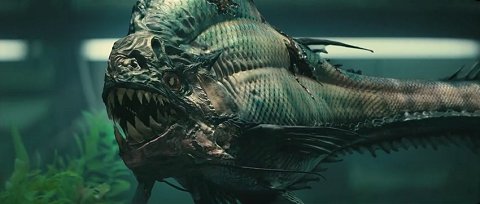
‘Piranha 3DD’ One Fin Closer to Going Straight to DVD

This article originally appeared on the Film School Rejects website.

‘Piranha 3DD’ One Fin Closer to Going Straight to DVD

by Nathan Adams

The 3D reboot of Piranha from 2010 was one of my favorite movies of that year. And I don’t usually much like horror stuff, especially winky, self-aware horror parody: that means they did something very right. So word of a followup should have been great news. But as soon as Piranha 3DD was announced as re-teaming the creative team behind the Project Greenlight winning horror film Feast rather than re-teaming the creative team that already worked so well together on a Piranha movie, director Alexandre Aja and writers Pete Goldfinger & Josh Stolberg, I was dubious.

The next hint that this movie wasn’t going to turn out so great came in October, when Piranha 3DD was scrapped from having its planned November 2011 release and was instead marked with the ominous “sometime in 2012” release date instead. It was starting to look like the writing was on the wall, that Dimension didn’t have much faith in the film and that it was now residing in limbo, probably until an eventual straight to home video release.

Well, it looks like the next step toward making that doomed future a reality has happened. It’s looking like the UK has now become the first market to scrap a theatrical release plan for Piranha 3DD in favor of dumping it onto disc. According to the British Video Association website, March 19th is the day it will happen. Unless this is a mistake by the BVA site, this means that not very many people will be seeing the movie in the UK, and almost no one will be seeing it in its intended 3D format. Also, once copies of this thing start floating around due to the UK release, it’s probably going to be a lot less likely that anyone is going to bother showing this thing in a theater in the States or anywhere else; if there were still any plans to make that happen at all.

This can only be seen as bad news for Feast fans, and fans of 3D boobs and gore in general. But, as a fan of the 2010 Piranha specifically, I kind of see it as just desserts. This is what you get when you try to keep a franchise going without bringing back the people who made the magic happen. Let that be a lesson to you, purveyors of filth. [via Bloody Disgusting]

Interview: Joining Trent Zelazny on the Dark Side of Fiction

This interview originally appeared on NEHW member Erin Underwood’s blog.

Interview: Joining Trent Zelazny on the Dark Side of Fiction

by Erin Underwood

You might have seen him around. His name is Zelazny. Trent Zelazny. If you read dark fiction he’s someone you want to know, or more to the point, he’s a writer that you want to read. Some people write from the heart, but Trent Zelazny leaves his blood on the page, creating fiction that feels like you’re living an experience while tucked safely in your own cozy home. He is definitely making his mark, writing some terrific pieces–most of which have just been published this year.

Perhaps one of the most impressive things about Trent Zelazny is his ability to keep moving despite the obstacles thrown in his path. Troubles aside, Trent had continued to produce some excellent heart pounding stories that are likely to worm their way into your “To Be Read” pile until you’ve got nothing left from him to read–at which point you will join the rest of us who are waiting for more. Luckily, he’s agreed to give Underwords an interview so that we have a little something to tide us over for now.

~

Drummer. Writer. Movie buff. How would you describe that guy people call Trent Zelazny?

Reserved. A bit neurotic. Still healing. My life has taken a lot of twists and turns. 2009 and 2010 were both pretty much one big downward spiral, filled with alcohol and the death of my fiancée, bouncing aimlessly around Florida, staying in flophouses and some nights on the street. Thankfully, with the help of family and friends, I was able to pull out of it. The 2011, the new Model T is a vast improvement, though it still clinks and clanks when it runs.

What can readers expect when they pick up your newest publication Destination Unknown?

Hopefully a story with characters they can relate to. Hopefully it’s exciting to them, too. A far-fetched scenario but one that, I think, is quite plausible, even moreso possible. To me it asks the question: Can you stick together if you’ve already fallen apart?

What literary (or other) influences have been the most powerful on your development as a writer?

Horror was the big one at the start. Matheson, Bloch, King, Koontz. Over time this evolved into crime and mystery, especially the old pulps from the 40s and 50s, and Film Noir. And not to come off as pretentious, but you have to sound pretentious when you use the word, existentialism, especially Sartre and Kierkegaard. The best mentor I’ve had is Jane Lindskold. I seriously doubt I’d be as far along as I am without her. I’ve kind of let that friendship slip away, and deeply regret that, knowing it’s mostly my doing.

Your fiction is a mixture of horror, noir, crime, and comedy in varying degrees. As a writer or reader, what attracts you most to this combination of literary genres?

It would be more as a reader than a writer, I think. They are typically my favorite things to read, so I guess it would make sense that they’re the things that come through most when I write. Dave Barry and Donald Westlake can make me laugh so hard that I practically wet my pants. Joe Lansdale has the mind-boggling talent to frighten you, make you cringe, and laugh out loud, all at the same time. I also really love heavy drama. Judith Guest’s Ordinary People was and is a personal favorite, as is the movie. I’d love to be able to write something like that one day.

You’ve worked with a variety of the darker genres, but haven’t touched much on the fantastic. Since fantasy and horror often go hand in hand, do you think you’ll explore this combination of these genres?

I have a little. When I was younger I wrote a lot of fantasy and some science fiction. As time went on, however, I found that, overall, I just wasn’t very good at it. I think, with my father being who he was, I kind of thought that that’s what I was supposed to be doing. I have fantastical elements in pieces, usually dark. The book I’m working on now has a big supernatural subplot, and I have a sort of fantastical story coming out in the anthology Fantastic Stories of the Imagination. I try to let the story tell me what it is. Often not, but at times it waves its arms and says, “Hey, there’s some fantasy in this one.”

What story or scene has been the most challenging for you to write or pushed you the furthest outside of your comfort zone?

The book I’m working on has done that a good amount. Fractal Despondency would likely be the biggest so far, I think. Semi-autobiographical. My fiancée had only been dead four or five months when I wrote it.

[sample chapter of Fractal Despondency]

If you had one chance to ask anyone (alive or dead/real or fictional) one question, what question would you ask? Why that question?

At the moment of this interview, it would probably be Kierkegaard. I’d wanna ask him why the hell he had to say “Life can only be understood backwards; but it must be lived forwards.” Because it is one of the truest things I’ve ever heard and, to me, it’s not an all-together pleasant thought.

In an interview with Darrel Schweitzer for Fantasy Magazine in which you were answering a question about your father’s (award winning author Roger Zelazny) influence on your writing, you said, “He gave advice and helped with certain must-knows, but he always encouraged individuality.” Looking back, how has that encouragement helped to shape your fiction into what it is today?

Well, it almost contradicts what I said above about feeling like writing fantasy was what I should be doing. Last thing he ever wanted was to turn anyone into a literary clone of himself. I have an older brother and a younger sister—I’m the Jan Brady. Whatever any of us took interest in, he encouraged. He encouraged my music, my writing, my drawing. Anything I seemed to take a real interest in. He wasn’t a cheerleader, but an encourager. I’m pretty sure he did that with my brother and sister as well. When he saw that I was gravitating more and more towards writing, we’d sit in his office and talk about it. He rattled off a few things that every writer should probably read (Shakespeare, for example) but otherwise told me more about fundamentals. He used favorite books of his as examples (Alfred Bester’s The Demolished Man, which is an amazing book, comes to mind), but he never told me I had to read them. He wanted me to find my own way.

In another interview that you did with Gabrielle Faust, part of your advice to new writers was not to be afraid to write something unpublishable. Why do you think this is so important?

This is often where writer’s block comes in, I think. Not that the words won’t come, but more a fear that the words will be bad, or wrong, and this will somehow, in some way, confirm that you don’t have what it takes. That you’re not a real writer. I still write stories that are beyond help. Am I let down when I finish? Yes. Am I glad that I wrote it? Yes. It’s a little like blowing your nose, clearing the gunk and crap out so you can breathe, and sometimes you’re really stuffed up. You may have to go through an entire box of tissues, but eventually you’ll breathe better, and you’ll be glad you got rid of all that snot.

Within the last year you have published a solid stream of fiction. What are you working on next?

    • Destination Unknown – print & e-book (Dec 2011)
    • “Snow Blind” in Stupefying Stories – e-book (Dec 2011)
    • A Crack in Melancholy Time – e-book (Sept 2011)
    • Shadowboxer – e-book (Aug 2011)
    • To Sleep Gently – e-book (Aug 2011),
    • A story in Kizuna [Fiction for Japan] – print & e-book (Aug 2011)
    • Fractal Despondency – e-book (Apr 2011), print (Jun 2011)
    • The Day the Leash Gave Way and Other Stories – print (Aug 2010)

Currently working on a new novel, as well as a short novelette for a shared world anthology, and a project I’m not allowed to discuss (tease, I know). I’m sure a short story or two will pop up soon enough. With 2009-2010 being what they were, I was at least blessed this year with a bit more publishing success.

~

Trent Zelazny is the author of Destination Unknown, To Sleep Gently, Fractal Despondency, Shadowboxer, The Day the Leash Gave Way and Other Stories, and A Crack in Melancholy Time. He was born in Santa Fe, New Mexico. He has lived in California, Oregon, Arizona, and Florida. He currently roams throughout the country aimlessly. He also loves basketball. You can visit Trent on Facebook, Twitter, and on his website.

Author Promotes His Book and Some Blogs

Author Promotes His Book and Some Blogs

by Jason Harris

The New Year is here. Have you started doing your New Year’s resolution or has it already fallen to the wayside? If you are still struggling with staying with your resolution then here is a link to an article on the Tipb website mentioning a few apps like Evernote and Weight Watchers mobile to help with those resolutions.

If you are looking for blogs to follow as one of your resolutions, NEHW member Rob Watts has a few suggestions of blogs to follow in an entry on his site. One of those suggestions is this site. I do thank him for the mention.

Recently, Watts was on the Sci-fi Saturday Night program discussing his book Huldufolk, Iceland, Cedar Grove and his Traffic Lights Soundtrack album.

His novel, Huldufolk, is a horror story set in both Iceland and Massachusetts and was published by Ocean View Press. According to the program’s website, Watts is also “a musician and songwriter for The Traffic Lights, an Icelandic Trance band whose music is integral to the book.”

You can download the podcast here: http://www.scifisaturdaynight.com/?p=5273.

Watts has also written album reviews and conducted interviews with musicians which can be found on the Ocean View Press website.

Author’s First Novel Being Rereleased by Evil Jester Press

Author’s First Novel Being Rereleased by Evil Jester Press
by Jason Harris

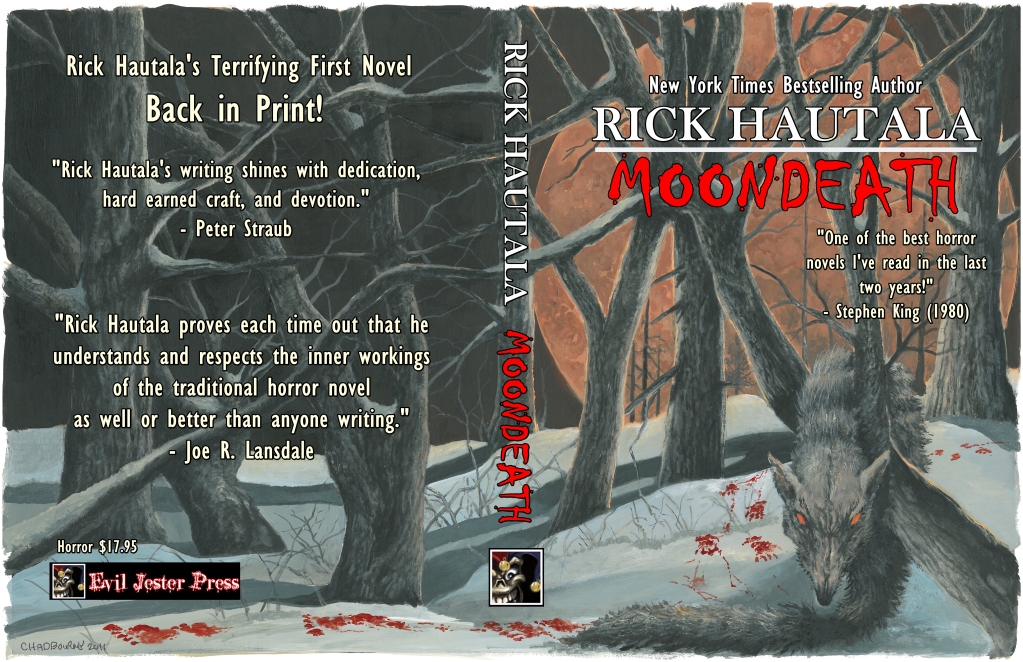
NEHW member Rick Hautula’s classic horror novel, Moondeath, is being rereleased by Evil Jester Press on Jan. 2. Publisher Charles Day said the novel has a new cover by “renown artist” Glen Chadbourne and the introduction was written by Christopher Golden.

Evil Jester Press’s Executive Editor Peter Giglio said on the Goodreads’ website that this was Hautala’s first book and was originally published in 1980. Moondeath is a werewolf and witchcraft tale set in Cooper Falls, New Hampshire, a small New England town, he said.

Stephen King said in 1980 that Hautala’s novel was “One of the best horror novels I’ve read in the last two years!,” Giglio said on Goodreads.

Click on Amazon to order the book.

Click on Evil Jester Press for more information about them and their books.