A Hard Pen is Good to Find

A Hard Pen is Good to Find

by Bracken MacLeod

I indulge a couple of writerly affectations that do nothing to improve the quality or prolificacy of my writing. Still, they stimulate some reptilian aspect of my neurology that compels me to maintain their use. For example, I take abundant notes about random facts and story ideas in a Moleskine notebook. Even though there are cheaper notebooks out there and its entire function is made redundant by smartphone apps like Evernote, I love the feeling of the small leather hardbound book in my hands. I love the (probably contrived) history of it. And I love belonging to the subculture of people who modify and use them. But the sensual experience of the notebook is limited by the quality of the pen one uses to write in it.

My former profession required constant note-taking and I found that writing with cheap pens resulted in hand cramps and near constant frustration at their lack of both comfort and style. As a result, I switched to a semi-expensive fountain pen in the hope that A) the necessity of finesse in its use would result in less white-knuckle writing (and the attendant cramping), and B) its elegance would satisfy that part of me that seeks sensuality in small experiences. It did both. Sadly though, my pen required regular upkeep as the nibs would wear out with the kind of punishing use to which I put them. Despite that inconvenience, I gained an appreciation for writing with a precision pen. The feeling of taking hand-written notes is enhanced by using a pen designed for performance and comfort.

There is a certain amount of anxiety inherent in carrying a fountain pen around in one’s shirt or pants pocket (or even in a bag), however, as they can and do occasionally leak. I’ve been the victim of more than one unintended ink emission and it had convinced me that, despite the pleasure of writing with one, the hazard of a Deeptrouser Horizon spill was too much for me to bear. As luck would have it, the twin burdens of maintenance and betrayal were about to be lifted from my shoulders as the Great God Pen smiled down and blessed me with his inky munificence.

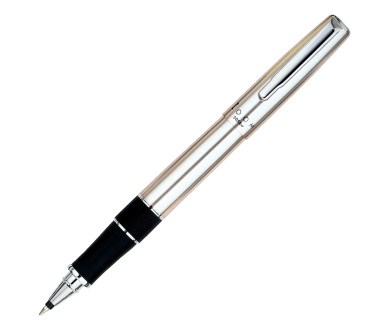
Tombow Ultra rollerball pen

One afternoon, as I was exiting a Barnes & Noble, I noticed a shiny beacon signaling me from a nearby bush. There I found a beautifully unadorned brushed chrome pen. Picking it up, the first thing I noticed was its weight. It had a pleasant heft and solidity that appealed to me. It was heavy–not a disposable thing, but significant–a potential weapon as well as a tool of creation. Not thinking that this was probably a moderately expensive pen that I should turn in to lost and found (thank you, greedy subconscious denial) I slipped my newly acquired Tombow Ultra rollerball pen into my pocket. An hour or so later I found myself presented with the opportunity to try it out. As I passed a horse trailer with a flat tire, a story title occurred to me and I desperately needed to record it before my capricious mental states robbed me of inspiration. I pulled over to the side of the road, opened my notebook, and set about writing down the two brilliant words that, once paired on paper, would open the flood-gates of further creative stimulation.

As ink slipped from pen onto paper, a jolt of exultation hit me like a liter of dopamine splashed in my face. The creative power of my stolen found pen flowed like Omar Khayyám’s proverbial moving finger. As the words took shape on the paper, I trembled in anticipation of their profound meaning awakening the Muse and sending me into a fury of automatic writing that would result in my literary magnum opus. I became one with the pen, feeling snug and comforted inside a brushed-chrome womb, floating in the black amniotic fluid of artistic creation. Drawing a final line beneath the words for emphasis, I slipped out of my trance. Holding my breath, I peered down at the title heralding my inevitable Stoker Award.

Corpse Rodeo

Oh well. It’s still better than writing with a Bic.

Heads Up!

Heads Up!

by K. Allen Wood

If you’re an author with access to the Internet, you’ve undoubtedly been bombarded recently by other authors peddling their books or stories. We’ve all been exposed to this before, but until the past year or so most self-promotion from authors was done in a classier, more respectful manner.

Some still operate that way (and we’re grateful), but others have taken it to a whole new level.

I won’t sit here and tell anyone they shouldn’t promote their work or the work of their friends or authors they enjoy, but I will explain what typically happens on my end when authors do it incessantly.

What’s that smell?

If you follow me on Twitter, I will likely follow you. If you do nothing but post links to your book or books, I will block you and vow to never read your work.

If I connect with you on LinkedIn and you immediately send me a message or an e-mail telling me to check out your book on Amazon, I will “disconnect” from you and vow to never read your book—especially when, as happened yesterday and thus prompted this post, I sample it and there is a mistake three words in. No, thank you!

If we’re friends on Facebook and I’ve “liked” your author page—which is the page I expect to see writing updates generate from—and you go and post daily the same goddamn updates on your personal page, your author page, and every writing-related group you and I (sadly) belong to, even those that are not meant for such updates, I will block your updates, vow to never read your work, and find you to be a total wackadouche.

If you constantly post 5-star reviews on Amazon and then share those overblown, unhelpful reviews loaded with WHIZBANGPOW! adjectives and vague clichés like “it gripped me from the first word and didn’t let go until the last”—which are obviously meant to A) kiss the (undoubtedly more popular) author’s ass, B) hide the fact that you didn’t actually read what you reviewed, and C) use his or her book as a piggyback to your own shitty book or books—I won’t believe a word you’re saying and more than likely will never read that author’s book because your word can’t be trusted.

(That’s right, an absurd run-on sentence in a post where I criticize bad writing. Got a problem with that?)

The fact is, you’re not helping anyone, especially yourself. Most of us promote our work in some regard, but some of you are OUT OF FUCKING CONTROL! I won’t begrudge you your rights to be that way—that pushy, lying kind of self-promoter. You’ll surely fool a lot of dummies out there. But I won’t support you. And worse, I’ll find it very hard to support those other authors that are unlucky enough to be promoted by you. They’re the innocent bystanders in this whole thing. And some are probably damn fine writers, which is a shame.

In the grand scheme of things, the big picture, this post is just one insignificant opinion from a relatively insignificant dude … but rest assured, I’m not the only one with this opinion.

So do as you will, but remember this: You can’t push or lie your way to the top. You can push and lie your way to a top, sure, but it’s most definitely not the top.

Editor’s Note:

This blog entry originally appeared on K. Allen Wood’s website.

Book Marketing Resources and Tools for Authors

Book Marketing Resources and Tools for Authors

By  

Jim Kukral has started up a free service for fiction and non-fiction authors called the Author Marketing Club.

Author Marketing Club

Author Marketing Club is a community of authors who are going through the same pains and successes, and who want to work together to help one other learn how to promote their books.

We just recently published a Kindle edition of Internet Marketing from the Real Experts, and from that experience I can say Jim is providing really useful tools and resources for anybody interested in publishing.

One of the useful resources available is a video, How To Upload Your Book To Amazon. You should really watch that if you want to publish to the Kindle.

More details at authormarketingclub.com.

Editor’s Note:

This article originally appeared on Shawn Collins’ website.

A Promise of Violence

VOYANTS: The Promise of Violence in Seeing and Being Seen

by Bracken MacLeod

What I apprehend immediately when I hear the branches crackling behind me is not that there is someone there; it is that I am vulnerable, that I have a body which can be hurt, that I occupy a place and that I cannot in any case escape from the space in which I am without defense—in short, that I am seen. – Jean-Paul Sartre, Being and Nothingness

________________________________________________

Every story I read or write involves a promise. It is the pledge that an author makes to the audience that they will be rewarded for their faith in the story. In romance, the promise is love. Mysteries guarantee the satisfaction of the unraveling of a puzzle. In horror, the promise that the writer makes to the reader is the he or she will evoke fear.

I understand the attraction of “subtle” and “atmospheric” tales; well done (and how I love them when they’re well done), they can produce a wholly satisfying sense of fearful dread. But I’d also say that even in atmospheric horror, the dread the reader feels is the result of the promise of what is being subtly revealed. And that pledge is exactly the same as it is for extreme horror. The deepest root of fear is the threat of violence. Just because someone doesn’t have whip welts on their back don’t think there hasn’t been violence. That is to say, all horror assures violence of some kind: physical, psychological, spiritual, etc. Without it, what have you got? A ghost isn’t scary merely because it is a ghost. Neither is a man holding a knife. Both must offer something to the reader to evoke fear.

To expand on an example given by Alfred Hitchcock, a bomb underneath a table is more terrifying if the people in the café carry on their conversations unaware of its presence while we, the viewers, know it is there. But the bomb is only frightening in the first place if three conditions are met. First, we must understand the underlying concept of a bomb. Since most of us possess an understanding of a bomb’s only purpose (destruction), we can leap into the conceptual future and imagine the result of the ticking timer reaching zero. The second condition is the story-teller’s willingness to make us believe that the device might actually go off. If we know the bomb’s a dud or the hero will always defuse it at the last second, it is simply not scary. Finally, and most importantly, is our ability to put ourselves in the place of people in that setting—to be present at the table with violence and death. Fear exists is the moment of transformation from the known to the lived—bridging the gulf between academically understanding danger exists and being in danger. Thus, the sine qua non of good horror, as I see it, is the transformation of the reader from subject (i.e., conscious observer) to object (i.e., victim).

In a horror story we want the babysitter to hide because we are vicariously experiencing events from her perspective.[1] As long as she remains an observer hidden from view behind slatted closet doors, the tension dissipates and we relax. Until she is discovered. The scariest scene to me in John Carpenter’s Halloween (to stray again from the written word for a moment) is when Laurie Strode believes she has defeated the Shape and collapses in the doorway of the bedroom from which she has just escaped. Behind her, perfectly silent, Michael Myers sits up and turns his head toward her … and keeps going all the way toward us. In this subtle breaking of the fourth wall, Carpenter assures us that being seen is the onset of violence.

Halloween

Let me give a more concrete example. My wife and I are what I like to call shoe-leather tourists. That is, we like to see the cities we visit on foot, moving between neighborhoods without mediating our experience from behind the barrier of a cab or a rental car window. On a trip several years ago to Salvador, Bahia (Brazil), however, we were told that we could we not walk the neighborhoods between the hotel and the historic district without endangering ourselves. The hotel concierge assured us also, once at our destination, that we should stay on the main thoroughfares. As long as we could see shop signs, he explained, we were reasonably safe. Wander down a side street, however, and we would again be taking unnecessary risks with our well-being.

Taking his advice, we stuck to the main streets. But it is impossible to move in a city without at least passing those side streets. And it’s just as impossible (for us, anyway) not to look up them, curious what wonders or terrors await. Passing by a narrow alley in Cidade Alta, the Upper City, we paused. Half way down the alley, three men vigorously kicked and beat a fourth who lay motionless on the ground. It was a sobering experience until one of the men administering the thrashing looked up from the object of his wrath and made eye contact with me. Then the promise was made and it became a terrifying experience as I became an object in the gaze of another.[2]

Reflecting upon that moment, I came to understand in a visceral way (the known becoming the lived) the existential horror of a shift of perception. Years later and thousands of miles away, those men are still present with me. I’d had a direct experience dreading the shifting gaze of The Other. What was scariest about Salvador wasn’t its reputation for violence, but rather the actual in-context promise of it. The difference between being and not being a body in an alley for me was merely a matter of shifting observations and the promise of what may follow upon.

That experience, has helped me truly understand the blurring of lines between the observer and the observed and between voyeurism and engagement. Emotional and psychological detachment from someone else’s suffering—what Michel Foucault would call the “medical gaze,” the dehumanizing separation of the patient’s body from the patient’s identity—is anathema to good story telling and the frequent problem with all bad story-telling, extreme or atmospheric horror or in between. The beating heart of fear is found at the point where the wall between knowing and experiencing comes crashing down, leaving the observer exposed.

And it all begins with a look. I promise.


[1] The observer who identifies with the monster is either missing the point or is in it for a different kind of titillation.

[2] To finish the tale, we fled and found a sympathetic policeman with a smattering of English (not an easy task on either count) as quickly as we could, doing our best to describe what we saw and where we saw it before going on with our vacation.

Marketing and E-Publishing Advice from the NEHW Co-Chair

If you don’t know how to publish your story or novel as an e-book on Barnes and Noble, NEHW Co-Chair Tracy L. Carbone has written a blog entry on her website explaining how she did it. You can read it here. At the moment, this is the first entry on her site so it is at the top of the page.

She also has another entry, “How to Waste Money on Marketing,” which you will have to scroll down the page to find. It’s worth the time to search for it. It will save you money.

10 Crucial Proofreading Tips

Here is an interesting blog post by Randall Davidson about “10 Crucial Proofreading Tips” that I can’t wait to try out. Here is the link to the post,

http://workingwritersandbloggers.com/2011/08/04/10-crucial-proofreading-tips/.

By dudley228 Posted in Advice

Just Learn How To Do It Yourself

Just Learn How To Do It Yourself

by Rob Watts

Remember the old sayings “If you want something done right, you have to do it yourself” and “don’t pay someone to do something that you can do on your own?” Well those sayings are especially true when it comes to authors in today’s rapidly changing publishing climate. In this ever-expanding technology age that we’re living in, it almost seems senseless to me to even bother seeking out a publishing company to release our work. With all the resources readily available to us, there is no reason to take 100 percent control of the work you slaved over. After all, you gave up your free evenings and weekends, missed out on get-togethers with friends, perhaps broke up with girlfriends/boyfriends, wives/husbands in order to express your inner-workings on pages upon pages of your masterpiece. Why turn it over to anyone (except perhaps Random House or Harper Collins) when you can do a far better job at it? Of course, you might be working with a traditional publisher at the moment and could be perfectly happy with them. That’s awesome. If you’re not happy, read on.

I understand the appeal of seeing your name in print within a book which was released by a “publishing company” but I must point out that what most of these small presses are doing is profiting on your work while you get the short end of the stick. What the small genre presses do, between performing a half-assed editing job, hiring their buddy to do the cover art, printing copies and posting it to Amazon is the same thing you can do, only you can do a better job and guess what? You profit from the book sales, not them. By the way, just placing a book on Amazon and having it “listed” on B&N doesn’t count as full book distribution. Many small presses seem to think that’s the case but trust me, it’s not. Again, that’s something you can do yourself. Also, be cautious of publishers of anthologies. Or more to the point anthology mills. These are publishers who have very little credibility but they are seeking credibility by bulking up their publishing credits by churning out crappy collections one after another. They accept short stories from unsuspecting authors and give them very little in return, if anything at all. I’ve seen them all before, the editing is poor, the selection process is questionable, there is hardly any kind of distribution efforts and almost all the time, the publisher of that said anthology conveniently has their story included within the collection. Of course not all anthology publishers are sinister. But it’s like anything in life, for every pile of coal you stumble upon, you have to search hard for the diamonds.

If I can pull the curtain away from the wizard for just one moment, I’d like to point out that 99 out of 100 authors have the dreaded day job to contend with (even ones that you think have it made.) None of us by any means are rich and famous due simply to our writing craft (I can’t stand it when writers act as if they make their living off their books.) But even if we don’t find immediate fame and success with our writing, we shouldn’t be taken advantage of along the way from point A to point B. Having your work published under the imprint of anyone (other than the last of the big six publishing companies) is only costing you money in the long run. Unless of course you don’t mind only being paid in the form of one author/contributor copy and maybe if you’re lucky, a few pennies for every copy sold. As I mentioned above, you put the time into it and agonized over your story. Isn’t it worth a little more time to learn the new-school methods of independent publishing? Even though there are some reputable and highly regarded small presses out there, unfortunately for every one of those there are a thousand hucksters who will rip you off, devalue your work and never lose an ounce of sleep while doing it.

As I write this, there is an unsettling amount of bad word-of-mouth over an unfortunate non-fictional character named Anthony Giangregorio. He is the owner of Open Casket Press and Undead Press and has allegedly taken advantage of newcomers to the publishing world by way of mistreatment, misrepresentation, broken promises, less-than-crafty editing tactics and poor royalty delivery. I won’t dwell on that but it does illustrate my point immensely that you have to be careful and protect yourself from these sort of people.

Which brings me to my original point. Take a bigger chance on yourself and give your work the attention it deserves. It’s not that hard to create your own imprint to publish under. I’ve been doing it for years and quite frankly, I’m not interested in turning my work over to anyone for peanuts just to pad my bibliography resume’. My work is too valuable to me and every word I write means something. That’s not egotistical, it’s simply how I feel about something that I spend my free time doing. It should be just as important to you to not throw your work on just anyone’s lap. I had the misfortune of working with a couple of small traditional publishers in the 90s who in all seriousness left me with nothing but my underwear. I was intent on avoiding that experience again and decided to cut out the middleman by creating my own company to publish under. Self-publishing (or independent publishing) is no longer a dirty word. Just ask a very talented Canadian author named Cheryl Kaye-Tardif who recently self-published Children of the Fog last fall and has thus far made $47,000 in book sales from Kindle alone. Her print edition sales have been rather spectacular as well. Independent authors, with a little research and patience, can achieve greater heights more than ever in today’s consumer age. Without giving a seminar on the subject, I’ll just share with you a handful of things to keep in mind when setting out to go it alone. They seem like no-brainers but believe me, I’ve seen people crash and burn because they were lazy about self-publishing.

1- A catchy company name. Not one that screams self publisher. If your name is Joe Schmoe, don’t call your company Joe Schmoe Publishing. Perhaps come up with a name that revolves around your subject matter or genre. Be sure to register a dot-com site (avoid dot net if possible) for the company as well. Don’t rely on the freebie sites. look professional. be professional. Make sure that your website looks occupied. Keep it updated so a visitor doesn’t think you’ve abandoned ship. Especially if you are selling books from your site. Make it inviting looking so a potential customer isn’t afraid to click that Pay Now button. One more thing, don’t clutter your pages up with unnecessary nonsense. Keep it clean and simple. Less is more. More is a bore.

2- Kindle and Nook are great supplements, but you’ll want print copies of your work if you are releasing a full-length novel, etc. After all, no one ever said “when I grow up, I want to be a writer and see my name in print on a digital e-reader.” Research a quality printer. Find one that will print small runs of 50 to 100 copies per order. Yes, it’s a little costly to pay upfront for your books, but if you truly believe in your work, you will invest the time and energy it takes to sell books and recoup your initial investment. When you need reprints, they will be far less expensive because the layout, design and initial process has been done already. Usually you can find a printer who will print your books anywhere between 3.20-4.75 per unit. If you price your book (depending on size) between $10.00-$20.00, well you’ve made a nice profit for yourself. That’s much better than getting .73 cents per copy from a blood sucking publisher.

3- How much of a profit you make on the sale of each book depends on where you are selling it. There are several avenues one can take. Amazon, of course, is the first logical choice, especially with the advent of CreateSpace. I know I listed a success story above regarding Amazon and Kindle but I must point out that you simply cannot rely on the click and publish websites as your only source of bookselling. The chances of someone buying Stephen King’s new book and then seeing Joe Schmoe in the “People Who Bought Stephen King also bought Joe Schmoe” section are slim to none (and slim just left town.) Amazon and Barnes & Noble take a hefty cut from the sale of your (print) book so it’s worth it to get creative on how and where you sell your books. How well you promote yourself and your work is a large factor too. Ask yourself, has your publisher promoted you or your work to the best of their ability or to your liking? Probably not. Can you do a much better job? Probably yes. By the way, if you’re fortunate enough to have someone land on YOUR website, why would you want them to click a link that directs them to another site (such as Amazon?) You’ve got them so keep them. let them buy directly from you and while they are there, perhaps they will sign up for your newsletters, follow you on your social networking sites, etc. Don’t turn your book buying audience over to the corporate monsters if you don’t have to.

4- If you are going to maintain and control your inventory of books, as I do (I buy my inventory up front and control where, when and how it’s sold) then right off the bat you’ll want to make sure your website is e-commerce ready. If not, set up a PayPal account. It’s a simple process and you can cut and paste your checkout buttons right onto your site. Everyone uses PayPal today so when they see their logo in the Buy Now section, they will feel a level of confidence in purchasing your book(s). The only caveat to this is that you can’t afford to be lazy when it comes to being your own distributor online. If someone spends money on your book, you had better package that book up nicely and get it to the post office in a timely fashion. I can’t tell you how many times I’ve bought directly from someones website and got ripped off. As I mentioned above, keep your site updated so your customer feels confident in their purchase.

5- Get creative with how you publish your work. Make it stand out from all the assembly line products that are on the market today. I’m not just just talking about great cover art (although that is important … hire a good designer) I’m talking about standing out and creating a buzz around your work by offering your audience something they haven’t seen or read before. For instance, my last book Huldufolk was limited to only 250 print copies signed and numbered. It included a music soundtrack to the book which was performed by me. It has sold 212 copies since November at $15.99 a copy ($10.00 at events) so I’ve made my initial investment back and am able to put the profits made into the production of the next book. The New York Times Bestseller list isn’t going to be knocking at my door over this, but as an independent seller it’s significant. Whether or not it’s the greatest story ever told is not for me to judge or assume. This is by no means an advertisement for my work. It’s to illustrate the appeal that my book had to a certain book buying audience. I’ll give you another example unrelated to my work. A few years back, a friend of mine sold their book inside of a “writers survival basket” which included the book (on self-publishing), a coffee mug w/gourmet coffee packs, candy, note pads, etc, etc. It sold like hotcakes. So the point is, do something unique with your work. Come up with something special that says “I’m serious about what I do.” These little rinky dink publishers will never put that much thought into promoting your work. You can and you’ll be all the better for it.

I could rattle on-and-on about the various things I’ve picked up on over the years but honestly I’m not writing this to give a lecture on the do’s and don’ts on self-publishing. I’m merely suggesting that anyone who’s been left with a bad taste in their mouth from working with a less-than-reputable publisher should seriously consider doing it on their own. You will be in control of your work, you will become more business savvy as time goes on, you will discipline yourself as a writer because you’ll be aware of what it will take to generate book sales and most of all you will profit more from it in the end. I hate to hear horror stories (no pun intended) about writers being taken advantage of. Hopefully someday these stories will lessen over time, but I’m not prepared to hold my breath that long.

Watts wrote this article for the NEHW and also published it on his LiveJournal site.
Authors Beware of Unscrupulous Publishers

Authors Beware of Unscrupulous Publishers

by Jason Harris

Recently, I found out about the experience of two authors who submitted stories to the same editor and had their stories butchered. One of these authors, Alyn Day, is a member of the New England Horror Writers. Here is Day’s blog entry, http://alyndayofthedead.blogspot.ca/2012/05/suffering-in-silence.html?zx=e7bf7a141b1b1d6b. Author Mandy DeGeit’s account of her experience can be found here, http://mandydegeit.wordpress.com/2012/05/14/when-publishing-goes-wrong-starring-undead-press/.

All new authors should read these posts so they will be cautious when finding a publisher for their work. These two authors didn’t do anything wrong. They were excited to be published and to see their name in print. I understand that feeling. As a journalist, I like seeing my name on an article so I know how these new authors felt when they found out their stories were going to be published.

All authors, new and old, should always find out about a publisher before submitting something to them. By Googling them, you will definitely find out about any kind of problem or horror story about them.

Publishers and editors should know what the word “edit” means. Editing means revising or correcting a manuscript. Basically, an editor is there to smooth out a story, make sure all punctuation and spelling is correct and to make sure the story makes sense and all facts are correct. Editing doesn’t mean adding something or deleting something that changes the stories meaning. And if an editor wants to add or change something then they should be contacting the author to find out if they approve of these additions or deletions.

These two blog posts show an unscrupulous practice a publisher has decided to perform so authors do your research because there are probably more than one shady company doing business out there.


Why I’d Rather Showcase My Books at Craft Fairs than Horror & Comic Cons

Why I’d Rather Showcase My Books at Craft Fairs than Horror & Comic Cons

by Rob Watts

There’s a misconception around the campfire these days that certain products should only be placed in a venue that showcases primarily the same exact products, just in different packaging. The same can be said about writers. We all want to present our work in environments where we are most likely to reach a captive audience. It only makes sense to want to sell our books at events where people attend simply to buy books. Trendy restaurants join other restaurants at local food festivals to sell their food and hot tub salesmen compete with other hot tub salesmen at the local hot tub expos, so why not? For starters, we aren’t hot tub salesmen; we’re authors with our own unique approach in our artistry. There is something very different in all of us that sets us apart from the assembly line produced…dare I say, crap.

Over the years, I have worked at various trade shows with my company and the most important thing I’ve learned is the value of having a unique and distinguished product to offer. Fortunately, my company fits that description, however I’ve witnessed much frustration and disappointment among patrons due to the over abundance of repetitive trade displays such as window installation, granite countertops and vinyl siding companies. So when I began the process of selecting events to promote my new book, I was aiming toward venues where I wouldn’t be just another author pushing my wares. I wanted to find places where an independent bookseller would be a welcomed surprise rather than a usual suspect.

Thanks to the like-minded folks at the NEHW who organize networking events, my vision has been met head-on. Sure, the horror cons such as Horror Hound Weekend and Rock & Shock are festive and fun. Yes, the energy at a comic con is off the hook, but when it comes to actual book selling and valuable interaction between writer and reader, arts and craft shows are an untapped resource for authors. When I spoke to a fellow writer not too long ago, they laughed and asked me if I hated the thought of being in a setting where soccer moms are buying handmade jams, baskets and socks. To which I replied, absolutely not. I would much rather interact with soccer moms than try to convince some teenager, who only has enough money in their pocket to meet Kane Hodder or Tony Todd at their 18th million appearance, that he/she should be buying my book instead. In short, I’d much rather spend my time at events where the chances are much greater that I’ll sell books and make fans.

Even though I write horror, a horror con isn’t always an ideal venue for a bookseller. The same can be said for comic cons. Attendees at these types of events are not really interested in books. They just aren’t. It’s not a slam on them; it’s just the way it is. They are more interested in meeting celebrities, sorting though rare DVDs and dressing up as their favorite characters. That’s not to say that I don’t enjoy these events because I do and oftentimes it’s more about who you meet rather than book sales. Just two weeks ago, I had a table at the Toronto Comic Con. Book sales were ok, but the best part was meeting an illustrator who’s going to design for me. So in the end, it was worth the time, travel and cost. It’s definitely worth it to participate in as many events as possible. But they aren’t all at the top of my preference list.

Whenever I see arts and crafts events listed on the NEHW’s calendar, I jump at the chance to attend every one of them. I love that we’re known simply as the authors in the room, not the other authors, or the one out of 20 bookseller tables. We are distinguished and well-regarded might I add. And the best part is, the patrons at these events actually enjoy reading and they love the fact that they are buying the books directly from the person who wrote it. And make no mistake about it, we as writers and independent booksellers fall under the guise of arts and crafts. These events are held everywhere, at any given time of the year and at low-cost. Why not take advantage of it? Don’t just wait for horror events held in the fall. October horror writers are only what Santa Clause is to Christmas. But that doesn’t need to be the case. And if I have the choice between selling at a horror event, where I’m up against Jack Ketchum’s forty-dollar signed copy of Off Season and Robert Englund’s autograph, I’ll take selling next to a table of country-made jam any day of the week.

Important Advice for Authors

Here are links to previous stories that contain important advice for authors.

The Traveling Writer: Ten Things You Should Own for Promotional Events
https://jasonharrispromotions.wordpress.com/2012/04/15/the-traveling-writer-ten-things-you-should-own-for-promotional-events/

Practical PR in Five Steps or Fewer.
https://jasonharrispromotions.wordpress.com/2012/04/17/practical-pr-in-five-steps-or-fewer/

Your Cover Art Sucks.
https://jasonharrispromotions.wordpress.com/2012/03/15/your-cover-art-sucks/

Jeers of a Clown: Exploring the Balancing Act of Black Humor Writing.
https://jasonharrispromotions.wordpress.com/2012/01/06/jeers-of-a-clown-exploring-the-balancing-act-of-black-humor-writing/

The Journey to an Author’s First Autograph.
https://jasonharrispromotions.wordpress.com/2012/04/11/the-journey-to-an-authors-first-autograph/

Another Notch in the Bedpost?
https://jasonharrispromotions.wordpress.com/2012/02/07/another-notch-in-the-bedpost/

An Author’s Account of the Middletown Open Air Market.
https://jasonharrispromotions.wordpress.com/2011/10/26/an-authors-account-of-the-middletown-open-air-market/

Breaking Out of the Vacuum.
https://jasonharrispromotions.wordpress.com/2011/11/15/breaking-out-of-the-vacuum/

By dudley228 Posted in Advice