Discovering Shock Totem

Discovering Shock Totem

By Jason Harris

Shock Totem: Volume 1

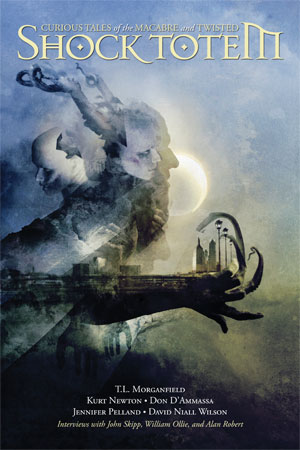
I recently read the first issue of Shock Totem: Curious Tales of the Macabre and Twisted. I had picked up the first four issues at the NEHW booth at the Hebron Harvest Fair in September.

The magazine was first published in 2009 and Publisher K. Allen Wood explains in the editorial how the magazine was created and the different names they had for the magazine before settling on Shock Totem.  It’s a lot better than Papercut Stigmata or Bleeding Penis Pens.

Volume one includes stories about vengeance meted out by childhood toys (“The Music Box”). Author T.I. Morganfield captures the magic of those special toys a person has as they grow up. As you read about Snowflake, you can’t help but think about a darker version of Toy Story. Morganfield even mentions in the “Howling Through the Keyhole” section of the magazine that he took the conflict between the toys in the Pixar movie in a “darker direction.”

In “Murder for Beginners,” the reader is lost as the story begins with a woman holding a shovel as she stands over the body of a dead man. As the tale continues, you find out there is another woman with her. By the end of this interesting story, the reader finds out about these two women plus what connections they have to the guy they are standing over. You are not lost by the end of the story. What Mercedes M. Yardley does with her tale is keep the reader interested and reading. Who wants to stop reading after a story begins with two women standing over a dead body? At that point, you want to know why they killed him or even if they killed him. There are so many questions the reader wants to find the answers to, and Yardley answers those questions.

Baseball fans will enjoy David Niall Wilson’s story, “Slider.” It involves a tale of a ball that has a bloody and cursed history. You don’t even have to enjoy the game of baseball to become engrossed in the story about the death of pitcher Jeb Rabinowicz.

One other story I will mention is Kurt Newton’s “Thirty-Two Scenes from a Dead Hooker’s Mouth,” which tells the story of a prostitute’s life from her death to her birth. It will remind you of the movie Memento, which inspired Newton when he wrote this story. He states, “knowing the outcome of events doesn’t necessarily remove the mystery.”

Shock Totem has a section “Strange Goods and Other Oddities,” which deals with reviews of books, movies, music, and more written by the magazine’s staff. This section reminds me of a similar section within the pages of Fangoria magazine.

The magazine also offers interviews with authors and artists in the horror community such as John Skipp and William Ollie. Those interviews make one want to go to the nearest bookstore and find the books these authors were discussing in these articles.

The “Howling Through the Keyhole” section is great if you want a peek into the writer’s mind. Well, that is if the writer wants to give you a glimpse into their dark playground. Each author has a little blurb about their story and the inspiration behind their story.

I am looking forward to reading the other volumes of the magazine that I own. Click on Amazon or Shock Totem to go to either site to buy any issue of the magazine. The issues are available in print and digital formats except for the Holiday issue, which is only available as an e-book.

What to Get After Receiving a New Phone or iPad

What to Get After Receiving a New Phone or iPad

by Jason Harris

It’s been a few days since Christmas. What do you do if you received a phone or iPad as a gift? You should buy a case to protect your new present. I know how a person can be rough on their gadgets especially a phone. You clip it to your belt or throw it into a purse or pocket. You definitely don’t want to do that without your phone being in a case.

You may be wondering why this entry about cases is on this blog. It’s important to protect your devices. I have used both my iPhone and iPad in my professional life.  A phone isn’t the best device to write something on, but if it is the only thing available then you have to do what you have to do to get an assignment in on time. If you depend on your devices for your job, you don’t want something happening to them.

The Defender series

The cases I have used for both my Apple devices are an Otterbox Defender case. These cases are made to protect your device from a lot of different every day accidents that can befall a device. I have dropped my iPhone many times and nothing has ever happened to it. Only the case has been scrapped up by these falls. I feel comfortable letting a child handle my iPhone or iPad since they are protected.

There are two reasons I recommend Otterbox products. They get the job done and the companies customer service is up there in my book with Apple’s customer service.

A few weeks ago, I had to contact Otterbox because my wife’s iPhone case was broken. She hadn’t dropped it or anything, but the case was cracked. I knew she hadn’t dropped it since most of the time her phone is in her purse. It’s not clipped to her belt like I have mine. I chalked it up to a defect in the case. I contacted the company and they asked for a four digit number on the inside of the case. All I saw was a one digit number so I emailed the customer service person who emailed me. I decided to include a few pictures of her case to go with my message about not seeing the numbers. The next email I received was one telling me that a new case was going to be shipped to me.

The reason I equate the customer service at Otterbox to Apple’s customer service because there were no hassles. I had an issue and they took care of it just like what Apple has done for me in the past.

NEHW Authors in Charity Anthology to Benefit HWA President

NEHW Authors in Charity Anthology to Benefit HWA President

by Jason Harris

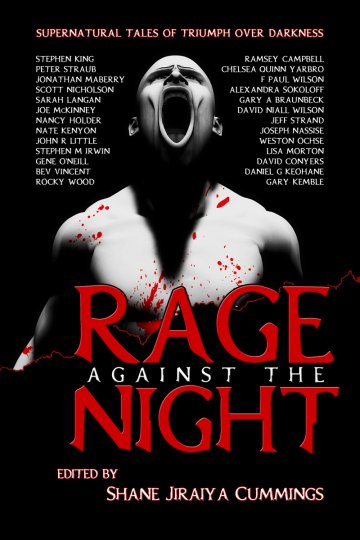
Daniel Keohane and Nate Kenyon, both NEHW members, have stories in the new collection, Rage Against the Night.

Keohane’s zombie story, “Two Fish to Feed the Masses” is appearing in “an amazing charity anthology,” he said.

Kenyon’s story is called “Keeping Watch.”

All the proceeds from Rage Against the Night will go to the Rocky Wood, an author and current President of the Horror Writers Association, who is battling motor neurone disease.

According to the Wikipedia website, “motor neurone diseases (or motor neuron diseases) (MND) are a group of neurological disorders that selectively affect motor neurones, the cells that control voluntary muscle activity including speaking, walking, breathing, swallowing and general movement of the body. They are generally progressive in nature, and can cause progressive disability and death.”

Amazon states the stories in this anthology detail the brave men and women who stand up to “the darkness, stare it right in the eye, and give it the finger.” These people are under the onslaught of supernatural evil and their good acts can seem insignificant.

The anthology was edited by Shane Jiyaiya Cummings and also features stories by Stephen King, Peter Straub, Jonathan Maberry, Ramsey Campbell, F. Paul Wilson, Nancy Holder and Scott Nicholson to name only a few of the authors in this charity collection.

Vincent’s story, “The View from the Top” is reprinted in this anthology, he said on his website. As of right now, it is only available in e-book format, but there will be a print copy in January, Vincent said.

The e-book is $3.99 through Amazon.

Six Ways Reading Series Can Improve Your Writing

This article originally appeared on the Tin House website’s blog.

Six Ways Readng Series Can Improve Your Writing

by Courtney Maum

My decision not to pursue an MFA felt like a pretty smart idea until the day I finished a short story collection and realized I didn’t have a single writer friend to share it with. The fact that I live in a rural town of eight-hundred people did little to improve my flu-like hallucinations about a world in which I was my only reader. “Courtney,” I said, teeth chattering beneath my Sturm und Drang, “What the hell will you do next?”

Was an MFA program the only way to meet aspiring writers? Or was there was something to be learned in the literary badlands outside of Academia? I gave myself a year to find out. If, within a year, I hadn’t found a community to exchange work with, I would get over myself and get higher education.

Picture courtesy of the Tin House website

To be closer to the pulsing aorta of the glitterati, I accepted a short-term assignment as a corporate namer in Manhattan—131 miles from husband, hearth and home. In order to convince a particular member of the aforementioned trifecta that this was a career move, I vowed to attend three readings a week during my NY exodus and to introduce myself to one person while there. At times, my self-imposed assignment felt daunting and foolish. Many evenings, I just wanted to sit on the flimsy Korean yo in my rabbit hole of a sublet and watch back episodes of “30 Rock.” But I forced myself to go to readings—usually alone—and the more often I went, the easier it got for me to introduce myself to someone, until it wasn’t only easy, it was a hell of a lot of fun.

By my count, I’ve attended and/or participated in nearly two hundred readings since April. I’ve met writers so talented they make your arm hair come to attention with the great weirdness of their words. There have been vibrant conversations. There have been whiskey shots.

Attending reading series with the devotion of a zealot has not only enabled me to construct the supportive network my writing life so lacked, it has also—and I never saw this coming—improved my work. Whether a writer steps behind a microphone to brave a cheapo sound system and a sea of empty chairs, or alights before a standing-room-only crowd; something important happens when a writer shares his work out loud. There are lessons to be learned from attending reading series. Here’s what I’ve learned so far:

Be vulnerable: Being vulnerable isn’t always the same thing as taking risks. Taking risks, to me at least, hinges on our desire to impress, while vulnerability requires us to force ourselves to do something when we’re feeling our least impressive. At the How I Learned” storytelling series in NY, I talked during intermission to a visibly anxious Elissa Schappell, the night’s final reader. “I’ve never done this story telling thing,” she admitted. She’d never, in her own words, “gone off the page.”

The night’s theme was “How I learned to say I’m sorry,” and Schappell shared a lifetime list of apologies she purportedly never made, including such whammies as “I’m sorry for thinking that men are better writers,” and, to her husband, “I’m sorry this is hard.”

Picture courtesy of the Tin House website

As seasoned of a writer as Elissa is, her vulnerability that evening was knife-cuttingly palpable. She didn’t seem to be having a particularly good time under the spotlight; in fact, one had the impression that her litany of apologies was something of an intellectual sacrifice. She read them because she had been asked to read at the series, because “apologies” was the theme, and because Schappell is not just brave, she’s professional. Her insistence on finishing the story she got up there to tell—even though she became emotional while reading—was a gift.

I often think of her performance when I’m writing non-fiction, a genre that I find as challenging (and enjoyable, honestly) as raking leaves. I still haven’t gotten rid of my desire to show off, to impress by taking risks. If I can strip away the artifice to reveal the vulnerable core like Elissa did that evening, I know that both my non-fiction and fiction will improve.

Take yourself seriously: If you want a guaranteed bad time, go to the reading of a self-depreciating writer. Sitting in an uncomfortable chair with a long ago emptied drink, bullied by such dandies as “You’re probably going to hate this,” or “This one kind of sucks, but,” is the literary version of passive aggression, and it’s no fun for the audience, and it’s no fun for you. And it sure as heck doesn’t make me want to buy your book.

I assume that most writers feel like misfits most of the time. I know I do. But when you get up to read your writing, for god’s sake, don’t act ashamed of it. Why sabotage your own work when there are so many other people willing to do it for you?

In August, at the Bread Loaf Writers’ conference, I witnessed a reading by a young poet named Rickey Laurentiis, there on a “waitership.”After serving two meals a day in the cafeteria, attending classes, lectures, and his colleagues’ readings, I imagine the young man was pretty strung out. But when he got up to that microphone, he read every single word of his poetry like it was the first—and last—reading of his life. There was a pride in his reading, to be sure, but it wasn’t hubris—it was a reverent acknowledgement that he had sacrificed some things to devote his life to words, and these were the words he had chosen, and you had better listen up. It certainly helped that he’s a brilliant poet, but the authority of his delivery was such that he could have read the same lines in pig Latin and we would have been enthralled. He took his work seriously, so we did, too.

Be funny often, but not always: The most memorable readings I’ve attended are the ones that combine humor with the pathos of the human condition. At a Kugelmass Magazine reading at KGB, the writer Simon Rich read a piece about going to a party where his ex-girlfriend showed up with her new boyfriend, who happened to be Hitler. Absurdist, provocative, his piece was all these things, but mostly it was about how awful it feels to want someone who’s moved on. And there is nothing funny about unrequited love.

Picture courtesy of the Tin House website

Back at the “How I Learned Series,” funny man Andy Ross told a hilarious story about his experience working at the beverage stand at the Cincinnati zoo, a place where drinks are served strawless because of the instruments’ tendency to end up in the animal’s pens, and then, their throats. It was a safe and fuzzy story until he got to the part where he adamantly refused a straw to a middle-aged woman for reasons already mentioned, only to watch her retreat to the other end of the food court and struggle to drink her supersized Pepsi. The woman suffered from multiple sclerosis but had been too proud to mention her illness when she was refused a straw. And when Andy saw her shaking hands fail to grasp her beverage, he was too embarrassed to do something about it. Yeah. Not very funny. Not funny at all.

Keep them wanting more: One of the best things about readings is fire and brimstone, scratch-your-eyes-out boredom. But you have to pay attention to it. Why are you tuning out? Nine times out of ten, if you can identify why and where you started to lost interest in a story, you can take the lesson home and apply it to your work. Personally, I disconnect when the writing becomes tangential and the story goes off-track. This, unfortunately, is the mistake I make the most often in my own writing. Going to readings reminds me to avoid doing so at all costs.

Say thank you: It’s a fairly uncomfortable experience to watch a well-known author reluctantly take the stage in front of an audience that is about fifty people smaller than he or she expected. But worse still is watching a writer—any writer—pull off a game-changing reading only to slink back to his booth to spend the rest of the evening with an exhausted publicist while his fans stand on the other side of the room fumbling with their cell phones, caving into sheepishness, deciding to go home.

I think writers have big egos. I think that we have to. After all, most of us will spend our writing lives co-habiting with rejection. In order to reside peacefully with this most daunting of roommates, we have to like ourselves. A lot. And when we’re not up to it, when we’re sick of the look or the sound of our own words, we need other people to step in and say they like us.

Picture courtesy of the Tin House website

If you’ve ever been to a reading of a writer who moved you and you didn’t tell the author because you assumed that he or she would be inundated with compliments after the show, you probably assumed wrong. I went to a reading of Jhumpa Lahiri’s at the Greenlight Bookstore in Brooklyn last spring and there were thirteen people there, tops. Lahiri—Pulitzer Prize winner—spent most of her time after the show browsing bookshelves, alone. I didn’t go up to her because I was horrified that no one else was talking to this brilliant writer. Far worse, I know now, is to imagine Lahiri traveling home wondering whether she’d actually read, or just imagined it, because no one in the audience acted as if they were there.

If you like something, say something. And if you really like it, buy it. Nothing says “thank you” quite like the purchase of a book.

Have fun: A writer once said to me that writing shouldn’t be torturous. That was news to me. There was a time in my life when I thought writing was about shutting myself away from the world in order to write about it—that a piece was meaningful only if the writing came hard. Writing is hard, but here is the fun thing about it: there are a lot of people doing it, and a lot of them aren’t doing it at night. Reading series provide an excellent way for writers to commingle, commiserate, or just gawk at one another over a pint of tepid beer. If you’re having a shitty day, there’s nothing quite like a stranger’s kick-ass reading to shake that I-want-to-make-it feeling back into existence. Simply put, reading series make you want to write.

If you live in the New York area, New York Magazine’s online book section, The Vulture, curates a great selection of literary events searchable by the day or week.

Here are a few of my favorite reading series in (and around) the Big Apple: Fiction Addiction (run by Christine Vines) Franklin Park (Penina Roth), Freerange Nonfiction (Mira Ptacin) Frequency North: The Visiting Writers Reading Series at the College of Saint Rose (Daniel Nester), Happy Ending Music and Reading Series (Amanda Stern) How I Learned (Blaise Allysen Kearsley) Hudson River Loft Series (Chloe Caldwell) Literary Death Match (Todd Zuniga) Real Characters (Andy Ross) Steamboat (Bob Powers) Sunday Salon (Sarah Lippmann, Nita Noveno)

Courtney Maum is a fiction writer based in between the Berkshires of Massachusetts and New York City. A humor columnist for Electric Literature, her work has appeared in Slice Magazine, The Rumpus, Vol.1 “Sunday Stories”, Anderbo and others. She is a frequent reader at NY-based series and a Literary Death Match champion. Courtney is currently working on a collection of comic fiction entitled “Funny You Should Say That.” Find her on Twitter at @cmaum.

A Writer Discovers the Famous Dundee Cemetery

A Writer Discovers the Famous Dundee Cemetery

by Kate Laity

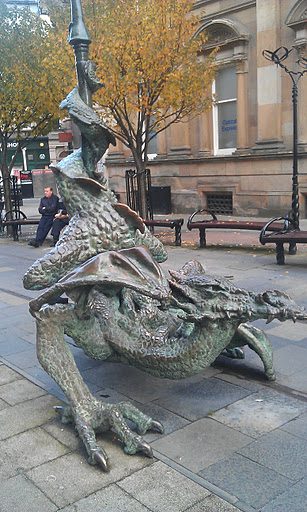
The Dundee Dragon (picture by Kate Laity)

I have a lot of New England friends who enjoy exploring the graveyards of the northeast and probing the histories behind them, so it’s a treat to be able to visit an even older cemetery here in Dundee where I am spending Christmas. Of course the big holiday in Scotland is Hogmanay, but I have to be back in Ireland this year, so I’m going to miss it. Dundee also has a famous dragon as well, though it’s best known for the three Js: jute, jam and journalism. The jute mills once employed much of the population, until jute production was outsourced to India in the 1920s. Orange marmalade continues to be a staple of British tables. And Dundee remains the home of DC Thomson, creator of The Beano, The Dandy and The Sunday Post.

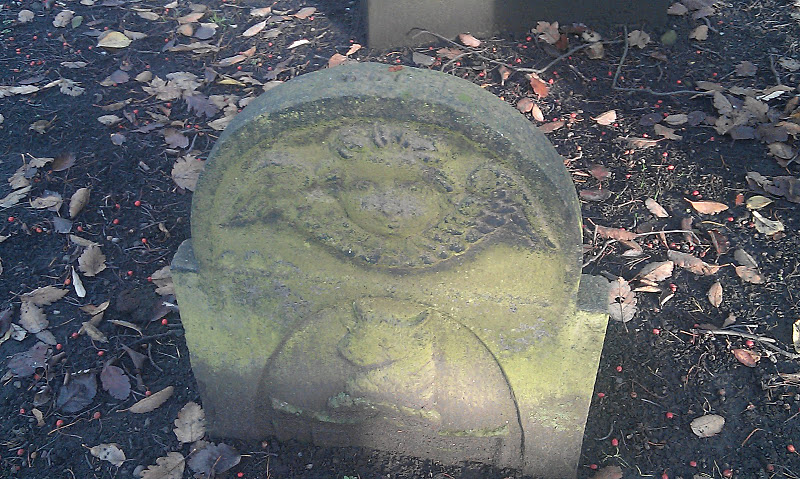
In the Howff (picture by Kate Laity)

The most famous old graveyard in Dundee is the Howff which lies in the centre of town.The land once belonged to the Greyfriars Monastery, founded in the thirteenth century. When the monasteries were dissolved in the sixteenth century, the land was given to the city by Mary, Queen of Scots, for a burial ground. Monuments from this time dot the space.

"Afternoon light" (picture by Kate Laity)

While its primary purpose was to welcome the dead, the Howff also became the meeting place for the Nine Trades of Dundee, a sort of affiliation of skilled trades including bakers, shoemakers, glovers and tailors. The peaceful surroundings of the beautiful setting with its trees and green lawn offered a neutral territory as well as  pleasant space. The trades would often gather around the gravesite of one of their departed elders.

"In memorium" (picture by Kate Laity)

The Howff is a wonderfully picturesque graveyard; it was already full up in the 19th century, so there haven’t been any new inhabitants since then. While most old burial grounds have a multitude of spooky stories about restless dwellers, there seems to be a shortage of such tales for Dundee’s most famous cemetery. Maybe it’s just the straightforward attitude of the Scots, but the only spirits that seem to roam at night come from a bottle!

Kate Laity is a NEHW member

5 Secrets an 8-year old Natalie Wood Can Teach You About Persuasive Writing

This article originally appeared on the Copyblogger website.

5 Secrets an 8-year old Natalie Wood Can Teach You About Persuasive Writing

by Susan Daffron

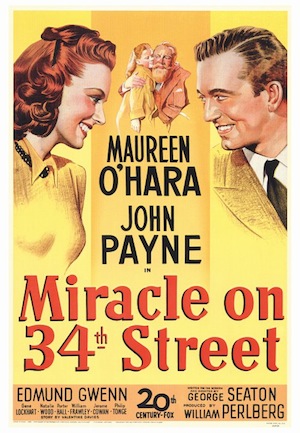
Like a lot of people, every year my husband and I watch Miracle on 34th Street during the holiday season.

One of my favorite scenes in the movie is right at the end when Natalie Wood is riding in the car with her mom and Fred Gailey.

The camera focuses in on Natalie sitting in the back seat of the car staring out the window looking bored and kind of annoyed, mumbling “I believe, I believe …”

Then, there’s a moment where the camera closes in a bit on her eyes as they widen in shock.

She shrieks, “Stop, Uncle Fred! Stop! Stop! Stop!”

The camera angle switches and you see Natalie running up the hill to the house that she had asked Santa Claus to give her.

Persuasive writing is like that.

When it works, the writing takes someone from a neutral state of bored indifference to excitement.

I think of that split-second transition as the “magic moment.”

Considering Natalie Wood was only 8 years old when the movie was made, she does an amazing job of conveying just what happens during that magic moment when suddenly something that seemed impossible becomes real.

To reach that magic moment in your copywriting, here are a 5 secrets you can learn from an 8-year old Natalie.

1. You need a big story

People don’t respond to boring. In fact, one of the worst insults an 8-year old can throw at you is “that’s boring.”

A story like, “What if Santa were real?” gets the attention of pretty much everyone, even those with short attention spans.

It gets people talking.

In Miracle on 34th Street, even the grandkids of the district attorney knew about the legal case. (And thought grandpa had a whole lot of nerve picking on Santa.)

Is your message something worth sharing? Could it be?

2. You need a big vision

Unlike most kids, instead of asking for a toy, Natalie Wood asks Santa for a house. She hands Kris Kringle a magazine photograph of a house and explains that she doesn’t want a dollhouse. She wants a REAL house.

She says, “If you’re really Santa Claus, you can get it for me. And if you can’t, you’re only a nice man with a white beard, like mother said.”

Natalie had a big vision for what life would be like living in a house in the suburbs versus living in an apartment in the city.

She doesn’t like her Manhattan apartment, and explains that her house would have a back yard with a big tree to put a swing on. She had a clear picture of exactly what she wanted.

With your writing, can you paint a transformative picture that inspires people to fill in the rest using their own imagination?

3. You need a big emotion

People do almost everything for emotional, not rational reasons.

It’s been said that Santa Claus doesn’t need a marketing department. What’s not to love about free gifts for boys and girls around the world? And the “spirit of Christmas” embodies noble emotions like generosity, love, and compassion.

As Kris Kringle says, “Christmas isn’t just a day, it’s a frame of mind.”

In your writing, you need to tap into emotions, whether they are noble like generosity or more negative like fear, greed, and vanity.

After all, there’s no logical reason to believe in Santa Claus or ever eat M&Ms, cookies or doughnuts. Yet people do. Krispy Kreme and Mrs. Fields are ample proof of that.

Why do people continue to buy fat-laden doughnuts and cookies? Because they taste yummy and eating them makes you feel good.

What are your reader’s biggest pain points? What make him feel good?

4. You need big proof

Natalie Wood wants to believe that Kris Kringle is really Santa and looks for proof. At Macy’s she sees him speak Dutch to a little girl and is thrilled to discover he’s not wearing fake padding on his jolly tummy. Then when she tugs on his beard, it doesn’t come off!

She’s excited to tell her mom what she’s learned, but mom raises objections. “Many men have long beards like that” and “I speak French, but I’m not Joan of Arc.”

Many types of proof exist. For example, you might include testimonials in your copy, but that might not be enough. You may need something bigger.

In the movie, the ultimate proof is the existence of the house. (And the real magic is finding the cane tucked into a corner.)

Are you giving people enough reasons to have faith in what you offer? (“Faith is believing in things when common sense tells you not to.”)

5. You need to believe

People want to believe a lot of things they think they can’t do. They might secretly want to travel around the world or write a book.

Generally, there’s no real reason why these people couldn’t travel or write; they just think they can’t.

Good copywriting taps into the emotions and dreams people want to believe anyway. Natalie Wood wanted to believe that Santa would bring her a house, but “common sense” kept telling her it would never happen.

Until it did.

She says, “You were right, Mommy! Mommy said if things don’t turn out right at first…you’ve still got to believe. I kept believing. You were right, Mommy!”

Does your writing give people the joy of realizing a dream they want to believe is possible? Could it?

Of course, in the movie, the logistics of actually buying the house, mom and Fred getting married, moving, and so forth work themselves out. By then, it’s just details.

That’s true of great copy too.

Once the magic moment happens, there’s no turning back.

About the Author: Susan Daffron, aka The Book Consultant owns a book and software publishing company. In addition to teaching aspiring authors about book publishing and putting on the Self-Publishers Online Conference every May, she also just relaunched and is the editor of ComputorCompanion.com, which offers ideas and advice to grow your business.

The NEHW Creeps into Sci-Fi Saturday Night

The NEHW Creeps into Sci-Fi Saturday Night

by Stacey Longo

Several New England Horror Writer members have been appearing or are scheduled to appear on Sci-Fi Saturday Night.

Craig D. B. Patton’s short story “Aftershocks” was spotlighted on the site’s Fiction Friday entry for 12/10/11. Bob Bois had a flash fiction piece appear on the site on 12/16/11, taken from his blog.

Kristi Petersen Schoonover was featured on the podcast dated 12/17/11, talking about Skeletons in the Swimming Hole and her upcoming novel, Bad Apple. You can download her interview here.

NEHW members on the slate to appear on the Sci-Fi Saturday Night podcast before the end of the year are Kasey Shoemaker, who will be interviewed on the 12/24/11 show, and Rob Watts, scheduled for 12/31/11.

Editor’s note: Stacey Longo is a NEHW member and part of the Publicity Committee.

Author’s Take on Holiday Classic

This entry originally appeared on NEHW member Stacey Longo’s blog.

Here Comes the Sun

by Stacey Longo

I’m not crazy about The Year Without a Santa Claus, and as you know, I despise Rudolph the Red-Nosed Reindeer, but the one holiday cartoon that I hate more than a root canal is Frosty The Snowman. Just hearing this self-centered, nihilistic boob’s voice gives me the dry heaves. Sometimes the wet heaves, too.

This cartoon starts off with a bunch of ably-challenged children being let out of school on Christmas Eve. I’m assuming they’re challenged, because one of them actually says “snow is good” when they’re let out of class, which is, of course, crazy. They decide to build a snowman, and one of these special kids wants to name their creation “Oatmeal,” which further proves my case that these kids are challenged. But I digress.

The magician who was hired to entertain these kids on the last day of school before winter break tosses out his hat, which lands on Frosty’s head, bringing him to life. The first thing he says is “Happy Birthday!” which would be nice if he was remembering what Christmas is actually celebrating. But no, the selfish sacrilegious snowball is talking about his own birthday, which he clearly feels is more important than, say, the birthday of the son of God. What a pompous egomaniac!

As soon as this numbskull is born, he immediately starts complaining that it is so hot he’s melting. Hey, stupid. Maybe you should have thought about that before coming to life in a temperate climate.

Frosty leads a parade through the center of town, scaring the bejeepers out of the townspeople. One poor policeman is so alarmed by the walking, talking snow abomination that he swallows his own traffic whistle, causing (I am sure) permanent damage to the man’s trachea. Frosty (I am sure) doesn’t care.

Frosty now reveals his true nature. Instead of buying a train ticket to the North Pole like a decent snowman, he kidnaps a little girl, Karen, and hops in to a refrigerated boxcar, which, might I remind you, is illegal. Of course, the little girl that is stuck freight-hopping with Frosty starts to suffer from hypothermia and frostbite. Good job, Frosty. He bullies some woodland creatures into making her a fire, but then the magician, who simply wants the hat Frosty stole from him back, blows out the fire. Apparently this scrawny magician has the lung capacity of the wolf from the Three Little Pigs, which I never would have guessed from looking at him.

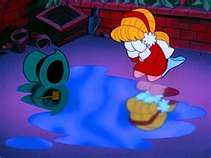
The highlight of this nauseating cartoon is when Frosty and Karen find a greenhouse in the middle of the frozen tundra…as you do. Inside the greenhouse, Frosty melts to a puddle in what I like to think of as a slow, agonizing death. Then Santa comes along and, proving he is looooong overdue to retire, brings him back to life. Really, Santa, what are you thinking? Frosty just kidnapped a kid and tried to freeze her to death! Also, I was taught that only one being was ever able to die and then rise from the grave, but I believe we’ve already established that this cartoon was written by a bunch of atheists. And really, who needs Jesus when you’ve got a self-centered, parading snow terrorist to worship?

The only nice thing that I can say about this cartoon is that at least it ends before Frosty can insist that Christmas be renamed in his honor. I say, bring on the sun!

Editor’s note: Stacey Longo also has an entry about Rudolph the Red-Nose Reindeer on her blog.

Have You Heard of Santa’s Traveling Companion, the Krampus?

Have You Heard of Santa’s Traveling Companion, the Krampus?

by Bracken MacLeod

Being more of an every-day-is-Halloween kind of guy, you’d be correct in assuming that I’m not a big fan of Christmas. The enforced cheer, expected gift-giving, and seeming endlessness of the season all leave me feeling colder than a winter Nor’easter. With the renewed interest in an Alpine figure who used to be associated with the holidays, however, some of the cheer of the season has crept into my spirit.

We’re all aware that during this time of year Santa Claus is the figure held up as the arbiter of who has been naughty and nice. Where Santa used to leave bad little children a lump of coal in their stockings instead of presents, his role in children’s programming and as a spokesmodel for a variety of wholesome family products has left him toothless and passive-aggressive (the jolly old elf today simply rebukes unruly children for their wickedness by failing to stop at their houses on Christmas Eve). It wasn’t always so, however. For centuries in Europe, St. Nicholas (the precursor to Santa Claus) has been known to have had a variety of traveling companions entrusted with making sure evil children got their just desserts. In recent years, one in particular is standing head and shoulders above the rest, having made his way to Twenty-First Century America and into my heart.

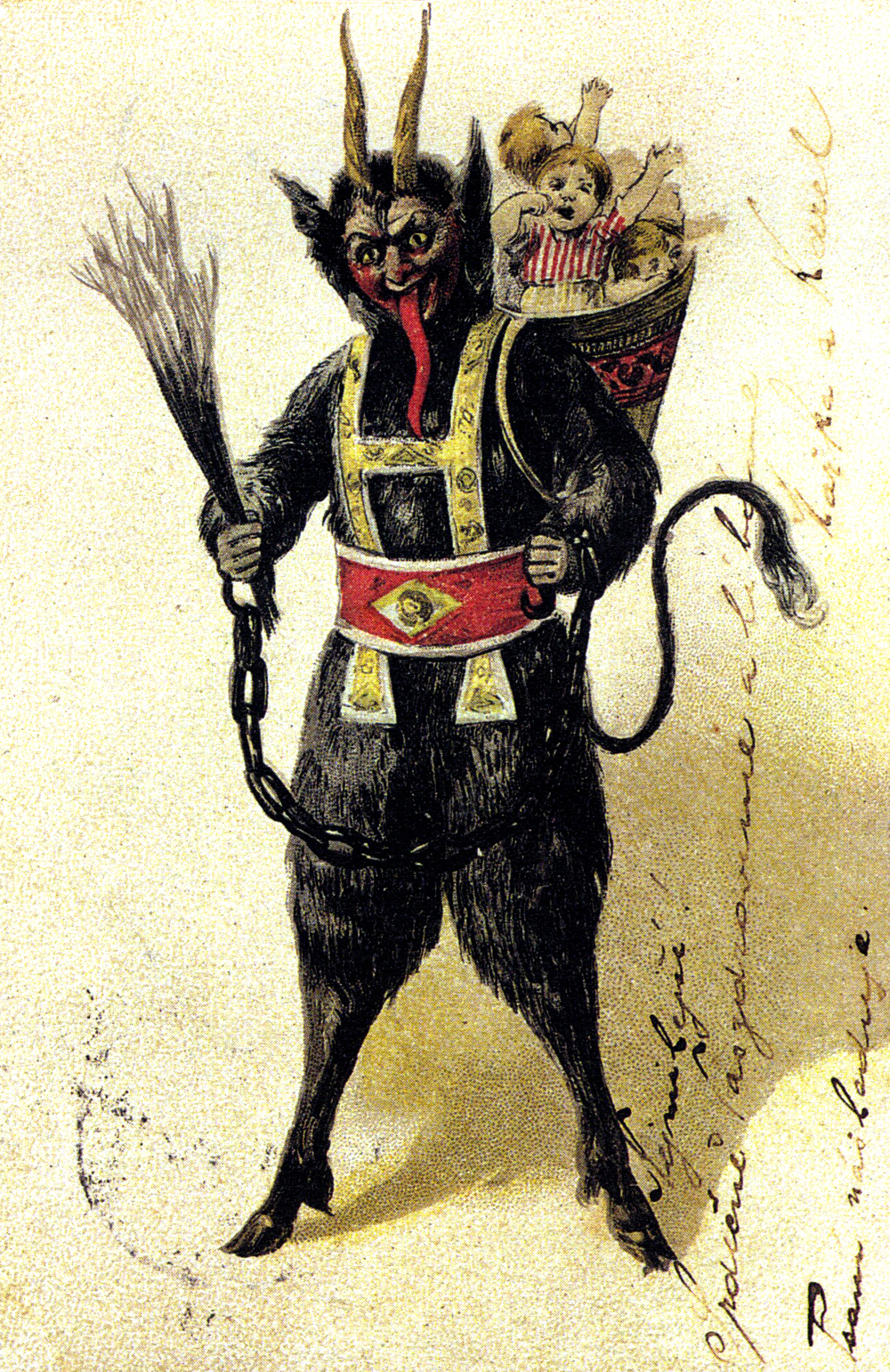
Picture courtesy of the Pushed Buttons Burning-in website

The Krampus is the ancient embodiment of accountability for wickedness balanced against St. Nicholas’ reward for virtue. He appears as a wild, bestial, goat-like figure wearing chains and bells that foretell his coming. As jolly old St. Nick is out leaving good children gifts and treats as a reward for good behavior, Krampus is prowling the night dishing out punishment for those who have fallen short of his exacting moral standards. He carries with him two fearsome instruments that should quicken the pulse of anyone who has been naughty more often than nice. First is a tied bundle of birch branches known as a “ruten” that he uses to whip naughty children (the beating is euphemistically called a “birching”). Second is a sack or a wooden tub that he wears on his back. Truly rotten children are stuffed in the sack to be taken away for further punishments that may include drowning in a river and/or inclusion in Krampus’ own Christmas dinner.

Unlike the modern Kris Kringle who doles out a half-assed punishment by failing to reward naughty kids (ostensibly making Christmas morning like any ordinary day), the Krampus does twice the work he needs to do just in case you were thinking of doing something bad later. Unwilling to let anyone become too comfortable with their own piety, Krampus still visits good families during the holidays, leaving them small gold-colored rutenas a reminder to remain morally upright. Krampus visits the good and bad alike — the holiday version of Scared Straight.

Although Krampusnacht is typically celebrated in parts of Europe on December 5 (the night before the Feast of St. Nicholas) with parades, elaborate Krampus costumes, and public birchings, I am as happy as a little school child to find that he has started to infiltrate the whole of the holiday season. Being a horror writer and fan, it really brings opens up the splendor and joy of the season to have my own Christmas demon waiting in the wings to inject a little horror into the holidays and scare the bejeepers out of everyone whether they need an attitude adjustment or not.

Gruβ vom Krampus!

Bracken MacLeod is a member of the NEHW.