Short Story Contest

This information was found by David Price.

Lulu has a short story contest for the month of November.  Write a 600 word short story and you could win $500 cash, a B&N Nook, or a $100 B&N giftcard.  Full details can be found here.

http://www.lulu.com/blog/2011/11/01/lulu-short-story-contest/

Price is part of the NEHW publicity committee. He can be located on the web in a couple of places. Here are his links: www.authorwebpage.com/davidprice
http://davidpriceauthor.blogspot.com
follow him on twitter: DPAuthor or
find him on facebook: DavidPriceAuthor.

Professor Writes about E-books and Short Fiction

This article originally appeared on the website, http://www.40kbooks.com/. Professor and author Daniel Pearlman is the writer of this article and is a new member of the New England Horrror Writers’ organization.

The e-book is the latest and best hope for the commercial viability of short fiction by Daniel Pearlman

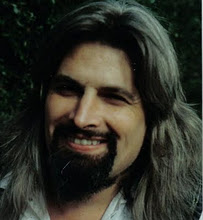
Daniel Pearlman

“Daniel Pearlman‘s writing presents us with a rare multiplicity of unique voices. His unforgettable characters continue to whisper in the reader’s ear long after the final page is turned,” said Paul Di Filippo.

Novels can have pauses, faults: a long story wins by points. A novelette, as Julio Cortazar wrote, needs to win by knock-out. Do you agree?

I generally agree. Few readers read novels with the expectation that a dramatic climax will repay them for the time, often portioned out over several days, they invest in reading them. Readers of novels expect to be “repaid” continuously, with several dramatic high points making the long haul worth it–each such high point followed by the “pause” you mention, though I don’t see why your question seems to equate “pauses” with “faults,” like passages that are boring. Pauses should simply be the re-commencement of the narration at a necessarily slower pace if the novel is to build up toward a new high point. In contrast, the shorter form is naturally designed to build up to the one high point only, Poe’s “single effect,” the knock-out Cortazar mentions–and that takes special dramatic skill, a ruthless focus of attention, that many writers, known primarily as novelists, do not have the capacity for, or the interest in, pursuing. Many novels succeed without a knockout ending, but a short story simply fails of its purpose without one.

Is there a literary bias against the short form of fiction?

There may be a market bias. Short stories of literary merit demand a great deal more of mental focus on the part of the reader than do most novels. Novels draw the reader into a narrative dream that relaxes the intellectually critical faculties. Reading a short story demands constantly being on the alert for the “point.” Reading a novel relieves you of that tension until perhaps you reach the ending. Reading a short story also demands close attention to language–to metaphor, irony, etc.–the kind of attention to language that you would give to poetry. Few novels demand such attention.

In any case, I don’t see any “literary” bias against short fiction. On the contrary, the classics of short fiction receive enormous literary-critical attention. Unfortunately, the market tells us that novels sell well compared to collections of short fiction. My hope is that someday, perhaps via the e-book, writers of excellent literary short fiction will be able to make nearly as good a living as do many writers of merely mediocre novels. Nowadays writers of excellent short fiction are taught to think that short forms are merely exercises preceding truly meaningful accomplishment by way of novels. How many writers have been warped, I wonder, by such market prejudices?

Plot, setting, ideas. What are in your opinion the perfect ingredients of a novelette/novella?

The novella is a really tough form to do well. You don’t have the leisure, as writer, to develop sub-plots and more than one or two main characters, and yet the reader demands a sense of fullness in the development of the main characters and setting, so that the novella has to provide some of the primary rewards of reading a novel–and still provide the climactic “single effect” demanded of the shorter form. It’s too bad that market conditions discourage the production of novellas, but I hope that the rising popularity of e-books will create a greater opportunity for their publication. The e-book is the latest and best hope for the commercial viability of short fiction.

Would you suggest 3 must-read novelettes/novellas?

There are just too many to choose from. But what jump out at me right away are Herman Melville’s “Bartleby the Scrivener,” Franz Kafka’s “The Metamorphosis,” and Leo Tolstoy’s “The Death of Ivan Ilyich.”


New England Horror Writers at the SouthCoast Toy and Comic Show This Sunday

Meet these New England Horror Writers at the SouthCoast Toy and Comic Show on Sunday! by Kristi Petersen Schoonover

If you’re up in Fairhaven, Massachusetts this Sunday, Nov. 6, you’ll have the opportunity to meet a few New England Horror Writers—and pick up a few of their books, as well as copies of my Skeletons in the Swimmin’ Hole—Tales from Haunted Disney World—at the SouthCoast Toy and Comic Show. The following writers will be on hand:

David Goudsward

Goudsward is co-author of Shadows Over New England and Shadows Over Florida, but has a myriad of titles in horror, archaeology, and short fiction out there. You can learn more about him at http://goudsward.com/dave/

Kasey Shoemaker

Shoemaker is the author of Silver Vengeance, an urban fantasy novel featuring werewolves, witches, romance and bloodshed. You can learn more about Kasey at http://kaseyshoemaker.com/

Rob Watts

Watts paranormal thriller, Huldufólk , was released just in time for Halloween! Find out more about Rob at http://www.robwattsonline.com/.

Stacey Longo

Longo has had several short stories published in various popular anthologies including the all-female-written zombie collection Hell Hath No Fury. Read more about Stacey’s work at http://www.staceylongo.com/

Writer Nathan Wrann (Dark Matter Heart) and I will not be at the show, but our books will be available. You can learn more about Wrann here: www.daltongang-productions.com, and, of course, you can find out about me on my own website (www.kristipetersenschoonover.com). In addition to Skeletons in the Swimmin’ Hole—Tales from Haunted Disney World, copies of In Poe’s Shadow — a Poe tribute in which my short story “Vanity” appears — will be available.

The SouthCoast Toy and Comic Show will run this Sunday from 10 a.m. to 4 p.m. at the Seaport Inn and Marina in Fairhaven, Massachusetts. For more information and complete details, visit www.southcoasttoyandcomic.com.

NaNoWriMo: Some helpful hints and tools

This article originally appeared at http://www.tuaw.com/.

NaNoWriMo: Some helpful hints and tools

by Steven Sande

This morning, I noticed a tweet from @rvbelzen that said, “As a NaNoWriMo veteran, do you have any tips for this NaNoWriMo newbie, maybe an article you wrote about it?” Most of the posts that I’ve done about National Novel Writing Month for TUAW have focused on the tools, not on the technique. Based on the tweet, I thought I’d give you some hints from a three-time NaNoWriMo winner (that means you wrote a 50,000-word novel in the month of November) about how to prepare for the writing marathon.

Helpful Hints For Writing Your NaNoWriMo Novel

1) Make sure you have a broad outline of your plot and characters in your mind or on paper. This was the hardest part for me the first two years I did NaNoWriMo, as I had a story in my head but didn’t spend the time to think of characters or how the story was going to evolve. As a result, those first two novels were only about halfway through the total plot line when I got to 50,000 words. What I suggest is sitting down with your favorite writing tool — whether that’s TextEdit, Word, Storyist, Story Mill, Scrivener, or another other writing tool, and just write a quick outline of how the story is going to unfold. Come up with character names and a rough description, locations, etc., and write them down as well.

2) At some point on November 1st, sit down for an uninterrupted spell of writing. In order to write 50,000 words in a month, you’ll need to average 1,667 words a day. I find that setting aside time to write in a place where I’m not going to be interrupted by talk, TV, or tweets is essential. If you’re enthusiastic about your story, that 1,667 words is going to flow out of you, and you’ll find that some days you’re writing 2,500 words. Go for it on those days, because you’ll have other days when you need to take a break. My favorite place to write NaNoWriMo novels? The kitchen table. The chair is uncomfortable, so I need to write quickly so I can get out of it ASAP.

3) It’s all about words, not about tools. I’ve noticed over the last few days that I see more and more tweets about “which tool should I use?” There are debates going on about the merits of Storyist versus Scrivener, or using one of the many minimalist writing tools. Here’s my take on the writing tools: don’t go out of your way to buy a new app that has lots of bells and whistles, because they’ll get in the way of writing your novel. Many of the novel-writing apps have ways to write outlines, build character cards, etc. I found these tools to be so incredibly distracting that I finally just started using minimalist tools. You can easily write a NaNoWriMo novel in Pages or Word — you don’t need an “author’s tool” unless you really think it will help you. My second NaNoWriMo novel was actually written in TextEdit.

4) Have fun writing. If NaNoWriMo turns into a chore, you’re not going to make it. For me, writing fiction ends up being so much different from blogging and writing tech books that it’s an absolute joy. I love thinking up characters, putting them in odd situations, and then trying to get them out of those situations while moving the plot forward. Are they well-written novels? Probably not. But it’s been a blast writing them. To make writing fun, think about something that either excites you or makes you laugh, and then use that as a key launching point for your novel. This year, I’m resurrecting a character from last year. He’s a private detective in the near future (about 10 years from now) who gets involved in some rather bizarre situations like a locked-room murder on a space station and (this year) being injected with nano-particles that cause him to grow.

5) Start fast. Seriously, try to beat your 1,667-word goal every day for the first 10 days. That way, you might be halfway done with the novel by the time November 10th rolls around. What does that mean? You can take a break from writing if you absolutely feel like it, or take more time focusing on a key point of the plot. My wife was a NaNoWriMo winner last year and she totally amazed me by writing almost half of her novel in the first five days of November. I like to start fast and finish at a comfortable pace.

6) Don’t focus on spelling or grammar. Once again, this is all about word count. It doesn’t have to be perfect. You just want to get the story out of your system and onto the screen (or paper, if you so desire). When you’re done at the end of the month, you have a working rough draft that you can then spend time cleaning up. So turn off the spell and grammar check, or ignore the red underlines that mean you misspelled something. Chances are very good that you’re not going to publish your book anyway, so who cares if it is filled with misspellings and lousy sentence structure? As long as you’re happy with it, that’s what counts.

7) Keep your writing to yourself. There’s nothing worse than thinking that you’re doing a bad job when you’re writing. It will absolutely defeat you from getting your novel completed. One of the biggest mistakes you can make during NaNoWriMo is to let somebody else read what you’ve written. Why? Well, everyone’s a critic these days, and the reader will have no hesitation telling you that what you’ve written is horrible or pointing out mistakes. Wait until December 1, 2011, and let them read it then. Don’t even talk about your novel with other folks, unless you’re just telling them how much fun you’re having and how far along you are.

8) Work through writer’s block. Here’s something I had issues with the first year I did NaNoWriMo. I was about one-third of the way through the novel and just lost focus. I had thought a lot about the beginning of the book, but didn’t have a clue where I was going. Preparation (see hint #1) will help this, but realize that you’re going to have days where you just can’t get the brain to wrap around writing! What do I do on these days? Try to write anyway. If I need help, I pick up a favorite good book and read parts of it, carefully noting the way that the writer crafted certain phrases or created a twist that caught my attention. That’s usually enough to motivate me to write more. Also consider taking a walk or doing something to clear your mind. I find that walking is a great way to get my mind to focus on developing plot points or thinking about dialogue.

9) Back up your novel every single day. I’ve been lucky — I’ve never lost any of my writing. But can you imagine how depressing it would be to get two-thirds of the way through your novel and then lose the file? It would be enough to make you never want to write again! I highly recommend doing multiple backups of your novel file every day. My base document is always sitting in a folder on Dropbox, which means that it’s also downloaded to the Dropbox folder on both of my Macs. That’s three copies right there, plus I always have a Time Machine backup going. That’s four. Am I paranoid enough? Probably.

10) Keep your eye on the goal. That’s going to motivate you more than anything. Thinking about getting to that 50,000th word is a daunting thing, but you’ll be surprised just how quickly your words will add up. Take the writing one day at a time, try to stretch your daily total over the required 1,667 words, and you’ll be a winner before the end of the month. I have to admit that there’s no better feeling than wrapping up a NaNoWriMo novel, even when I know that nobody will probably read it. Having done this three times, I’m confident that I can write another novel, and I’m looking forward to that sense of accomplishment at the end of November.

Tools Of The NaNoWriMo Writer

When you’re thinking about which tool to use to write your novel, keep hint #3 in mind — it’s about writing, not about tools. I really do get irritated with the annual debates over which app is better than another, but then again I’m an antisocial curmudgeon. I’ve tried ’em all, but the two apps that I find work the best for me are TextEdit and Microsoft Word. Get a blank piece of digital paper and start writing. I haven’t tried Pages, although I’m sure it would work swimmingly in the “typewriter” Lion full-screen mode. Maybe this year?

Most of the writing tools that people spend their money on before tackling NaNoWriMo fall into two camps — the “Swiss Army Knife” apps that have all the bells and whistles, and the “Minimalist” apps that just give you a blank page and a word count. Here are some examples of both types.

“Swiss Army Knife” Writing Apps

I think I’ve tried each and every one of these apps at one point or another, and even though I’ve used them to start NaNoWriMo novels, I’ve always just transferred my text to another app within a day or two. Your mileage may vary, and you may make use of all of the many features of these apps.

I won’t go into a lot of detail about each of the apps; the developers have info for you and in many cases will let you download a trial copy:

Scrivener (US$44.49)

Storyist ($59.99 for Mac, $9.99 for iPad)

StoryMill ($49.95)

Manuscript ($39.99)

Ulysses ($19.99)

CopyWrite ($24.99)

DEVONThink ($49.99): Actually more of an outlining tool, but can be used for writing.

OmniOutliner ($39.99): Once again, an outlining tool that is perfect for writing. Also available on iPad for $19.99.

Minimalist Writing Apps

WriteRoom ($24.99): available for both Mac and iOS ($4.99)

Ommwriter Däna ($4.99): available for both Mac and iPad at the same low price!

Byword ($9.99)

Clean Writer ($0.99): available for Mac and iPad

Writer ($2.99)

Grandview ($4.99)

iAWriter ($9.99): also available for iPad ($0.99)

I’m sure there are a lot more tools available, but I’ll leave this as an exercise for TUAW readers to go out and do some research. If you find any, please let us know in the comments. Also, if you’re a NaNoWriMo winner and have some additional hints and tips, be sure to write a comment.

By the way, in case you’re wondering how long this post is, it’s 1827 words. That’s more than a person needs to write every day to be a NaNoWriMo winner. YOU CAN DO IT!

The Epitaph, Issue #13 (October 2011)

Issue #13 (October 2011)

The Epitaph
Journal of the New England Horror Writers (NEHW)

The NEHW Board of Directors:

Tracy L. Carbone – Co-Chair
Stacey Longo – Co-Chair
Dan Keohane – Treasurer
Jason Harris – Director of Publicity/Webmaster
Tim Deal – Director of Publications
T.J. May – Co-Director of Events
Scott Goudsward – Co-Director of Events
Danny Evarts – Art Director

NEHW Events:

SouthCoast Toy and Comic Show, Nov. 6

The NEHW will have a table at the SouthCoast Toy and Comic Show on Sunday, Nov. 6, from 10 a.m. to 4 p.m. at the Seaport Inn and Marina in Fairhaven, MA. For more information, check out the website, http://www.southcoasttoyandcomic.com. Authors Dave Goudsward, Kasey Shoemaker, Rob Watts, and Stacey Longo will be at the event. Authors Nathan Wrann and Kristi Petersen Schoonover will have books at the show. There is still time to participate. Email Jason Harris at dudley228@gmail.com if you wish to be at the NEHW table at the show.

Anthocon, Nov. 11 – 13

There will be a NEHW table at Anthocon the weekend of Nov. 11-13. Email Tracy Carbone at tracy@tracylcarbone.com if you are interested in a spot at the table.
There will also be a book release party for Epitaphs, NEHW’s first anthology. There will be a special table for the anthology and most of the authors included in this collection will be at the convention throughout the weekend signing copies.
For more information about Anthocon and Epitaphs, click on the “Anthocon” and “Epitaphs” categories on the website, http://www.newenglandhorror.org/.

NEHW Publicity Committee:
The Publicity Committee members are Stacey Longo, Kristi Petersen Schoonover, David Price, and Doug Rinaldi. If you are interested in joining the committee, please contact Jason Harris at dudley228@gmail.com.

NEHW WRITING OPPORTUNITIES:

From David Price:

The Mystery Writers of America are now accepting submissions for an anthology tentatively titled What Lies Inside, edited by Brad Meltzer. This should be a story about something that is hidden, whether it is a real object hidden in a vault somewhere or a secret buried deep down in someone’s subconscience. Stories should be between 3,500 and 7,000 words. Deadline is February 1, 2012. Full guidelines can be found at:
http://hosted-p0.vresp.com/208752/42a6e17ebb/ARCHIVE

PUBLISHING NEWS:

From Stacey Longo:

The Library of Living Dead Press and its sister imprints, including the Library of Horror Press, have sadly announced a hold on all anthology publishing for a minimum of six months. Authors with stories waiting for publication with this press can visit the Twisted Library forum at http://libraryofthelivingdead.lefora.com/ for information regarding specific anthologies and story rights.

NEHW MEMBER NEWS:

From Kristi Petersen Schoonover:

Schoonover’s short story, “Vanity,” which was inspired by Poe’s “The Oval Portrait” is now available in Dark Opus Press’ In Poe’s Shadow.

In this anthology each piece is inspired by one of Poe’s, and they’re grouped as such. If you’re a fan of “The Fall of the House of Usher,” there’s Sorrel Wood’s “De’Atherton House;” if you’re a fan of “The Masque of the Red Death” there’s S.S. Hampton, Sr.’s “The Mumbai Malaise;” if you’re a fan of “The Premature Burial,” there’s Dorian Dawes’ “Loving the Dead.”

You can order your copy of In Poe’s Shadow here: http://amzn.to/InPoesShadow

Schoonover was recently interviewed by Dave’s Disney View, a podcast dedicated to all things Disney for Disney Park fans. She spent the time talking about the real ghost stories behind the tableaux in the Haunted Mansion attraction. You can listen to the episode right from the Dave’s Disney View website here: http://disneyview.blogspot.com/2011/10/ddv-72-look-at-some-of-stories-of.html

For those of you who missed it, Kristi has a mini-movie posted of the New England Horror Writers’ experience at Rock and Shock on her blog. You can watch that here: http://wp.me/pIXRs-13x

From Eric Dimbleby:

Dimbleby’s debut novel, Please Don’t Go, was released in September. Details can be found at his website, www.ericdimbleby.com.

From Dave Goudsward:

Goudsward was interviewed for the October issue of Rue Morgue magazine, an issue dedicated to the Fly movies in their various incarnations. He discusses George Langelaan, author of the original short story, “The Fly” as well as The Fly at Fifty, Dave’s non-fiction book/anniversary retrospect on the classic David Hedison/Vincent Price version of the film.

He will also be attending the SouthCoast Toy and Comic Show in Fairhaven, MA. on Sunday, Nov. 6.

From Alyn Day:

Day has been accepted into the anthology, So Long And Thanks For All The Brains, due out mid-December.

From Rick Hautala:

Hautala has sold Star Road, a collaboration with Matt Costello, to Brendan Deneen at St. Martin’s/Thomas Dunne, for publication in 2013.

His novel, The Mountain King and Four Octobers, is now available as an e-book from Cemetery Dance Publications.

From Dale Phillips:

Phillips’ second novel, A Fall From Grace, is at the publisher and should be released in November. It’s a mystery.

From Timothy Flynn:

Flynn’s first pro sale of a poem, “My Mind Floats Above Me,” will be in Space and Time magazine (Issue 115) this Fall.

From Jesse Young:

Young is a new member and wanted people to know he is an illustrator. He is available for cover art and interiors. His portfolio is available online at www.jessedavidyoung.com.
“I look forward to getting to know and working with you all,” Young said.

From Kevin Lewis:

Dead Christmas: A Zombie Anthology, which features Lewis’ short story, “Merry Christmas, Claire,” is now available in both print and on Amazon Kindle. It is published by Open Casket Press.

From John Grover:

Grover is pleased to announce the re-release of his collection Feminine Wiles to the Kindle and Nook. After years of only being available in paperback, his favorite collection of 16 wicked women is now available on any e-reader.
All new cover art and a great price make this a great deal and it has already garnered two new 5-star reviews.

Check it out here:
http://www.amazon.com/Feminine-Wiles-ebook/dp/B005O53WXS/ref=sr_1_1?s=digita l-text&ie=UTF8&qid=1319585261&sr=1-1

For the nook:
http://www.barnesandnoble.com/w/feminine-wiles-john-grover/1016121190?ean=29 40011521782&itm=1&usri=feminine%2bwiles

Grover’s story, “Their Familiar,” is now available in the new anthology by Open
Casket Press, Creature Features, which is in trade paperback and
e-book at Amazon.

His story “Projecting Evil,” is in Library of Horror Press’ Horrorology also
available at Amazon.

Grover is also thrilled to have his story, “Windblown Shutter,” in the NEHW’s first anthology, Epitaphs and will be attending the signing at Anthocon where he hopes to meet many of his fellow writers.

Finally, if you would like to sample some of Grover’s writing, he has a free story available on Smashwords, “The Disembodied.” Stop by and check it out:
http://www.smashwords.com/books/view/96063

All of these titles can be easily found on John’s recently updated website:
http://www.shadowtales.com/. Where you will find two new book trailers on the news page, one for Terror in Small Doses, still only .99 cents on Kindle or Nook.

From Stacey Longo:

Longo was recently asked to speak to a group of high school students at the Arts at Capitol Theater magnet school in Willimantic, CT. She spoke about writing as a craft and an industry. Her notes about this presentation appeared on the NEHW blog on October 24, 2011.

From Lawson Welles:

Welles is currently putting the finishing touches on the controversial horror/political novel, Schreck – The Hunt for Hitler’s Vampire, about to go out to an undisclosed publisher (to be announced at a later date). It has been described as “Dracula meets the Odessa File.” His first film, Cricket Snapper, a neo-noir BDSM crime drama based on the true story of the Quincy dominatrix, premiered in Boston this past May, which received news coverage from the Quincy Patriot-Ledger.

He is also preparing his Penn State Master’s paper on Japanese Vampire legends for publication.

WELCOME NEW MEMBERS:
Jesse Young (CT)
Michael Dias (RI)
Christopher Pappas (MA)
Matt Sughrue (MA)
Kris Triana (MA)
Raynard Stevens (NH)
Suzanne Reynolds-Alpert (MA)
Matthew Martino (MA)
Ashleigh Homon (MA)
Jenna Moquin (MA)

– Jason Harris, Editor, the Epitaph: Journal of NEHW
– Stacey Longo, Assistant Editor, the Epitaph: Journal of NEHW

Writers Against Plagiarism

This blog post originally appeared on http://accrispin.blogspot.com/2011/10/writers-against-plagiarism-call-to.html.

Writers Against Plagiarism: A Call to Action by Victoria Strauss

It’s been a year since I first blogged about serial plagiarist “Iron” Dave Boyer (among many other names), whose prolific pilfering of other writers’ words has become something of an Internet legend, especially in the horror community, where he concentrates his efforts.

The fact that Boyer’s multiple misappropriations have been extensively exposed by intrepid researchers and bloggers, and discussed on popular message boards, doesn’t seem to have fazed him in the slightest. He is still at it, swiping stories from writers both known and unknown, and selling them to unwitting consumers as his own original work. Lately, he has branched out into snitching song lyrics–something that, unlike merely filching fiction, can get you into real trouble with the corporate overlords. (See B.Thoughtful’s blog for an encyclopedic expose of Boyer’s prose pirating, as well as a list of his many aliases.)

Now, thanks to activism by Ferrell Rick Moore, one of Boyer’s first victims, the Attorney General in Boyer’s home state of Indiana is investigating whether to pursue Boyer on consumer fraud charges.

Here’s where we can help. From Rick’s blog (the bolding is mine):

In the past, the only recourse a writer had was to file an expensive, time consuming and ultimately unproductive lawsuit against creeps like Boyer who then claim they’re bankrupt. Help me change that. Tell the Attorney General’s office for the State of Indiana how important it is for this plagiarist publisher to be subject to the same penalties as any other crooked business. We want him pursued under Consumer Fraud regulations at their cost, not ours. He’s defrauding consumers by selling them our stuff with his name on it.

Here’s where to send your respectful but firm letters and or emails of support, and be sure to include the File Number File No. 10-CP-62157:

Tom Irons
Consumer Protection Division
Office of the Indiana Attorney General
302 W. Washington St., 5th Floor
Indianapolis, IN 46204
Tom.Irons@atg.in.gov

Please add your voice to this campaign. A letter of support has already been sent by the Horror Writers Association. Mine went off this morning.

Please feel free to share this post, or put the call out on your own blog. There’s also a Facebook page where you can express support and check for updates. Thank you!

(As a matter of interest, Indiana is one of the few states that has actually prosecuted literary scammers–vanity publisher New Century Publishing in 2010, and self-publishing service/marketing company Airleaf in 2008.)

Publishing, Self-Publishing and Scams

David Price found this blog entry at http://nyki-blatchley.blogspot.com/.

Publishing, Self-Publishing and Scams by Fantasy author Nyki Blatchley

There’s been a lot of debate online recently about traditional publishing and self-publishing. Most of this has been constructive, but there’s also some misinformation flying about, whether this is from people with a vested interest in a particular sector, or from authors who’ve got the wrong end of the stick from being scammed in the past. I’d like to go through the various options in, I hope, an impartial and objective way.

Few would disagree, I think, that the holy grail for any author is to land a contract with a major publishing house.

While it doesn’t by any means guarantee a place on the bestseller lists, that isn’t easy to achieve without a major publisher behind you.

Besides having the funds to support a substantial print-run, they also have extensive distribution networks, large publicity departments ready to swing into action, and the name to attract the attention of reviewers and booksellers.

The drawback, of course, is that few major houses will even look at submissions from an unknown author. Though there are occasional exceptions, the only practical way to get such a contract is to be taken on by a literary agent. This too can be difficult, but not impossible.

I’ve read some extraordinary claims online about the way agents are supposed to work: that anyone who gets a business card printed up can be an agent; that all they do is leech money from an author, offering nothing in return; that they’re really publishers in disguise, or that they’re actually working for a particular publisher.

There are, as in any industry, crooks out there posing as literary agents, and perhaps these claims come from authors who have fallen into the clutches of such crooks. None of the claims, however, are true of any reputable agent.

A good agent will have a background working in the industry, either for him/herself or for another agency or publisher, and will have a list of successful clients. In the digital age, it’s easy enough to check up on them.

Besides studying their own website, google the name and see what’s being said about them online. Pay particular attention to any discussion on the anti-scamming sites, such as the excellent Writer Beware.

A literary agency is, of course, a business, and its primary purpose is to make money. However, the only way the agent can make money is if the author does. An agent works for a fixed percentage (normally between 10% and 15%) of what the author makes and doesn’t make a penny unless there’s money coming in.

The golden rule in all sectors of publishing is that money always flows towards the author, not away. If any agent or publisher (other than an avowed self-publisher) asks for money up front, do a quick about-turn and beat it.

In return for this, the author gets a range of professional services which, even if they could learn to achieve, would take away a considerable amount of writing time, together with a network of contacts and a reputation that only an already successful author could hope to match.

A literary agent is a facilitator, working for the author, and any hint of other interests should be treated with extreme suspicion. S/he might, certainly, recommend using a professional editor, but a reputable agent will direct you to a resource where you can examine and compare the various editors available. If an agent refers you to one specific editor, then it’s almost certain that the “editor” is the “agent” wearing a different hat. This would be completely unprofessional behavior.

If it proves too difficult to get an agent or major publisher, there are countless small-to-medium publishers out there who will usually look an unagented submissions – many of the best will be listed on sites like Ralan and Duotrope.
These often use either POD (print on demand) or e-publishing, both of which are sometimes mistakenly assumed to be synonymous with self-publishing. In fact, they are merely techniques which can be used by publishers, self-publishers and scammers alike to keep costs down. POD is a method where, instead of committing in advance to a large print-run, a publisher can produce copies as and when they’re ordered.

Similarly, e-publishing requires only the initial costs for editing, layout and artwork, and the result can be sold however many times it’s needed.

What both methods offer is a means by which a book can be published with relatively little capital, thus allowing these companies to accept books that, although they might be good, wouldn’t be considered viable ventures by a larger company. These small publishers operate a submission and selection procedure, rejecting far more than they accept, provide a full editorial service, fund all production costs and distribute the book. What they don’t usually offer is a publicity service. Some might send out review copies, especially if they’re electronic copies, but on the whole it’s up to the author to promote their work.
Not an ideal situation, but better than any option other than a major house.

One thing that e-publishing has changed is the range of lengths possible for publication. In general, traditional publishing is unlikely to be financially viable outside the 80,000 to 120,000 thousand word range – unless, of course, you’re already famous enough for sales to be guaranteed.

With e-publishing, even short stories can be individual books, while epics could theoretically be as long as you like.

Self-publishing, in which the author pays the costs of production and distribution, has been around for some time, and many classic authors self-published their first book. Some authors prefer to refer to this now as independent publishing. There are many areas in which self-publishing works very well. An academic, for instance, may wish to publish a highly specialist work which is unlikely to sell more than a few dozen copies, but might be the very thing that will gain the author that lucrative professorship or research post. At the other end of the spectrum, during the 1990s I put together several booklets of poetry, which I simply ran off from my computer and sold at gigs, and this worked very well.

In recent years, self-publishing has become considerably easier and cheaper. E-publishing systems like Kindle and POD systems like Lulu make it possible for authors to do it themselves with no upfront costs, simply paying the company a cut of each book sold. It’s also possible to publish work on your blog or website.
There’s both good and bad in this. It certainly provides a means for authors to get work out to the public that might not see the light of day otherwise, some of it excellent. I know of at least one case where a novel originally published on the author’s blog was picked up by a publisher and is now enjoying a fair degree of success.

Still, these cases are rare. Like all the old Hollywood stories of actors (or more often actresses) being discovered in bizarre circumstances, they happen, but the odds of gaining success that way are probably considerably less than by going through the conventional route.

The biggest disadvantages of the self-publishing boom are the sheer volume of material being put out and the fact that, because there’s no quality control, the vast majority of it is stuff that would never stand a chance of getting published in any other way. Even books that have promise often come over as very amateurish. I’ve read self-published books by authors who have considerable talent and flair, but their work cries out to be edited.

The editorial process isn’t a luxury or an optional extra or, as some unpublished authors seem to assume, an insult to their talent. It’s a dialogue between the author and a highly experienced professional who can take a dispassionate look at dotting the Is and crossing the Ts, and this can make a vast difference. I’ve a reasonably healthy estimate of my writing ability, but I’d be very reluctant to allow a novel to go out under my name without having gone through the editorial process.

Of course, it’s possible to hire a freelance editor to provide the same service, but that’s expensive, and the temptation to go it alone is too great for most authors. This gives self-publishing a (mostly deserved) reputation for poor quality.

It has another effect, too. It can be distressing and soul-destroying to endlessly submit and be rejected, but it can also be very good for the writing. Some publishers and agents will give feedback as to why they weren’t willing to take the work, and this advice should be treasured, even if it hurts at first. Even when the rejection is by form, it forces the author to think about what they’re not doing well enough, and to strive for improvement.

The reaction of many authors now to receiving a few rejections is to forget about it and self-publish. They’re never challenged to improve because they know anything they want published will be. Comparisons are often made with the music industry, and I think the same plusses and minuses exist there. The Beatles, for instance, became the great band they did not just through raw talent, but by playing endless sessions, to every conceivable audience, in the clubs of Liverpool and Hamburg. If they’d simply been able to record in their bedrooms and put out the results on YouTube, they’d never have achieved the polish to become the legend they did.

This doesn’t mean self-publishing doesn’t have a place. As in the music industry, established authors can buy back the rights to older, out-of-print books and reissue them under their own imprint. Authors who can afford to pay for editors, artists and designers might produce high-quality books. There are other possibilities, too. I’ve toyed with the idea of setting up a collective of reasonably experienced authors who can offer mutual editorial support and self-publish under an imprint which could eventually build up a reputation for quality. Even so, I doubt that I’d publish anything longer than a novella that way. I want my novels to be published because someone out there loves them, not just because I’ve chosen it.

I’ve dealt with the publishing and self-publishing in the title of this piece. There are, unfortunately, also scams in publishing, just as there are in every other industry, traditionally referred to as vanity publishing. Unlike self-publishing, these outfits delude authors into believing they’re actual publishing companies and praise their work to the skies, but come up with various excuses to part the author from his/her money. The traditional method is to call something like “subscription publishing”, which they assure you is normal practice, or make the author undertake to buy a certain number of copies, usually to be paid for in advance. If the book ever sees the light of day (the likelihood is that it won’t) it’ll be of poor quality, and it won’t stand a chance of being reviewed or stocked by anyone.

Other scams include referring the author to a specific service, such as an editor, as described above. This will be the same outfit in a different guise, and the service will almost certainly not be worth the paper it’s written on (or the pixels, as the case may be).

There are various ways of recognising scams. Firstly, genuine publishers rarely, if ever, advertise for authors – they get more submissions than they can deal with, without having to do anything. Secondly, anyone who tries to get you to pay them money for the publication process isn’t to be trusted.

And thirdly, information about scammers can be found all over the internet. Several sites exist primarily to give information about these – Writer Beware and Preditors & Editors are perhaps the best known, but there are others also doing sterling work.

Recently, the scammers have began to fight back. A bizarre website called The Write Agenda is making a concerted attempt to impugn the integrity of everyone involved in exposing scams, and has started a “boycott list” of anyone they see as a threat to themselves, encouraging book-burnings of the authors on it. Hopefully, this piece will get me onto the list – I’d be honoured to be included in such great company. Essentially, believe nothing they say. Their “information” is absurd, and all they’re defending is their right to steal your money. A thread about them can be found on the Writer Beware blog.

Magazine Promotes NEHW Member

Author Kris Triana’s new piece of fiction, “Giving from the Broken Down Bottom,” is now up at Spinetingler Mag (http://www.spinetinglermag.com/2011/10/17/fiction-giving-from-the-broken-down-bottom-by-kris-triana/).

He hopes readers will leave him comments about his story after reading it.

According to the magazine’s website, Spinetingler Magazine was created to entertain its audience while it promotes and enhances the profile of talented emerging writers using the forum of electronic publishing.

“We know there are a lot of great stories out there that should have a place where they can be told, so we are providing that venue for them,” the website said.

NEHW’s First Anthology Now Available and the Planned Book Release Party

The first NEHW anthology, Epitaphs, is now available at Amazon (http://www.amazon.com/gp/product/0982727593/ref=ox_ya_os_product). The price is $12.99 plus $3.99 for shipping and handling.

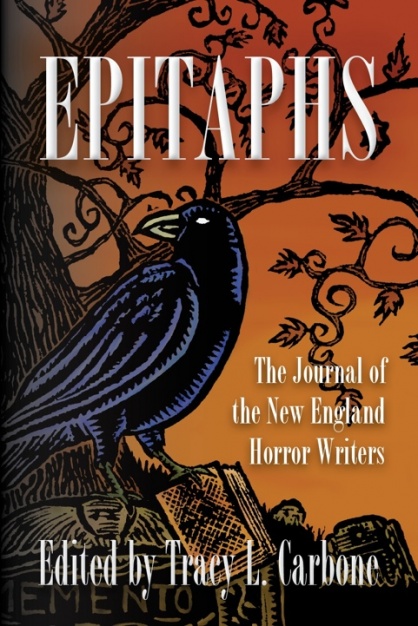
The cover of NEHW

Amazon states, “the New England Horror Writers Association, in partnership with Shroud Publishing, are proud to debut its inaugural anthology, Epitaphs. The anthology is a compilation of some of the best dark fiction from both best-selling authors and up-and- coming writers throughout New England. Contributors include Christopher Golden, Rick Hautala, Holly Newstein & Glenn Chadbourne, LL Soares, Trisha Wooldridge, Kurt Newton, and more. The anthology features 26 stories and poems from the delightfully scary to the deeply macabre.

Epitaphs was edited by author Tracy L. Carbone and includes an introduction by award-winning author and publisher Peter Crowther, as well as a cover by Danny Evarts.

The table of contents in this chilling anthology is as follows:

Jeffrey C. Pettengill “To Sleep, Perchance to Die”
Paul McMahon “The Christopher Chair”
Kurt Newton “A Case of the Quiets”
Scott T. Goudsward “Build-a-Zombie”
John Goodrich “Not an Ulcer”
B. Adrian White “The Possesor Worm”
John M. McIlveen “Make a Choice”
Michael Allen Todd “The Death Room”
Rick Hautala “Perfect Witness”
Holly Newstein and Glenn Chadbourne “Stoney’s Boneyard”
Trisha J. Wooldridge “Kali’s Promise”
David Bernard “The Sequel”
David North-Martino “Malfeasance”
Stacey Longo “Private Beach”
Christopher Golden “All Aboard”
L.L. Soares “Holiday House”
Steven Withrow “Lines at a Wake”
K. Allen Wood “A Deeper kind of Cold”
P. Gardner Goldsmith “Alone”
Roxanne Dent “Pandora’s Box”
Michael Arruda “Chuck the Magic Man Says I Can”
T.T. Zuma “Burial Board”
John Grover “Windblown Shutter”
Stephen Dorato “Cheryl Takes a Trip”
Philip Roberts “The Legend of Wormley Farm”
Peter N. Dudar “Church of Thunder and Lightning”

Carbone, a New England native, has published several horror and literary short stories in magazines and anthologies in the U.S. and Canada. Her YA horror novel, The Soul Collector, will be released by Shadowfall Publications in late fall 2011. She is Co-Chair of the New England Horror Writers (NEHW) and a member of the Horror Writers Association (HWA).

There will be a book release party for Epitaphs and a panel with a few of the authors from the anthology at AnthoCon, Nov. 11 through 13. There will be a special table for the anthology at the convention as well. Throughout the weekend, most of the authors in Epitaphs will be available to sign copies.

Presented by Shroud Publishing, The Anthology 2011 Conference will “showcase the imaginative talent in speculative fiction and art, with an additional focus on the convergence of images and literature,” according to the AnthoCon website (http://anthocon.com/).

The NEHW will also have a table where members can sell their books and other items at the convention.

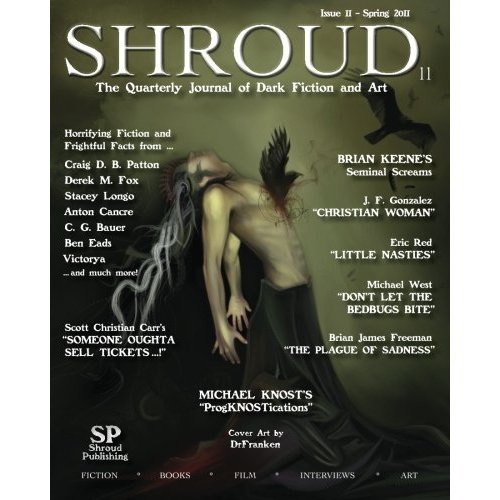
The cover of Shroud issue #11

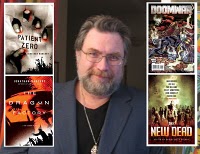
Like other cons, well-known writers will be on hand, among them Christopher Golden (Of Saints and Shadows), who will offer a reading and signing; Jonathan Maberry, who read from one of his new novels; and Jennifer Pelland, who will read from her debut novel, Machine. There will be an extensive dealer area which will feature books, films, artwork, comics, and more. There will also be a Juried Art Exhibit to include such shelf familiars as Ogmios (The Witches’ Almanac), Morbideus Goodell (Apex Digest, Maberry’s Vampire and Cryptopaedia), and Michael Bailey (who is also the editor of Pellucid Lunacy, an anthology of psychological horror and several novels).

“[AnthoCon] has some amazing authors, publishers and film people attending,” said Tracy L. Carbone, editor of Epitaphs, New England Horror Writers Association’s first official anthology. “It should prove to be the best new Con for horror folks out there.”

Jonathan Maberry (photo courtesy of the Anthocon website)

But what makes AnthoCon unique is its focus on the nine panels’ concentration on education for both writers and horror fans. For example, Reaching through the Veil will examine the channeling of myth, religion, spirituality and the collective unconscious in imaginative fiction; Getting Your Short Story Published with the Small Press will offer insight on finding, submitting, and selling your short story; Evil Jester Press Presents “Help! Wanted: Tales of On-The-Job Terror” will dissect the process of producing an anthology. Horror names Brian Keene, Rick Hautala, Cat Valente, Maberry, Joseph

Nassise, Pelland, and Golden will present I’ve Made It This Far, Now What?, using their paths to literary success to illumine what the process could be like for those in attendance.

Brian Keene (photo courtesy of Anthocon website)

Topics also go deeper with Writing Programs: from the MFA to Private Workshops. And Eric Red (The Hitcher, Near Dark) will present a lecture and workshop The Elements of Writing Horror and Thrillers for Films.

Aside from guests, vendors, and panelists, the event promises to draw a unique crowd to include film and book reviewers and magazine editors—like Peter Schwotzer, the man at the helm of Literary Mayhem (http://literarymayhem.com/) who also reviews anthologies, lit-zines and books for Famous Monsters of Filmland and IMDB.

“I’m going mainly to meet a lot of authors I’ve met over the past couple of years in person. We correspond by e-mails, phone, Twitter, Facebook, etc., but it will be nice to meet face to face,” Schwotzer said. “All of the authors have been so kind and generous to me, it still boggles my mind that I actually correspond with my literary heroes.”

With so much to offer that seems to be different from what’s offered at other cons, this promises to be a great inauguration with long-lasting recurring potential—writer or fan, artist or reviewer, don’t miss out.

AnthoCon 2011 will be held at the Best Western Wynwood Hotel & Suites at 580 US Route 1 in Portsmouth, New Hampshire, from Friday, Nov. 11 through Sunday, Nov. 13. For complete information on AnthoCon, including schedules, costs, and who will be there, visit www.anthocon.com.

An Author’s Account of the Middletown Open Air Market

Rob Watts writes about his experience at the NEHW tent at the Middletown Open Air Market. This originally appeared on Watt’s website, http://robwattsonline.livejournal.com/.

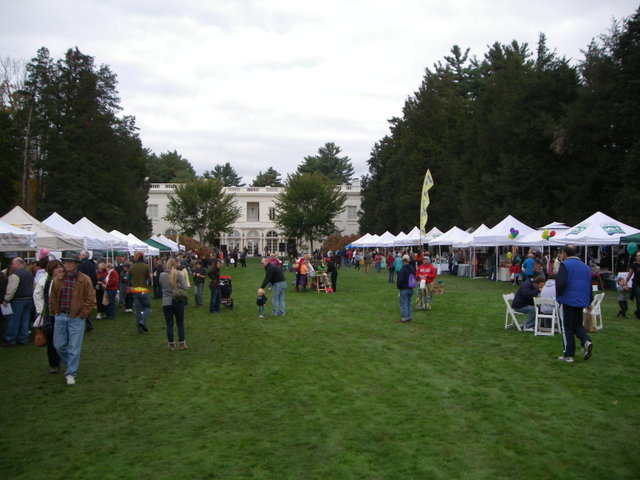
The vendor tents on the grounds of the Wadsworth Mansion (photo by Maria Arakil)

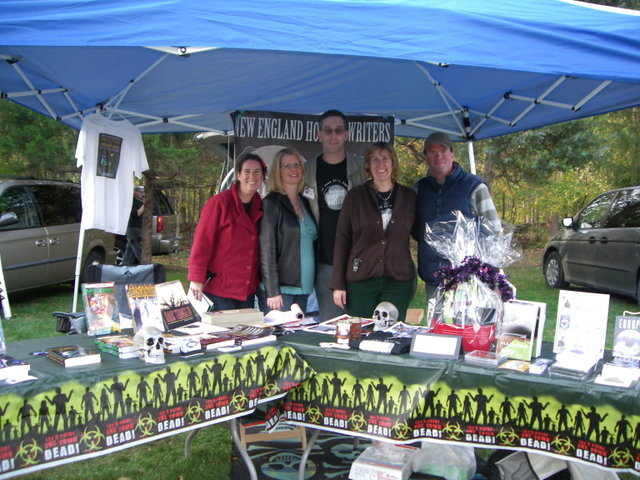
As colder days are approaching in New England, I would say we lucked out by being able to take advantage of one of the few remaining weekends where the weather gods were smiling down upon us. Even though there was a slight chill in the air, locals turned out in impressive numbers for the Middletown Open Air Market in Middletown, Connecticut on Sunday afternoon. I, along with fellow members of the NEHW, spent the better part of the day behind our booth fielding questions from curious visitors about us, our books, the organization and anything else that crossed their minds.

NEHW member

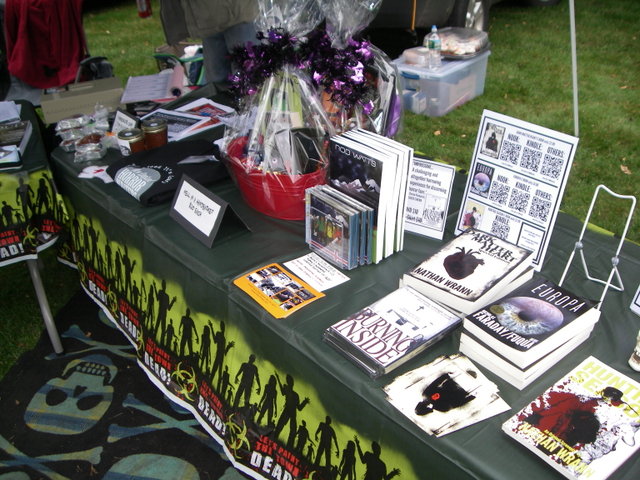
Table full of NEHW products (photo by Maria Arakil)

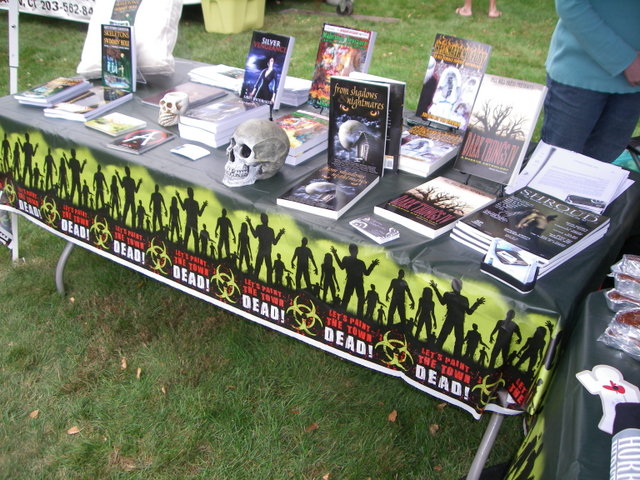
What made this a truly pleasurable event was the very laid-back atmosphere. It was held on the grounds of the beautiful Wadsworth Mansion, and the event itself was well organized which allowed for a positive flow throughout the day, for both the patrons and the vendors. Foot traffic around our booth was plentiful and with the beautiful display of books from the talented writers on hand, passersby were hard-pressed not to stop and browse through the displays. Camaraderie was the word-of-the-day, as each author did a great job of talking up their fellow writer’s books, not just their own (everyone at the table sold and signed books.) The team spirit and support throughout the booth made for great vibes and good fun during the afternoon. That’s something that can easily be lost and forgotten at events such as this.

From left to right: Kristi Petersen Schoonover, Kasey Shoemaker, Jason Harris, Stacey Longo, and Rob Watts (photo by Maria Arakil)

So kudos to all involved…myself, Stacey Longo, Jason Harris, Kristi Petersen Schoonover, Kasey Shoemaker and Kurt Newton. It was definitely the perfect event to debut my new book and well worth the 2 1/2 hour drive to and from Boston 🙂

Watts will be making an upcoming appearance at the NEHW table at the Southcoast Toy and Comic show on Sunday, Nov. 6, from 10 a.m. to 4 p.m at the Seaport Inn and Marina in Fairhaven, MA. The location is 110 Middle Street. For more information, check out the website, www.southcoasttoyandcomic.com.