Your Cover Art Sucks

This entry originally appeared on author and NEHW member, K. Allen Wood’s website.

Your Cover Art Sucks

by K. Allen Wood

Let’s talk about cover art.

There has been a self-publishing boom as of late. Once a surefire way to garner scorn from so-called professional writers, now even those dingleberries of the upper crust are self-publishing their work. With its rapidly growing popularity, there are those in the industry whom suggest there is a bubble…and that it’s about to burst. But I disagree. I think things are just getting started.

And that means more self-published books flooding the market.

There is an oft-used quote out there, which goes like this: “Just because you can doesn’t mean you should.”

A few years ago, when I started Shock Totem, a well-known author told me that cover art “isn’t that important.” The argument being that it’s the content that matters more. It’s hard to argue with that. However, I think, in a certain regard cover art matters more. The expression “never judge a book by its cover” exists because everyone judges a book by its cover.

First impressions matter. That initial connection between cover art and potential reader is intimate, and it matters more than you and the masterpiece you think is a page turn away.

I won’t buy your book if the cover art sucks. I won’t download it for free. I won’t do more than laugh derisively like a too-cool uptowner and walk on. Haughtily.

I fully understand that the majority of writers doing this sort of thing are, to put it bluntly, bad writers; but many are quite good, in fact. And to them I say this: If you truly care about your work, seek out the work of professionals in areas where you are not King Dingaling. Dig deep. It doesn’t cost much.

In other words, don’t do this…
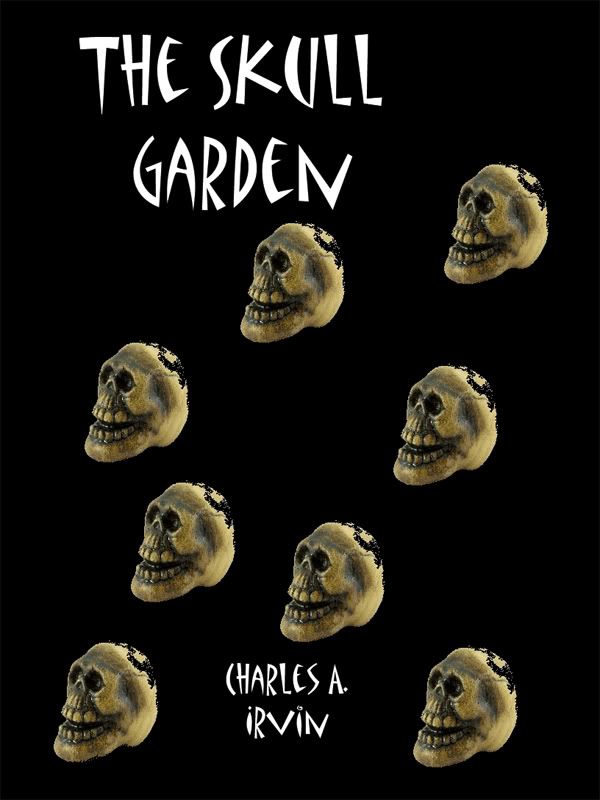
[ click any photo to enlarge ]

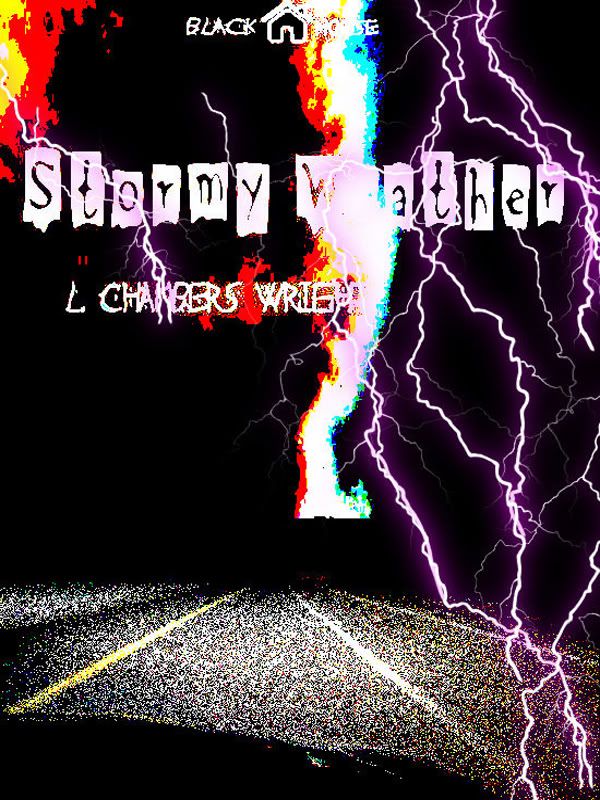
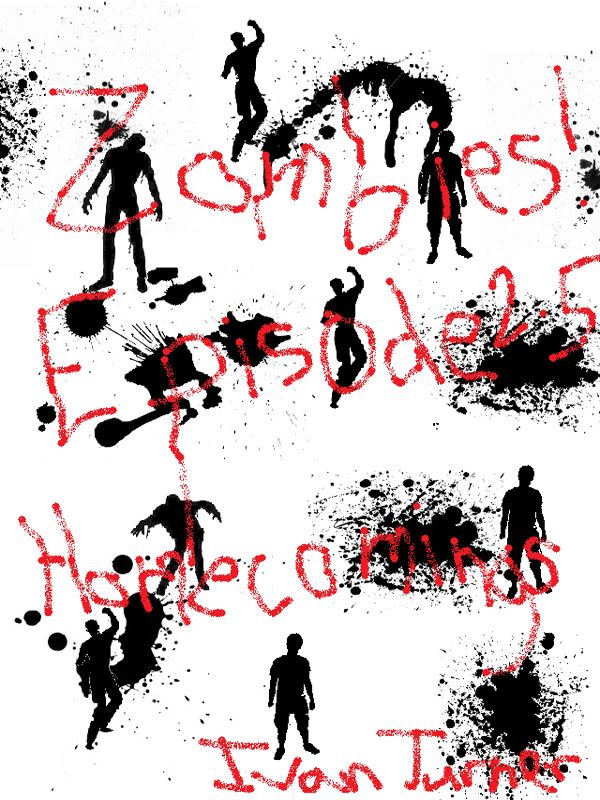
Above are four actual book covers not designed by a 4-year-old.

Trapped inside the social-media matrix, I am bombarded daily with similar fruits of so many would-be writers’ half-assed labor. You, as well, I imagine.

I see authors posting bad cover art all the time, constantly asking for opinions (which people freely give but which equates to little more than smoke up the ass), often readily admitting that he or she has little skill in Photoshop or design, of any sort.

Thus, I question: If you are that person, why the fuck are you creating cover art?

Author Forecasts a Warm, Dark Future in New Story

This article originally appeared in the Monday edition of the Journal Inquirer, a newspaper out of Manchester, Connecticut.

JI editor forecasts a warm, dark future in ‘The End of Ordinary Life’

By Julie Ruth

The year is 2028. An Alaskan bush pilot is flying an electric plane. The Arctic Ocean is ice-free because of global warming. The U.S. has been in an economic slump ever since the banks collapsed in 2008, and things are coming to a head. That’s the backdrop for Journal Inquirer Associate Editor Daniel Hatch’s latest science fiction story, “The End of Ordinary Life,” which appears in the May issue of Analog: Science Fiction and Factmagazine.Hatch, who’s published more than 20 works of science fiction in Analog, Absolute Magnitude, and other publications, opens his latest science fiction story in southeast Alaska, where his lead character, Tom O’Reilly, discovers that each of his four girlfriends has disappeared. When he later finds himself uprooted against his will as well, O’Reilly realizes that what he has known as “ordinary life” is now over.

“I have been living in the shadow of the economic collapse, and the bill is finally coming due,” O’Reilly says.

The story explores the consequences of global warming and a longterm economic slump following the 2008 banking crisis.

“It’s a pessimistic projection that we don’t fix the things that are wrong with the economy, and they get worse,” he explained. “All kinds of solutions out there are easily attainable but nobody wants to touch them because they will interfere with the profit stream of the big corporate players.”

Hatch is a longtime contributor to Analog, which has been around since the 1930s, the Golden Age of science fiction, when there were dozens of fiction magazines.

Analog is known as the “hard science fiction” magazine, where stories are driven by science rather than characters, said Hatch.

He got the idea for the story after reading a report prepared for the U.S. Navy that predicts that the Arctic Ocean will have no ice during the summer within the next 20 years.

“It said we’re going to have an extra ocean to deal with, and we should start making plans now.” The report included things the Navy should watch out for, like terrorists and arms smugglers coming through Canada.

Hatch said he discovered science fiction in first grade, when he found “Danny Dunn and the Weather Machine” in the library, a novel about a teenager who discovers a device that can make small clouds and miniature rainstorms.

Like many teenage boys in the ’60s, he was reading science fiction novels voraciously.

He wrote his first saleable science fiction story during a stint in the U.S. Coast Guard in Cape May, N.J., after finding a book in the library. Written in 1929 by John Gallishaw, who taught at Harvard, it was called “20 Problems of the Fiction Writer.”

“I still have it; I never took it back,” he said. Which is just as well, since the book is no longer in print.

At the University of Connecticut Hatch prepared for his writing career.

“I studied all the things science fiction writers should study: Shakespeare, history, journalism,” he said. “Because you’re writing grand narratives about the meaning of life in the universe, man’s place in the universe.”

After graduating in 1980, he worked for the Connecticut State News Bureau and The New York Times before joining the Journal Inquirer in 1988.

Hatch said the story is also an excuse to write about flying, one of his passions, though he learned flying through the Microsoft Flight Simulator program, rather than by spending actual time in the air.

After Hatch submitted the story, his longtime Analog editor, Stanley Schmidt, sent him an email: “I don’t remember your ever saying anything about being a pilot, or living or traveling in southeastern Alaska, but if you haven’t done those things, you sure know how to research a story. I’ve done both, and this feels real!”

The May issue of Analog magazine featuring Hatch’s story will be available at Barnes & Noble stores.

The issue is also available on Barnes and Noble’s Nook and Amazon’s Kindle.

Ode to Channel 56

This originally appeared on author and NEHW member David Price’s blog.

Ode to Channel 56

by David Price

What makes a science fiction fan? It’s a good question, right? The short answer is a simple one. It’s all about the imagination. While I believe everyone is born with one, some people’s imaginations seem to atrophy from lack of use. It helps to have parents who encourage its use, because not all do. Fans of speculative fiction, that all-encompassing term that includes fantasy, science fiction, and horror, have over-active imaginations. We’re dreamers. Do we daydream a lot? Sure. Do we let our minds wander on to things that many people would not consider important? You bet we do. It’s who we are, and where would the world be without the dreamers? Still stuck in the Stone Age, that’s where.

Okay, so it all has to start somewhere. Someone or something has to have nurtured that imagination at an early age. I am going to give a good chunk of that nurturing credit to an independent Boston television station, WLVI, channel 56. Funny, how you can’t appreciate some things until long after they are gone. I grew up in the 70s, and was raised on broadcast television. We didn’t even get cable until 1980 or so. Channel 56 was a UHF station, that ran a lot of syndicated series and old movies. So what did they air? Only some of the most amazing programs a young mind could soak in. My favorite was the original Star Trek series. My mother was a fan too, so this was something we could enjoy together. Star Trek was not perfect, by any stretch of the imagination, but it remains one of my all-time favorite shows. If I happen to be flipping channels and see Kirk, Spock, Bones, or Scotty, I will always stop and watch the rest of the episode. How many shows or movies can you say that about?

Growing up in the 70s was exciting for someone who dreamed about life “out there” and reaching for the stars. Star Trek was so inspirational for me. It hadn’t even been ten years since we first landed on the moon. NASA was actively exploring our moon with the Apollo program and our solar system with the Pioneer, Voyager, and Viking programs. Star Trek seemed like just a taste of what we might find out amongst the stars. Who knew, right? I wanted to be an astronaut right up until I entered college. I wanted to find what was out there. Kirk and the crew of the enterprise were responsible for those dreams just as much as our own space program was.

There was another series, however, that gave us some different ideas about what the future could hold for humanity. This series also aired on channel 56. It was called The Outer Limits. It gave warnings about the future, about contact with alien races, and about man’s ever improving technology. It was scary. Like The Twilight Zone, there was usually a moral associated with each story; a moral that said something about humanity. It was a much darker message and not as hopeful as Star Trek, but I took it all in, just the same. As a matter of fact, I even told myself, one day, I’ll be a scientist, but I won’t make those kinds of mistakes. I’ll be one of the good ones.

On Saturday afternoons, The Outer Limits led into one of the greatest programs that channel 56 had to offer. This was the show they labeled “Creature Double Feature.” As you might have guessed, this creature show aired giant monster, horror, and sci-fi movies. All those Japanese monster movies were great, especially Godzilla. That big, mutant dinosaur was nature unleashed. Godzilla was like the earth saying to the people of earth, “You know what? I don’t like your cities and pollution. I’m gonna stomp ‘em. Your military power? Pathetic. I’m gonna swat it away.” Godzilla was large and in charge. How could you not love that?

Another major sci-fi influence I can remember from channel 56 was Lost in Space. I know, I know, it was a very campy show after the first season. Still, I really loved that robot. There was just something about the robot which made the whole show for me. The robot was heroic, selfless, funny and often displayed more emotion than Mr. Spock. The best moments of the series were often between the once-evil, but now-bumbling Doctor Smith and the robot. He remains my all time favorite robot. “Warning! Warning! Danger, Will Robinson!” Classic stuff right there. I like it when robots show us how good humanity should be. The kinds of robots in Lost in Space and The Iron Giant, and also Data from Star Trek: The Next Generation are the ones that have always appealed to me. If mankind could create something noble like that, it might just say something good about us, and our future.

Speaking of Star Trek: TNG, it is the last sci-fi show that channel 56 broadcast, I will discuss. I was a little older when this show came out. I was out of high school and was reading mostly horror at the time. It didn’t really grab me right away. I kind of half-heartedly watched season one. I didn’t even start watching season two right away. It wasn’t until a friend of mine brought it up and said season two was much better that I even bothered with the second season. Once I did though, I got hooked. The original Star Trek was about what strange, alien, and sometimes familiar life forms we might find once we travelled to the stars. TNG was different, though, because it was more about what humanity’s place in the universe could be. Even in the face of a fearsome threat like the Borg, Picard and his crew used the human spirit to be a force for good and a defense against the darkness when necessary.

These are the shows and movies that WLVI, channel 56 in Boston, brought to me. Everything I have ever read or seen has influenced me, as a dreamer and a writer, in some way. I will remember fondly the part of my childhood that channel 56 influenced. I have even heard that fans still contact the station asking them to bring back Creature Double Feature. I can understand that. If the Syfy channel broadcast stuff that was half as good as channel 56 used to, I’d have more respect for them. I can’t imagine that the disaster movie knock-offs they show constantly are making any of today’s kids look towards the stars. At least, I can consider myself lucky enough to have been exposed to shows that made me think and dream. Thank you channel 56.

Interview with Actor/Comedian Kevin Pollak

This article originally appeared on the DVD Snapshot website.

Interview: Actor/Comedian Kevin Pollak

by Jason Harris

Necessity is the mother of invention and the reason why Columbus Circle came to be.

“This is the most ridiculous example of the necessity being the mother of invention,” said Kevin Pollak in a phone interview.

Columbus Circle, which he co-wrote with the movie’s director, George Gallo, came about when producer Christopher Mallick’s financing for a remake of a Korean movie fell apart when the Korean government took back the movie rights in 2009, Pollak said.

This bad news came to Mallick as he was at the Cannes Film Festival celebrating the movie, Middle Men, with its cast that included Giovanni Ribisi, who is also in Columbus Circle, and Pollak.

Since Mallick already had two apartment sets built in Los Angeles for his now defunct remake, Pollack told him he would come up with an idea that night and they would go over it on the 11-hour trip home the next day to figure it out.

He was up most of the night coming up with the story for Columbus Circle, which concerns an heiress portrayed by Selma Bair, who is holed up in her apartment and no one knows who she is, and the couple who move into the apartment across the hall from her.

You can read the rest of the interview by clicking here.

Timing Not Perfect for Boskone 49

Timing Not Perfect for Boskone 49

By David Price

Would you have the wedding rehearsal after the wedding? No, I didn’t think so. So I am a little confused as to why the sci-fi convention Boskone would be held about a month after the much larger spectacle of Arisia, in the exact same hotel, no less. This would be like going to watch the Super Bowl on the jumbotron of the stadium it was played in a month after it was over and everyone else had left. That would be something of a letdown, right? Oh sure, the vendors would still be open and you could pay ten bucks for a beer if you really wanted to, but it’s not the same thing. Now, by contrast, if they had played the first Giants/Patriots Super Bowl on the jumbotron in the stadium a couple days before this year’s, that might have been cool. It would have been a primer for what was coming.

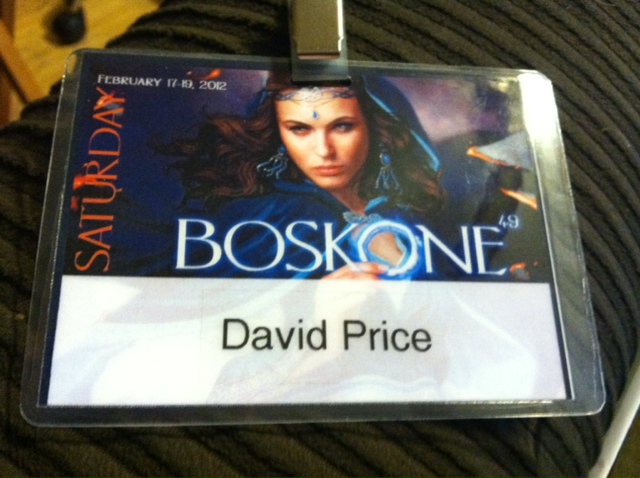
Photo by David Price

All right, admittedly, every time I have been to some sort of fan convention in the last six months, it has been a first time for me. But maybe, just maybe, that means my opinions should matter, just a little, if some of these cons want to actually attract newbies. Boskone is very much like a primer or practice run for something as grandiose as Arisia. I’m not saying that both shouldn’t exist together in the same world, but I can’t help but feel that Boskone should be held before Arisia, not after. Just four weeks before Boskone was held, I was completely overwhelmed by the magnitude of Arisia. Held at the Westin Boston Waterfont, Arisia seemed to make use of every single conference room in the hotel. To be honest, I’m surprised the Westin had enough space available to accommodate the seemingly hundreds of events that Arisia had going. As I walked around with my eleven year old daughter at Boskone, I found myself asking, where’s the rest of it?

Also, what’s with almost all of the vendors selling books? Nothing against books, per se, but don’t sci- fi fans also like to wear cool geeky t-shirts, watch movies, and own toy props from their favorite series? There hasn’t been as much of that as I expected, at either Boskone or Arisia, to be honest. Arisia had a better mix, to be sure, but still fell short of my expectations when it came to vendors. My daughter was drawn to a woman who sold stuffed animals of every imaginable species. She even had dodo birds! My daughter, Kayleigh, asked for a monkey backpack. Since she was nice enough to accompany me to something that she had no idea if she would enjoy, I bought it for her.

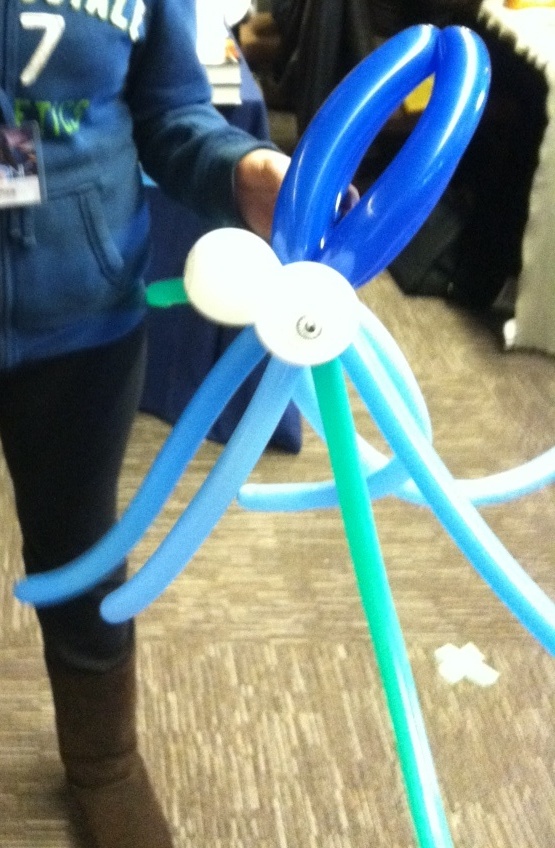
Kayleigh’s squid. Photo by David Price.

We sat down and watched the Higgins Armory put on a display of medieval sword fighting for a while. This was cool for me, because I actually took those classes at the Higgins Armory about ten years ago, so watching it brought me back to the fun I had learning that style. It wasn’t the most exciting thing for an eleven year old girl, however, so we eventually moved on. The most fun we had together was at the art show. I was happy to see how all the artwork appealed to my daughter, since I have loved fantasy art for as long as I can remember. I wish we had more money on hand, because there was a piece Kayleigh really admired, but I couldn’t afford it. We must have walked through the art show a half-dozen times and I saw something new each time. Knowing what I know now, I’ll be more ready for it next time.

I will say this about Boskone, it has a much more personal atmosphere than Arisia. There were reserved tables all over the place for groups to get together and game, chat, hang out or whatever. But since I am not a member of any of those groups, that part of the con was lost on me. As Kayleigh’s enthusiasm started to wane, I finally talked her into checking out the kids section that they called Dragon’s Lair. She didn’t want to at first, since it seemed to have mostly younger kids in there. She gave in at last, because the children in Dragon’s Lair were obviously having fun. While Kayleigh was in the kids’ section, I spent some time going through a display that advertised many of the upcoming cons. I’ll give many of them a try this year, and I have a feeling I will have a much better idea of the what will appeal to me after all is said and one. 2012 is going to be an interesting year. After goofing around in there for a little while, Kayleigh came out with a balloon animal squid. That was pretty cool, since a giant squid attacks my hero and his friends in my first novel.

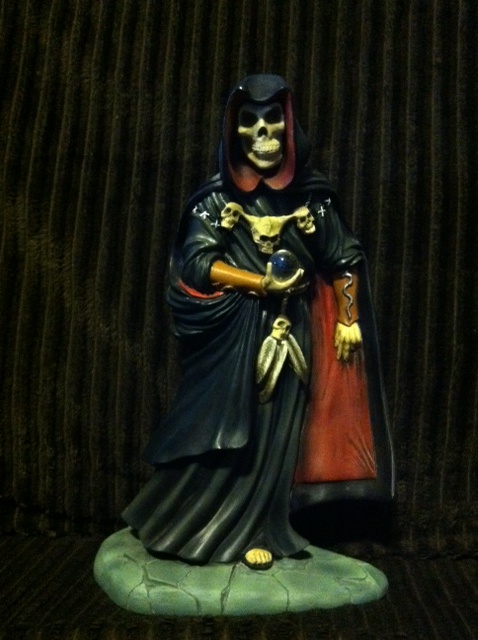
A lich. Photo by David Price.

Before we left, Kayleigh insisted I buy something for myself as well, especially since we couldn’t afford the art we had been admiring. I finally settled on a small statue that truly embodies my two favorite genres; horror and fantasy. The statue is of a lich. If you are unfamiliar with the term, consider it an undead sorcerer. There is just something about it that is inspirational to me. I guess when I look at it; I imagine that it is what my muse probably looks like, when I am writing my particular brand of monster fantasy. Anyway, Boskone 2012 was also Boskone 49. I imagine the organizers are planning something big for the fiftieth anniversary of Boskone next year. Maybe that’s why this one seemed a little small to me. Perhaps they are saving up the big guns for next year. I guess I’ll just have to wait and see.

The NEHW Survives High School a Second Time

The NEHW Survives High School a Second Time

by Stacey Longo

Nobody really wants to go back to high school, but that’s exactly what the New England Horror Writers did when they attended Queen City Kamikaze at Memorial High School in Manchester, NH on Feb. 18.

The NEHW had four tables set up at this anime and video game convention. While some skeptics might think that an auditorium filled with gaming consoles and Japanese animation may not be the best fit for a group of horror writers, the event was a huge success for NEHW. All throughout the day, fans young and old stopped by the booth to meet the authors, buy some books, and learn more about what it is, exactly, that is so fascinating about the horror genre. NEHW members Tracy Carbone, Alyn Day, Sarah Gomes, Scott Goudsward, Jason Harris, Kristi Petersen Schoonover, Nathan Schoonover, Rob Watts, K. Allen Wood, and myself were on hand to meet the convention-goers. Author T.T. Zuma and Sci-Fi Saturday Night creators The Dome, the Dead Redhead, and Illustrator X stopped by the booth as well.

The attendees were largely made up of high school age students, dressed up in creative costumes that varied from anime and manga characters to the occasional Darth Vader and assorted storm troopers. While this particular writer would have never been allowed by my father to leave the house dressed in some of the outfits on display, the mood of the crowd was upbeat and squeals of excitement could be heard as each new Pikachu and Vegeta costume came through the door. Despite not really knowing who these characters were, the attendees’ enthusiasm was contagious, and the NEHW members had an entertaining day.

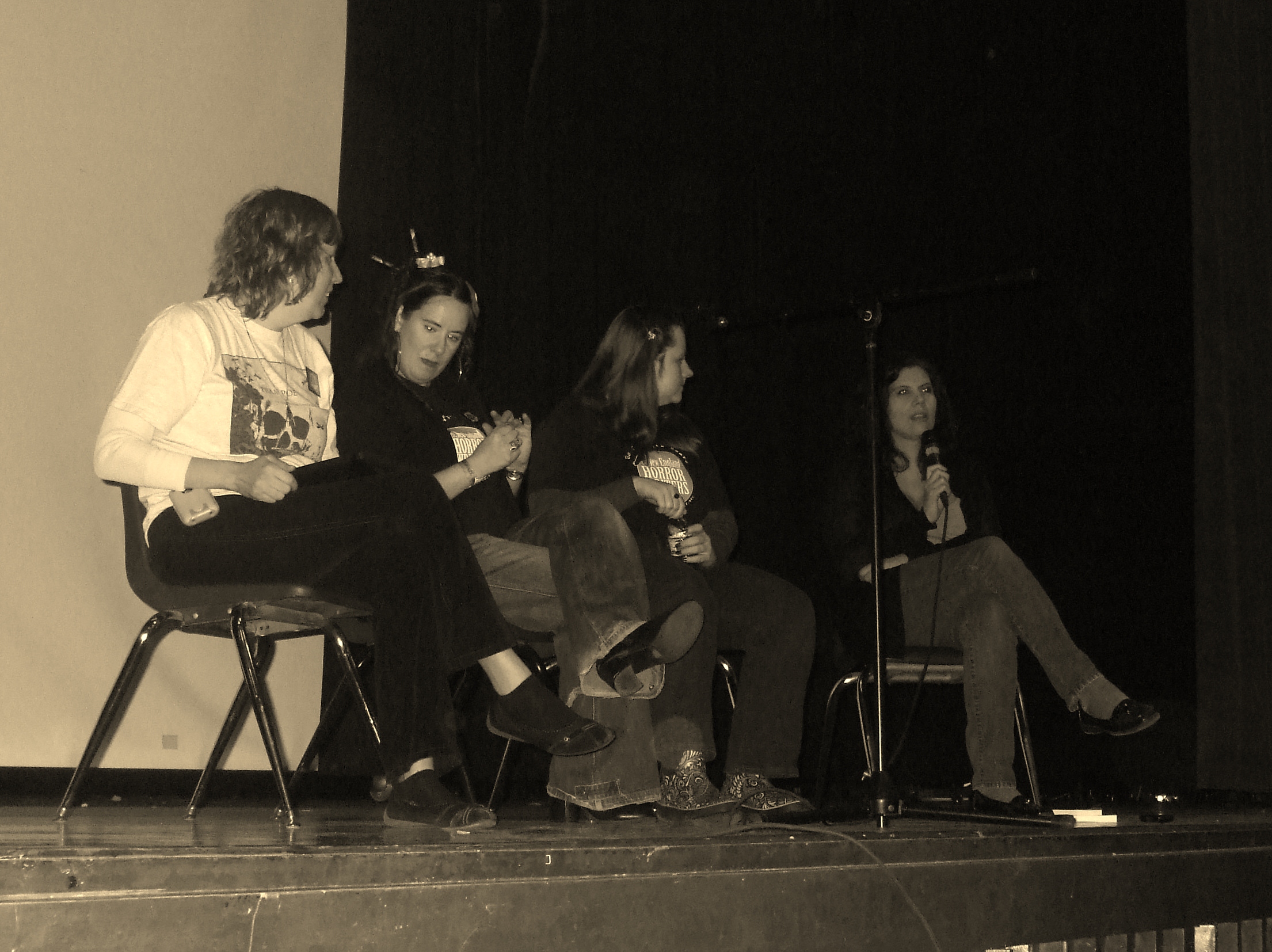
The Women in Horror panel. From left to right: Stacey Longo, Kristi Petersen Schoonover, Alyn Day, and Tracy Carbone. Photo by Jason Harris

Tracy Carbone, Alyn Day, and Kristi Petersen Schoonover participated in a panel on Women in Horror, moderated by myself. The panel debated such topics as victimization of female characters in the horror genre and who would win in a catfight between Halloween’s Lori Strode and Nightmare on Elm Street’s Nancy Thompson. They were followed by a panel on Trends in Horror comprised of Nathan Schoonover, Rob Watts, K. Allen Wood, and myself. It was moderated by Jason Harris. This group discussed the cyclical nature of horror trends and deliberated over the future of shows like The Walking Dead and Finding Bigfoot. Audience participation was high for both panels, and both groups received enthusiastic applause at the end of the day.

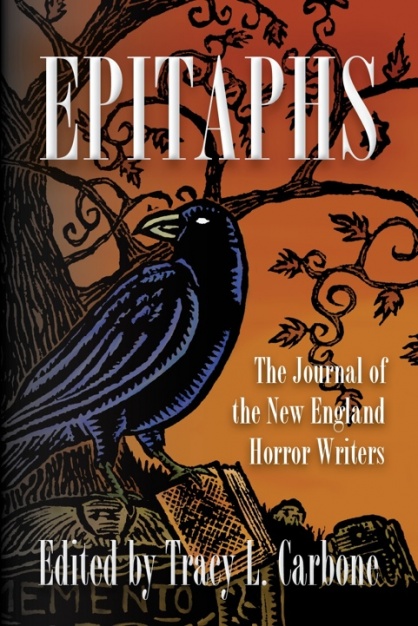
Personally, I had a great time at Queen City Kamikaze. I gained a new fan (thank you, Artie!) and was able to visit with old friends and new. Book sales were high, buoyed by the morning’s announcement that the NEHW’s first anthology, Epitaphs, was now officially a Bram Stoker Awards nominee. Going back to high school wasn’t bad at all, but of course that should have been a given—no matter what the age, horror writers are usually considered to be the cool kids in class.

Organization’s First Anthology Makes the HWA Final Ballot

Organization’s First Anthology Makes the HWA Final Ballot

by Jason Harris

It became official on Saturday, January 18, the New England Horror Writers’ first anthology is now a Stoker nominated collection.

Epitaphs is on the final ballot of the Horror Writers Association’s Bram Stoker Awards for works published in 2011. The Awards will be presented at a gala banquet on Saturday, March 31, at the World Horror Convention in Salt Lake City, Utah.

“It’s a great achievement for the NEHW to have its first anthology get this far,” Carbone, who is the editor of the collection, said on her Facebook page. “We all put in a tremendous amount of work in a short time to get this off the ground and I want to again thank the board and all the contributors.”

To purchase a copy of Epitaphs, click here.

Panels at Queen City Kamikaze

The New England Horror Writers’ organization will conduct two panels this Saturday at the Queen City Kamikaze anime and video game convention in Manchester, New Hampshire.

The NEHW panels are titled: Women in Horror and Trends in Horror: From the Apocalypse to Zombies: Where is Horror Heading?. The Women in Horror will be moderated by author Stacey Longo and start at 4 p.m. She will be joined by fellow authors Tracey Carbone, Alyn Day, and Kristi Petersen Schoonover.

The Trends in Horror panel will start at 4:50 p.m. and be moderated by Jason Harris. His guests will be authors K. Allen Wood, Rob Watts, and Stacey Longo. Demonhunter Nathan Schoonover will also be joining the panel.

The Queen City Kamikaze Anime and Video Game convention takes place at the Manchester Memorial High School at 1 Crusader Way in Manchester, New Hampshire. It operates from 10 a.m. to 7 p.m.

For more information about the convention, click here.

Rebecca Rosenblum: Oh my God, my friend is a writer! What do I do?

This article originally appeared in the National Post’s section, The Afterward, back in December.

Rebecca Rosenblum: Oh my God, my friend is a writer! What do I do?

Rebecca Rosenblum’s fiction has been short-listed for the Journey Prize, the National Magazine Award and the Danuta Gleed Award. Her first collection of stories Once (2008) was one of Quill & Quire’s 15 Books that Mattered. Her latest collection is titled The Big Dream (2011). Rosenblum lives, works and writes in Toronto. She will be guest editing The Afterword all this week.

Don’t panic—this is something most adults will eventually have to deal with, if only until they can find a way to leave the bar. Maybe it’s a new friend, that great guy or gal from work or the gym, who suddenly blurts it out as if you should have somehow known from his or her lack of dress sense and unfocused stare. Or maybe it’s a friend you’ve known for years, a trusted confidante who you’d never have suspected harboured such a secret. But now here you are, where you never expected to be—a person with a writer in your life.

Ok, so calm down, take a deep breath and think. Is this a friend you want to keep? Because if you’ve been dreaming of ditching him/her, now is your chance; writers are used to rejection.

But say you like your friend enough to overcome this objectionable habit. How then to keep on spending time together, sanely, safely, without undo melodrama or romantic-poetry intake (which can be one and the same)? Here is my handy FAQ below—how to be friends with a writer.

Will my writing friend drink during the day/be surely at dinner parties/refuse to hold down a job?

Actually, that’s not a writer you’re describing; that’s a midlife crisis. Most writers support themselves and their families adequately, try to be kind to their friends and their partners, and many have jobs or at least some unliterary human interaction in their lives in addition to their writing. Sure, there might be a modest amount of nihilism, but this more usually takes the form of a third beer on a Tuesday rather than a 2-week bender. The Hunter S. Thompson-style shenanigans are largely the stuff of fantasy…or two-week vacations.

Do we have to talk about writing all the time? Because I don’t know whether truth is beauty or beauty, truth—and I don’t care, either. Is my friend going to be boring from now on?

Maybe; many people are boring. But writers don’t seem to turn up in this category any more or less than any other group of folks. We definitely like talking about books—if you happen to be into it, bring on the literary discussion. But depending on the writer, he or she may enjoy discussion of television, war, ethics, celebrity sex scandals, low-fat recipes, this weather we’ve been having, all of the above or countless other things. And writers who wish only to speak of their own work are as cloddish as lawyers, doctors, and anyone else who wishes to speak only of themselves. Disown immediately.

Should I read my friend’s writing? What if it’s bad? What if it’s really good, but I don’t understand it? What if I just don’t bloody want to?

I’ve found that the only folks in a writer’s life who need feel any pressure to read their work are fellow writers; the rest of you lucky ducks are off the hook. Writers like to give each other their manuscripts for shoptalk and advice; laypeople should only ask, offer, or agree to read manuscripts if they think they can contribute a serious opinion that would help improve the text, or else a cheerful one that might improve the writer’s mood. I never offer to read other writers’ unpublished work unless I’m clear on what sort of feedback they are looking for, and we set a timeline. The same is true for when kind friends offer to read mine. I have found that generally otherwise such impulses go into an abyss where, except for bimonthly protestations of guilt and insane busyness on the part of the (non) reader, it is never discussed again.

All that applies to unpublished work, of course. If a writer publishes something in a journal or a book, all friends except those who have recently declared bankruptcy are expected to purchase one copy each (multiple copies for gifting optional). This wanes with subsequent publications, but at the beginning, the support is so terribly valued and appreciated. When my first book came out, everyone I knew bought one, including those whom I knew to dislike reading short stories, reading fiction, or reading period. It was so terribly kind of them, and a pleasant surprise for us all when a few informed me that they’d read and liked some of my stories. I was truly touched. However, many of these friends have never mentioned their experience of the book, except to proudly point it out on the shelf when I visit. Did they read it and hate it? Never touch it at all? I don’t ask and they don’t tell; that’s what friends are for.

Experiencing Arisia

Experiencing Arisia 2012

by David Price

When did steampunk become so popular, would someone tell me? I went to Arisia for the first time this year, which, for those who don’t know, is a yearly science fiction and fantasy convention in Boston. Now, admittedly, my convention-going experience is limited. When I was a kid, I used to go to some of the local comic book and Star Trek conventions, but that was over twenty years ago. Last year, I went to a horror convention called Rock and Shock, in Worcester, Massachusetts, and a horror writers’ convention called Anthocon in Portsmouth, New Hampshire. Neither one of those prepared me for the spectacle I would find at Arisia.

I had expectations for Arisia. I’ve seen these kinds of things on tv, so I thought I would find a bunch of people dressed up like Starfleet officers, Klingons, Jedi, Hobbits, Elves, and Battlestar Galactica pilots. My expectations were, however, blown out of the water. Instead, it seemed like every science fiction fan woke up one morning and said, “Hey, I finally get that 1960s television show, The Wild Wild West. You know the show, right? Robert Conrad and Ross Martin were James West and Artemus Gordon. These two were a couple of James Bond types during the time of the Old West. It was half science-fiction, half western. The gadgetry they employed was far in advance of what you would expect for the period, with things like cyborgs, force fields, flamethrowers, and batman-style grappling hooks. The 1999 version starring Will Smith and Kevin Kline really sucked, but they played up the whole steampunk angle even more than the series. So that’s what steampunk is, this blending of Old West and Victorian era time period with science fiction elements.

If the the Arisia I attended is representative of what it is usually like, they could just call it a steampunk convention. There were plenty of people dressed up in costume, that’s true, but most of it had that steampunk theme. I saw one Starfleet uniform, one hobbit, and a couple of guys who might have been Jedi, but they didn’t have light sabers, so I couldn’t be sure. Dressing for the occasion seems to be the way to go at one of these things too, as I would say a good three quarters of the convention-goers showed up in costume. I was in the minority. It was fun to go there and people watch, though. Let me tell you something; nerd girls dress up in some of the, ah, *ahem*, most appealing costumes you could imagine. I’ll admit they surpassed what I expected. There may not have been any Slave Leias, but there was a scantily clad elven archer from the Lord of the Rings or Skyrim, a seductive assassin from the video game Assassin’s Creed, and a very revealing Poison Ivy from Batman wrapped in only, you guessed it, ivy.

All right, so I still decided I would go in there and enjoy myself. I like Doctor Who, Star Wars, Star Trek, Battlestar Galactica and Babylon Five as much as the next geek. Stepping into the dealer room was like entering some alternate universe, where geeks didn’t even know who the Doctor, Captain Kirk, Han Solo or Starbuck were. I wandered around and checked out everything they had to offer, but nothing really jumped out at me. I’m amazed to say that I walked out of Arisia without purchasing a single thing. When I went into the dealer room, however, it seemed the dealers got the same memo that everybody else did. It was Steampunk Central in there. I’m an introvert by nature and I have to admit that I found the place to be a bit overwhelming. I think I could have settled in better if I found some of the familiar Harry Potter and Star Wars elements that I expected to, but those things were almost non-existent, except for one notable exception. One of the highlights of the day was a life-sized stormtrooper cake that was on display. Towards the end of the day, it was sliced up and served to a very long line of hungry Star Wars fans. I passed on that, because hey, how good could it really be? If it was Darth Vader cake, maybe, but stormtrooper? It was probably just a cloned recipe, anyway.

The biggest lesson I learned from this convention, was that I should have made myself familiar with the schedule before I even walked in the door. There were hundreds of events that included movies, seminars, discussion groups, and even combat sword training. I know I would have enjoyed a bunch of those, and next time I intend to have a plan of attack. I missed the discussion I had planned to attend, which was a panel of critics wrapping up the science fiction movies from 2011. A friend of mine, Woody Bernardi, had what they call a “fan table.” Woody started a group called the Boston Science Fiction Association, which is really just a bunch of fans who get together and hangout sometimes. He got the fan table to drum up some more interest in the group. So far we’ve mainly been getting together for lunch at the Tavern at the End of the World, in Charlestown, Massachusetts. I agreed I would take a turn watching the fan table for Woody so he could go to some of the discussion groups that interested him. I think he was particularly interested in a tribute to Anne McCaffrey. I was happy to sit down and unwind a bit. I actually talked to more people sitting at that table than I had wandering around the crowded dealer room.

I look forward to the next one, though, now that I’ve had a chance to process the experience. As a writer, I dream of a day when people will be dressing up as characters from my fantasy novels. That would be something to see. Would I go in costume? I don’t think I’m ready for that yet. Of course, my ultimate goal is to be one of those guys sitting behind a table with a long line of people waiting to see me. I’ll be serving the Darth Vader cake, of course.